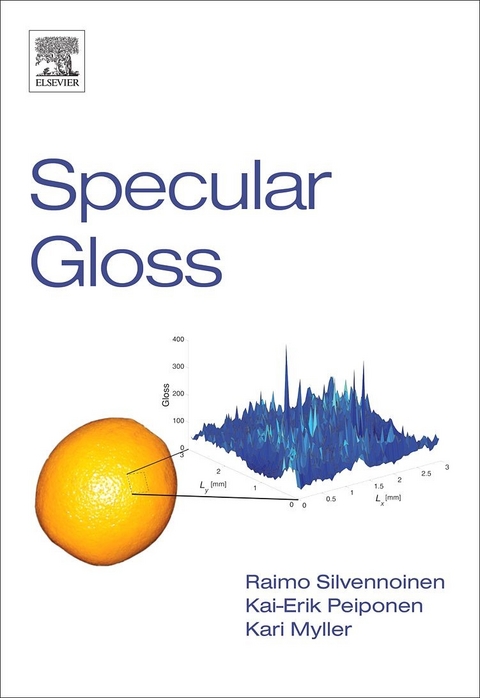
Specular Gloss (eBook)
520 Seiten
Elsevier Science (Verlag)
978-0-08-055468-6 (ISBN)
The book gives a fresh treatment on the concept of gloss. Theoretical description will be on more general basis of optical physics than in other sources. The text will give a modern treatise of machine vision based glossmeters and furnish the ideas how to measure and analyse gloss from complex-structured objects. Innovations of machine vision and gloss data analysis by embedded micro-controllers and microprocessors are trademarks that fill the gaps of older textbooks.
Key Features:
- modern treatment of gloss
- presents novel glossmeter based high technology
- completes principle of machine vision
- application in industrial environment
- emphasis on pedagogical presentation
- modern treatment of gloss
- describes novel glossmeter-based high technology
- presents principles of machine vision
- gives applications in industrial environment
- emphasis on pedagogical presentation
The aesthetic appearance of various objects is important to human beings. One measure of the quality of an object is its surface quality, which can be characterized with the concept of gloss. Nowadays measurement of the gloss is a routine off-line method in assessment of quality of product at various sectors of industry.The book gives a fresh treatment on the concept of gloss. Theoretical description will be on more general basis of optical physics than in other sources. The text will give a modern treatise of machine vision based glossmeters and furnish the ideas how to measure and analyse gloss from complex-structured objects. Innovations of machine vision and gloss data analysis by embedded micro-controllers and microprocessors are trademarks that fill the gaps of older textbooks.Key Features:- modern treatment of gloss - presents novel glossmeter based high technology- completes principle of machine vision- application in industrial environment- emphasis on pedagogical presentation- modern treatment of gloss - describes novel glossmeter-based high technology- presents principles of machine vision- gives applications in industrial environment- emphasis on pedagogical presentation
Front Cover 1
Specular Gloss 4
Copyright Page 5
Table of Contents 6
Preface 12
Notation 14
Video Clip Examples of Gloss in Different Applications 20
Disclaimer 22
Chapter 1 Introduction 24
Chapter 2 Light Reflection from Ideal Surface 28
2.1. Electromagnetic theory of light waves 29
2.1.1. Wave equation 29
2.1.2. Maxwell equations for free space 31
2.2. Light irradiance 36
2.3. Light polarization 37
2.4. Real refractive index 39
2.5. Group velocity 42
2.6. Normal reflection of light 44
2.7. Light reflection at an oblique angle of incidence 48
2.8. Complex refractive index 54
2.9. Beer–Lambert law 62
2.10. Oblique angle reflection from light-absorbing isotropic media 63
2.11. Reflectance from anisotropic media 67
2.12. Specular reflection from nanostructured medium 69
Chapter 3 Light Reflection from a Rough Surface 76
3.1. Statistical surface roughness parameters 77
3.2. Light diffraction from finishing marks 81
3.3. Kubelka–Munk function for diffuse reflection 86
3.4. Specular reflection of laser beam from moderately rough surface 89
3.5. Specular reflection from surface with normal distribution of surface heights 92
3.6. Speckle pattern 94
3.7. Statistical parameters for specular gloss 98
Chapter 4 Specular Gloss 102
4.1. Visual appearance of a surface 102
4.2. Directionality of surface 108
4.3. Standardized method for specular gloss 110
4.4. Problems in the gloss measurement 118
Chapter 5 Light Sources for Gloss Measurement 126
5.1. Radiation laws 126
5.1.1. Geometrical consideration 127
5.1.2. Kirchhoff’s law 131
5.1.3. Black body radiation 132
5.1.4. Grey body radiation 135
5.1.5. Stefan–Boltzmann law 136
5.1.6. Wien’s displacement law 137
5.1.7. Planck’s radiation law 139
5.1.7.1. Derivation of Stefan–Boltzmann constant (s) 141
5.1.7.2. Derivation of constant (C0) in Wien’s displacement law 142
5.1.8. Brightness temperature 143
5.1.9. Colour temperature 146
5.2. White light source (So) for standardized glossmeter 150
5.2.1. Brightness and emissivity of tungsten 150
5.2.2. Stability of tungsten as an So 153
5.2.3. Spectral irradiance of incandescent lamp of standardized glossmeter 156
5.3. Coherence and partial coherence of light 159
5.3.1. Damping effect on function of electric dipole 161
5.3.1.1. Light emission influenced by damping 166
5.3.1.2. Light absorption influenced by damping 169
5.3.2. Concept of coherence 172
5.3.2.1. Time coherence 173
5.3.2.2. Spatial coherence 175
5.3.3. Coherence function and fringe visibility 178
5.3.4. Coherence of thermal So 183
5.3.5. Photon correlation 189
5.4. Light-emitting diode 191
5.4.1. Energy bands in semiconductors 192
5.4.2. Radiative and non-radiative transitions 196
5.4.3. Spectral broadening of luminescence spectra 200
5.4.4. Light generation efficiency 202
5.4.5. Electrical characteristics of LEDs 205
5.4.6. Architecture of LED 207
5.4.7. Frequency response of LED 209
5.4.8. Spectral response of LED 210
5.5. Laser 213
5.5.1. Theory of inversion population – a paradox of equilibrium 213
5.5.2. Lasing conditions 216
5.5.3. Spectral profile of lasing radiation 220
5.5.4. Laser beam directionality 222
5.5.5. Cavity modes 223
5.5.5.1. Longitudinal modes 223
5.5.5.2. Transverse modes 224
5.5.6. Electrical characteristics of semiconductor LD 230
5.5.7. Laser categories 232
Appendix A.5.1 233
Appendix A.5.2 234
Appendix A.5.3 236
Appendix A.5.4 237
Appendix A.5.5 238
Chapter 6 Detectors for Gloss Measurement 242
6.1. Principle to simulate human eye response in detectors 243
6.1.1. Basic structure of human eye 243
6.1.2. Optical properties of human eye 250
6.1.3. Hazards in human eye after excess of MPE 252
6.1.4. Standardized human eye 253
6.2. Semiconductor photodiode 254
6.2.1. Photovoltaic effect 254
6.2.2. Spectral response of PD 260
6.2.3. Electric response of PD 262
6.3. APD 264
6.4. Phototransistor 265
6.5. Photoarray 266
6.5.1. Basic principle of CTD 267
6.5.1.1. Principle of BBD 270
6.5.1.2. Principle of SCCD 271
6.5.1.3. Principle of BCCD 272
6.5.1.4. Principle of PCCD and P2CCD 272
6.5.2. Charge-coupled photoarray 274
6.5.2.1. One-dimensional CCD array 274
6.5.2.2. Two-dimensional CCD array 275
6.5.2.3. Colour CCD array 277
6.6. Electric noise 278
6.6.1. Types of basic electric noise 278
6.6.2. Signal to noise ratio, noise figure and noise temperature 286
6.6.3. Noise in real materials and in electric components 288
6.6.4. Detecting limits of photodetectors 288
Chapter 7 Traditional Glossmeters 290
7.1. Spectral reflectance 290
7.1.1. Non-coherent spectral reflectance 292
7.1.2. Coherent spectral reflectance 297
7.2. Principle of reflectometer 298
7.2.1. Principle of spectral reflectometer 299
7.2.1.1. Monochromator 299
7.2.1.2. Specular reflectometer 304
7.2.1.3. Reflectometer for specular and diffuse radiation 307
7.2.2. Principle of laser reflectometer 309
7.2.3. Spectral ellipsometer 313
7.3. Spectrophotometer 318
7.4. Spectroradiometer 325
7.5. Goniophotometer 328
7.6. Spectrogoniometer 330
7.7. White light glossmeter 332
Chapter 8 Modern Glossmeters 338
8.1. Imaging spectrometers 340
8.2. Gloss measurement by LED and photodiode 341
8.3. Gloss measurement by laser and photodiode 347
8.4. Gloss measurement by laser and photoarray 348
8.4.1. Gloss measurement from planar surface 349
8.4.2. Diffractive optical element (DOE) based glossmeter 351
8.4.2.1. Beam waist environment 352
8.4.2.2. Basis for DOE – hologram imagery 357
8.4.2.3. Wave optical treatment of DOE 363
8.4.2.4. DOE as sensor element of diffractive optical glossmeter (DOG) 367
8.4.2.5. Analysis of DOE image in gloss measurement 377
8.4.2.6. Gloss measurements at normal incidence 380
8.4.2.7. Miniaturization of DOG 387
8.4.2.8. Gloss of plastics 390
8.4.2.9. Gloss of metals 400
8.4.2.10. Gloss of ceramics 411
8.4.2.11. On-line measurement of gloss of print 419
8.4.2.12. Offbeat applications of DOG 427
References 436
Subject Index 504
Color Plates 518
| Erscheint lt. Verlag | 7.7.2010 |
|---|---|
| Sprache | englisch |
| Themenwelt | Naturwissenschaften ► Chemie ► Physikalische Chemie |
| Naturwissenschaften ► Chemie ► Technische Chemie | |
| Naturwissenschaften ► Physik / Astronomie ► Optik | |
| Technik ► Maschinenbau | |
| Technik ► Umwelttechnik / Biotechnologie | |
| Wirtschaft | |
| ISBN-10 | 0-08-055468-7 / 0080554687 |
| ISBN-13 | 978-0-08-055468-6 / 9780080554686 |
| Informationen gemäß Produktsicherheitsverordnung (GPSR) | |
| Haben Sie eine Frage zum Produkt? |
 PDF (Adobe DRM)
Kopierschutz: Adobe-DRM
Adobe-DRM ist ein Kopierschutz, der das eBook vor Mißbrauch schützen soll. Dabei wird das eBook bereits beim Download auf Ihre persönliche Adobe-ID autorisiert. Lesen können Sie das eBook dann nur auf den Geräten, welche ebenfalls auf Ihre Adobe-ID registriert sind.
Details zum Adobe-DRM
Dateiformat: PDF (Portable Document Format)
Mit einem festen Seitenlayout eignet sich die PDF besonders für Fachbücher mit Spalten, Tabellen und Abbildungen. Eine PDF kann auf fast allen Geräten angezeigt werden, ist aber für kleine Displays (Smartphone, eReader) nur eingeschränkt geeignet.
Systemvoraussetzungen:
PC/Mac: Mit einem PC oder Mac können Sie dieses eBook lesen. Sie benötigen eine
eReader: Dieses eBook kann mit (fast) allen eBook-Readern gelesen werden. Mit dem amazon-Kindle ist es aber nicht kompatibel.
Smartphone/Tablet: Egal ob Apple oder Android, dieses eBook können Sie lesen. Sie benötigen eine
Geräteliste und zusätzliche Hinweise
Buying eBooks from abroad
For tax law reasons we can sell eBooks just within Germany and Switzerland. Regrettably we cannot fulfill eBook-orders from other countries.
aus dem Bereich