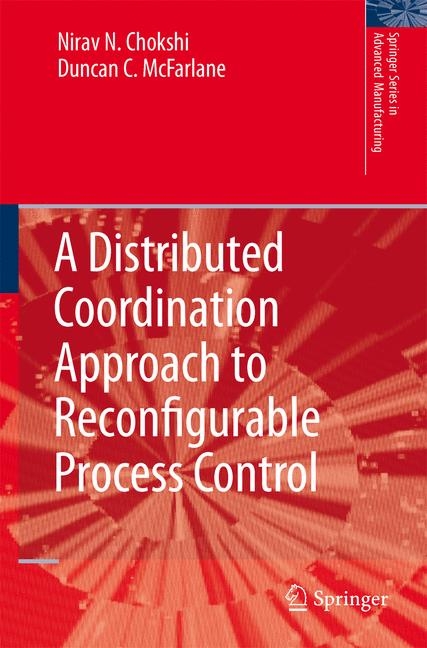
A Distributed Coordination Approach to Reconfigurable Process Control (eBook)
XI, 189 Seiten
Springer London (Verlag)
978-1-84800-060-5 (ISBN)
Success in the continuous process industries depends upon the ability to adapt to the demands of global supply chains in real-time. Thus, process plants must be designed to be easily reconfigured as and when necessary. 'A Distributed Coordination Approach to Reconfigurable Process Control' presents research that addresses this issue, via developing a new distributed framework that will enable the building of a process control system that is capable of reconfigurability. This framework views the process as a set of readily-integrated, modular process elements, which operate relatively independently and are each supported by a degree of stand-alone decision-making capability. The rationale and benefits of moving towards the new approach is demonstrated by means of a worked example of a real process plant. The research will also help end-users to gain an understanding of the economic aspects of material flows across their plants, and the ways in which their processes can be integrated across the enterprise.
Nirav Chokshi is a Visiting Researcher with the Centre for Distributed Automation and Control at the University of Cambridge. He has worked in the chemical industry and the nuclear industry, where he was involved in a variety of small-to-medium scale projects on design and maintenance of process automation systems. His research interests include distributed automation, systems integration and process optimization and control.
Duncan McFarlane is a Professor of Service and Support Engineering at the Engineering Department of the University of Cambridge, and Head of the Distributed Information & Automation Laboratory within the Institute for Manufacturing. He is also Director of the Cambridge Auto-ID Lab and Research Director of two industrially supported activities: the Service and Support Engineering Programme and the Aero ID Programme. He has been involved in the design and operation of automation and information system for the manufacturing supply chain for twenty years. His research interests include manufacturing control & automation, modular manufacturing systems design, analysis and synthesis of co-operative control systems, information filtering, model tuning and adaptation, manufacturing systems integration, fault diagnostics, automated identification systems, quality control, and supply chain execution systems.
Success in the continuous process industries depends upon the ability to adapt to the demands of global supply chains in real-time. Thus, process plants must be designed to be easily reconfigured as and when necessary. "e;A Distributed Coordination Approach to Reconfigurable Process Control"e; presents research that addresses this issue, via developing a new distributed framework that will enable the building of a process control system that is capable of reconfigurability. This framework views the process as a set of readily-integrated, modular process elements, which operate relatively independently and are each supported by a degree of stand-alone decision-making capability. The rationale and benefits of moving towards the new approach is demonstrated by means of a worked example of a real process plant. The research will also help end-users to gain an understanding of the economic aspects of material flows across their plants, and the ways in which their processes can be integrated across the enterprise.
Nirav Chokshi is a Visiting Researcher with the Centre for Distributed Automation and Control at the University of Cambridge. He has worked in the chemical industry and the nuclear industry, where he was involved in a variety of small-to-medium scale projects on design and maintenance of process automation systems. His research interests include distributed automation, systems integration and process optimization and control. Duncan McFarlane is a Professor of Service and Support Engineering at the Engineering Department of the University of Cambridge, and Head of the Distributed Information & Automation Laboratory within the Institute for Manufacturing. He is also Director of the Cambridge Auto-ID Lab and Research Director of two industrially supported activities: the Service and Support Engineering Programme and the Aero ID Programme. He has been involved in the design and operation of automation and information system for the manufacturing supply chain for twenty years. His research interests include manufacturing control & automation, modular manufacturing systems design, analysis and synthesis of co-operative control systems, information filtering, model tuning and adaptation, manufacturing systems integration, fault diagnostics, automated identification systems, quality control, and supply chain execution systems.
Preface 6
Contents 9
Problem Development 12
Introduction 13
Reconfigurable Process Control Research 25
A Distributed Reconfigurable Process Control Approach 51
DRPC: Distributed Reconfigurable Process Control 52
Reconfigurable Process Control Architecture 59
An Interaction Model for Reconfigurable Process Control 78
A Distributed Algorithm for Reconfigurable Process Control 99
An Assessment of the DRPC Approach 131
Application of Distributed Coordination Approach — A Case Example 132
Conclusions 154
A Appendix to Chapter 6: Background Concepts 158
B Appendix to Chapter 6 — Implementation of Distributed Coordination Algorithm 168
C Appendix to Chapters 6 and 7 - Problem Data for Numerical Examples 173
References 181
Index 191
| Erscheint lt. Verlag | 21.11.2007 |
|---|---|
| Reihe/Serie | Springer Series in Advanced Manufacturing | Springer Series in Advanced Manufacturing |
| Zusatzinfo | XI, 192 p. |
| Verlagsort | London |
| Sprache | englisch |
| Themenwelt | Technik ► Elektrotechnik / Energietechnik |
| Technik ► Maschinenbau | |
| Wirtschaft ► Betriebswirtschaft / Management ► Logistik / Produktion | |
| Wirtschaft ► Betriebswirtschaft / Management ► Planung / Organisation | |
| Schlagworte | algorithms • Control • control system • Design • Development • Distributed Automation • Holonic Manufacturing • Industrie • linear optimization • Manufacturing • Model • Process Control • Reconfigurable Control • SRUK • Supply Chain Management |
| ISBN-10 | 1-84800-060-X / 184800060X |
| ISBN-13 | 978-1-84800-060-5 / 9781848000605 |
| Informationen gemäß Produktsicherheitsverordnung (GPSR) | |
| Haben Sie eine Frage zum Produkt? |
 PDF (Wasserzeichen)
DRM: Digitales Wasserzeichen
Dieses eBook enthält ein digitales Wasserzeichen und ist damit für Sie personalisiert. Bei einer missbräuchlichen Weitergabe des eBooks an Dritte ist eine Rückverfolgung an die Quelle möglich.
Dateiformat: PDF (Portable Document Format)
Mit einem festen Seitenlayout eignet sich die PDF besonders für Fachbücher mit Spalten, Tabellen und Abbildungen. Eine PDF kann auf fast allen Geräten angezeigt werden, ist aber für kleine Displays (Smartphone, eReader) nur eingeschränkt geeignet.
Systemvoraussetzungen:
PC/Mac: Mit einem PC oder Mac können Sie dieses eBook lesen. Sie benötigen dafür einen PDF-Viewer - z.B. den Adobe Reader oder Adobe Digital Editions.
eReader: Dieses eBook kann mit (fast) allen eBook-Readern gelesen werden. Mit dem amazon-Kindle ist es aber nicht kompatibel.
Smartphone/Tablet: Egal ob Apple oder Android, dieses eBook können Sie lesen. Sie benötigen dafür einen PDF-Viewer - z.B. die kostenlose Adobe Digital Editions-App.
Buying eBooks from abroad
For tax law reasons we can sell eBooks just within Germany and Switzerland. Regrettably we cannot fulfill eBook-orders from other countries.
aus dem Bereich