


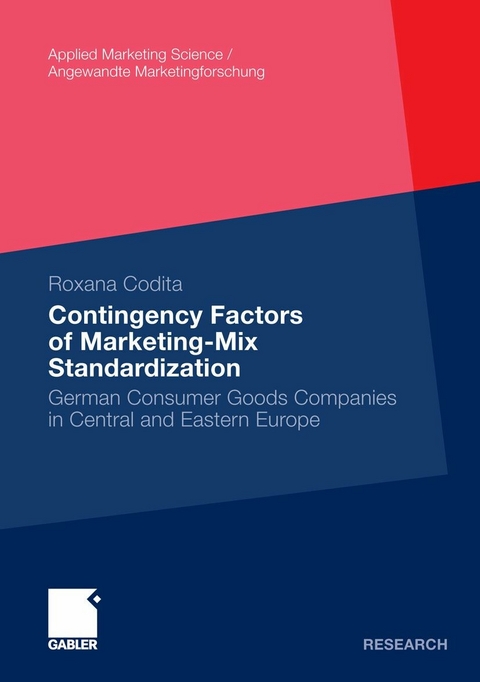
Contingency Factors of Marketing-Mix Standardization (eBook)
XXII, 312 Seiten
Betriebswirtschaftlicher Verlag Gabler
9783834961693 (ISBN)
Dr. Roxana Codita wrote her dissertation under the supervision of Univ.- Prof. Dr. Frank-Martin Belz at the Chair of Brewery and Food Industry Management, Technische Universität München, where she continues to work as a researcher.
Dr. Roxana Codita wrote her dissertation under the supervision of Univ.- Prof. Dr. Frank-Martin Belz at the Chair of Brewery and Food Industry Management, Technische Universität München, where she continues to work as a researcher.
FOREWORD 7
ACKNOWLEDGEMENTS 9
CONTENTS 11
LIST OF FIGURES AND TABLES 15
FIGURES 15
TABLES 18
LIST OF APPENDIX ILLUSTRATIONS 20
LIST OF ABBREVIATIONS 21
1 Introduction 23
1.1 Relevance of the Research Topic 24
1.1.1 Theoretical Relevance 24
1.1.2 Practical Relevance 26
1.2 Research Objectives and Questions 28
1.3 Research Design 30
1.4 Thesis Structure 32
2 International Marketing Standardization: A Literature Review 34
2.1 Circumscribing the Field of Study 34
2.1.1 International Marketing from a Definitional Perspective 34
2.1.2 International Marketing from a Paradigmatic Perspective 38
2.1.3 International Marketing from a Research Perspective 41
Literature Reviews 41
Principal Streams of Research 42
A Theoretical and Methodological Evaluation of IM Literature 43
2.2 The Standardization versus Adaptation Debate 45
2.2.1 Standardization School of Thought 47
2.2.2 Adaptation School of Thought 47
2.2.3 Contingency School of Thought 48
2.2.4 The Standardization versus Adaptation Debate from a Central and Eastern European Perspective 50
2.2.5 Theoretical Bases of the Contingency Approach of Marketing-Mix Standardization 54
Contingency Theory 55
Industrial Organization Theory, Structure-Conduct-Performance Paradigm and Strategic Fit 56
Resource-Based View 56
Bounded Rationality 58
2.2.6 An Integrative Review of the Marketing Standardization vs. Adaptation Debate 58
3 Conceptual Framework 61
3.1 Standardization of Marketing-Mix Elements 61
3.1.1 Product 62
3.1.2 Promotion 65
3.1.3 Pricing 68
3.1.4 Distribution 72
3.2 Contingency Factors of Standardization 74
3.2.1 Macro-Environmental Factors 76
Natural Environment 76
Economic Environment 77
Political-Legal Environment 79
Socio-Cultural Environment 81
3.2.2 Micro-Environmental Factors 86
Consumer Characteristics 86
Country-of-Origin Effect 90
Brand Familiarity 91
Marketing Infrastructure 92
Competitive Environment 96
3.2.3 Product Related Factors 97
Nature of Product 98
Product’s Standardization Potential 102
Product Life Cycle Stage 103
Product Cultural Specificity 104
3.2.4 Organizational Factors 107
3.3 Performance Implications of Marketing-Mix Standardization 112
4 Empirical Conceptualization and Operationalization of the Product Cultural Specificity Construct 116
4.1 Scale Development Methodology 116
4.1.1 General Considerations 116
4.1.2 Formative versus Reflective Measures 117
4.1.3 Measurement Quality 120
4.1.4 Criteria for Evaluating a Scale’s Psychometric Properties 122
First Generation Criteria 122
Second Generation Criteria 126
4.2 The Scale Development Process of the Product Cultural Specificity Construct 131
4.2.1 Defining the Construct’s Domain 131
4.2.2 Identifying Potential Indicators of Product Cultural Specificity in the Literature 134
4.2.3 Identifying Potential Indicators of PCS through Explorative Studies 138
Expert Interviews 139
Focus Groups 140
4.2.4 Initial Item Pool 141
4.2.5 Judging Items for Content and Face Validity 144
4.2.6 Conducting a Pre-Test for Initial Development and Validation of the PCS Scale 145
Data Collection and Sampling Frame 145
Sample Description 146
Initial Item Analysis via First Generation Criteria 149
Initial Item Analysis via Second Generation Criteria 154
Initial Validation of the PCS Scale in the Pre-Test 157
5 Testing the Contingency Model of Marketing-Mix Standardization and Its Performance Outcomes 158
5.1 Structural Equation Modeling as Primary Statistical Analysis Method 158
5.1.1 Basics 158
5.1.2 Comparison of Covariance-Based and Variance-Based SEM 160
5.1.3 PLS Path Modeling Algorithm 164
5.2 Evaluation of Measurement and Structural Models 165
5.2.1 Measurement Model Assessment: Reflective Mode 166
5.2.2 Measurement Model Assessment: Formative Mode 166
5.2.3 Structural Model Assessment 169
5.3 Data Collection Process and Sampling Frame 171
5.3.1 Questionnaire Design 172
5.3.2 Data Collection 175
5.3.3 Data Quality 176
Key Informant Bias 176
Common Method Bias 177
Non-Response Bias 178
Missing Data 178
Outliers 180
Data Distribution 180
5.3.4 Sample Description 181
5.4 Descriptive Data Analysis 186
5.4.1 Status-Quo of Marketing-Mix Standardization in CEE 186
5.4.2 Management’s Perceptions of Business Environment in CEE 189
5.5 A PLS Path Analysis of Contingency Factors of Marketing-Mix Standardization 191
5.5.1 Operationalization and Measurement Model Assessment of Exogenous Latent Variables 192
Operationalization of Environmental Factors 192
Measurement Model Assessment of Environmental Factors 194
Operationalization of Product Related Factors 197
Measurement Model Assessment of Product Related Factors 198
Product’s Standardization Potential 198
Product Cultural Specificity 199
Operationalization of Organizational Factors 201
Measurement Model Assessment of Organizational Factors 202
5.5.2 Operationalization and Measurement Model Assessment of Marketing-Mix Standardization Constructs as Endogenous Latent Varia 203
Measurement Model Assessment of Marketing-Mix Standardization Constructs 205
5.5.3 Structural Model Evaluation 207
Effects of Environmental Factors on Marketing-Mix Standardization 209
Effects of Product Related Factors on Marketing-Mix Standardization 210
Effects of Organizational Factors on Marketing-Mix Standardization 210
Assessment of the Model’s Predictive Quality 211
5.6 A PLS Path Analysis of Performance Outcomes of Marketing-Mix Standardization 213
5.6.1 Operationalization and Measurement Model 213
5.6.2 Operationalization and Measurement Model Assessment of Performance as Endogenous Latent Variable 214
5.6.3 Structural Model Evaluation 215
5.6.4 Direct and Total Effects of Selected Contingency Factors on Performance 216
5.7 Validation of Product Cultural Specificity 219
5.8 Investigating Relationships Between Categorical Variables and Marketing-Mix Standardization in CEE1 222
5.8.1 Target Segment and Marketing-Mix Standardization 222
5.8.2 Product Life Cycle Stage, Nature of Product and Marketing-Mix Standardization 224
5.8.3 Firm Size, Market Entry Mode, Management’s International Orientation and Marketing-Mix Standardization 226
6 Discussion 229
6.1 Degree of Marketing-Mix Standardization in CEE 229
6.2 Determinants of Marketing-Mix Standardization in CEE 233
6.2.1 The Influence of Environmental Factors on Marketing-Mix Standardization 233
6.2.2 The Influence of Product Related Factors on Marketing-Mix Standardization 237
6.2.3 The Influence of Organizational Factors on Marketing-Mix Standardization 238
Synopsis of Results 241
6.3 The Product Cultural Specificity Scale: Outcome and Outlook 242
6.4 Performance Outcomes of Marketing-Mix Standardization in CEE 244
7 Implications, Limitations and Future Research 248
7.1 Theoretical Implications 248
7.2 Managerial Implications 250
7.3 Limitations and Future Research 251
APPENDIX ILLUSTRATIONS 254
PART A. INDUSTRY AND INTERNATIONAL ACTIVITY 261
PART B. QUESTIONS CONCERNING YOUR SELECTED PRODUCT 262
PART C: CONFIGURATION OF MARKETING-MIX 264
TEIL I: INTERNATIONALE TÄTIGKEIT 270
TEIL II: FRAGEN ZU IHREM AUSGEWÄHLTEN PRODUKT 271
TEIL III: FRAGEN ZUR GESTALTUNG DES MARKETING-MIX 273
REFERENCES 297
| Erscheint lt. Verlag | 7.2.2011 |
|---|---|
| Reihe/Serie | Applied Marketing Science / Angewandte Marketingforschung | Applied Marketing Science / Angewandte Marketingforschung |
| Zusatzinfo | XXII, 312 p. 52 illus. |
| Verlagsort | Wiesbaden |
| Sprache | englisch |
| Themenwelt | Wirtschaft ► Betriebswirtschaft / Management ► Marketing / Vertrieb |
| Wirtschaft ► Betriebswirtschaft / Management ► Unternehmensführung / Management | |
| Schlagworte | Construct Conceptualization and Operationalization • Formative Measurement • Industrial Organization Theory • Resource-based View • Wirtschaftswissenschaft |
| ISBN-13 | 9783834961693 / 9783834961693 |
| Informationen gemäß Produktsicherheitsverordnung (GPSR) | |
| Haben Sie eine Frage zum Produkt? |
 PDF (Wasserzeichen)
DRM: Digitales Wasserzeichen
Dieses eBook enthält ein digitales Wasserzeichen und ist damit für Sie personalisiert. Bei einer missbräuchlichen Weitergabe des eBooks an Dritte ist eine Rückverfolgung an die Quelle möglich.
Dateiformat: PDF (Portable Document Format)
Mit einem festen Seitenlayout eignet sich die PDF besonders für Fachbücher mit Spalten, Tabellen und Abbildungen. Eine PDF kann auf fast allen Geräten angezeigt werden, ist aber für kleine Displays (Smartphone, eReader) nur eingeschränkt geeignet.
Systemvoraussetzungen:
PC/Mac: Mit einem PC oder Mac können Sie dieses eBook lesen. Sie benötigen dafür einen PDF-Viewer - z.B. den Adobe Reader oder Adobe Digital Editions.
eReader: Dieses eBook kann mit (fast) allen eBook-Readern gelesen werden. Mit dem amazon-Kindle ist es aber nicht kompatibel.
Smartphone/Tablet: Egal ob Apple oder Android, dieses eBook können Sie lesen. Sie benötigen dafür einen PDF-Viewer - z.B. die kostenlose Adobe Digital Editions-App.
Buying eBooks from abroad
For tax law reasons we can sell eBooks just within Germany and Switzerland. Regrettably we cannot fulfill eBook-orders from other countries.
aus dem Bereich


