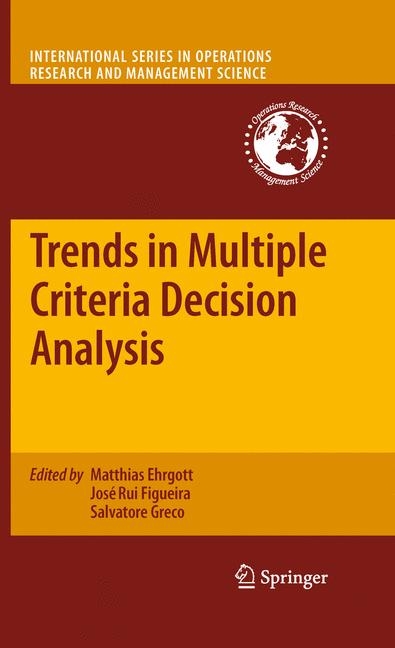
Trends in Multiple Criteria Decision Analysis (eBook)
412 Seiten
Springer US (Verlag)
978-1-4419-5904-1 (ISBN)
Multiple Criteria Decision Making (MCDM) is the study of methods and procedures by which concerns about multiple conflicting criteria can be formally incorporated into the management planning process. A key area of research in OR/MS, MCDM is now being applied in many new areas, including GIS systems, AI, and group decision making.
This volume is in effect the third in a series of Springer books by these editors (all in the ISOR series), and it brings all the latest developments in MCDM into focus. Looking at developments in the applications, methodologies and foundations of MCDM, it presents research from leaders in the field on such topics as Problem Structuring Methodologies; Measurement Theory and MCDA; Recent Developments in Evolutionary Multiobjective Optimization; Habitual Domains and Dynamic MCDM in Changeable Spaces; Stochastic Multicriteria Acceptability Analysis; and many more chapters.
Multiple Criteria Decision Making (MCDM) is the study of methods and procedures by which concerns about multiple conflicting criteria can be formally incorporated into the management planning process. A key area of research in OR/MS, MCDM is now being applied in many new areas, including GIS systems, AI, and group decision making.This volume is in effect the third in a series of Springer books by these editors (all in the ISOR series), and it brings all the latest developments in MCDM into focus. Looking at developments in the applications, methodologies and foundations of MCDM, it presents research from leaders in the field on such topics as Problem Structuring Methodologies; Measurement Theory and MCDA; Recent Developments in Evolutionary Multiobjective Optimization; Habitual Domains and Dynamic MCDM in Changeable Spaces; Stochastic Multicriteria Acceptability Analysis; and many more chapters.
Trends in Multiple Criteria Decision Analysis 1
Contents
5
List of Figures 7
List of Tables 9
Introduction 11
1 Introduction 11
1 Dynamic MCDM, Habitual Domains and Competence Set Analysis for Effective Decision Making in Changeable Spaces 17
1.1 Introduction 17
1.2 Three Decision Makings in Changeable Spaces 19
1.3 Dynamics of Human Behavior 20
1.3.1 A Sketch of the Behavior Mechanism 21
1.3.2 Eight Hypotheses of Brain and Mind Operation 22
1.3.3 Paradoxical Behavior 25
1.4 Habitual Domains 27
1.4.1 Definition and Stability of Habitual Domains 28
1.4.2 Elements of Habitual Domains 30
1.4.3 Expansion and Enrichment of Habitual Domains 31
1.4.3.1 Seven Self-Perpetuating Operators 31
1.4.3.2 Eight Methods for Expanding the Habitual Domains 33
1.4.3.3 Nine Principles of Deep Knowledge 34
1.5 Competence Set Analysis 35
1.5.1 Concept of Competence Set Analysis 36
1.5.2 Research Issues of Competence Set Analysis 38
1.5.3 Innovation Dynamics 40
1.6 Decision Making in Changeable Spaces 44
1.6.1 Parameters in Decision Processes 45
1.6.2 Decision Blinds and Decision Traps 47
1.7 Conclusion 48
References 49
2 The Need for and Possible Methods of Objective Ranking 52
2.1 Introduction 52
2.2 The Need for Objective Ranking and the Issue of Objectivity 54
2.3 Basic Formulations and Assumptions 57
2.4 Why Classical Approaches Are Not Applicable in This Case 59
2.5 Reference Point Approaches for Objective Ranking 61
2.6 Examples 65
2.7 Conclusions and Further Research 69
References 70
3 Preference Function Modelling: The Mathematical Foundations of Decision Theory 72
3.1 Introduction 72
3.2 Measurement of Preference 73
3.2.1 Empirical Addition – Circumventing the Issue 74
3.2.2 Applicability of Operations on Scale Values Versus Scale Operations 75
3.3 The Principle of Reflection 76
3.4 The Ordinal Utility Claim in Economic Theory 76
3.4.1 Ordinal Utility 77
3.4.2 Optimality Conditions on Indifference Surfaces 78
3.4.3 Pareto's Claim 80
3.4.4 Samuelson's Explanation 80
3.4.5 Counter-Examples 81
3.5 Shortcomings of Utility Theory 81
3.5.1 Von Neumann and Morgenstern's Utility Theory 82
3.5.2 Addition and Multiplication Are Not Applicable to Utility Scales 82
3.5.3 Barzilai's Paradox: Utility's Intrinsic Contradiction 83
3.5.4 Utility Theory Is Neither Prescriptive Nor Normative 83
3.5.5 Von Neumann and Morgenstern's Structure Is Not Operational 84
3.6 Shortcomings of Game Theory 84
3.6.1 Undefined Sums 85
3.6.2 The Utility of a Coalition 85
3.6.3 ``The'' Value of a Two-Person Zero-Sum Game Is Ill-Defined 85
3.6.4 The Characteristic Function of Game Theory is Ill-Defined 86
3.6.5 The Essential Role of Preference 86
3.6.6 Implications 87
3.6.7 On ``Utility Functions That Are Linear in Money'' 88
3.6.8 The Minimax Solution of Two-Person Zero-Sum Games 88
3.6.9 Errors Not Corrected 90
3.7 Reconstructing the Foundations 90
3.7.1 Proper Scales – Straight Lines 90
3.7.2 Strong Scales – the Real Numbers 92
3.7.3 The Axioms of an Affine Straight Line 93
3.7.3.1 Groups and Fields 93
3.7.3.2 Vector and Affine Spaces 93
3.8 Measurement Theory 94
3.9 Classical Decision Theory 95
3.9.1 Utility Theory 95
3.9.2 Undefined Ratios and Pairwise Comparisons 96
3.9.3 The Analytic Hierarchy Process 96
3.9.4 Value Theory 97
3.9.5 Group Decision Making 98
3.10 Summary 98
References 99
4 Robustness in Multi-criteria Decision Aiding 102
4.1 Introduction 103
4.2 Why Is Robustness of Interest in MCDA? 104
4.3 Robustness in MCDA: Mono-dimensional Approaches 110
4.3.1 Characterizing Mono-dimensional Approaches 110
4.3.2 With an Initial Mono-criterion Preference Model 110
4.3.3 With an Initial Multi-criteria Preference Model 113
4.3.4 With an Initial Preference Model That Is Either Mono-criterion or Multi-criteria 114
4.4 Robustness in MCDA: Multi-dimensional Approaches 114
4.4.1 Characterizing Multi-dimensional Approaches 114
4.4.2 Without Any Initial Preference Model 115
4.4.3 With an Initial Mono-criterion Preference Model 116
4.4.4 With an Initial Multi-criteria Preference Model 118
4.5 Robustness in MCDA: Other Approaches 120
4.5.1 Preliminaries 120
4.5.2 Robustness in Mathematical Programming 121
4.5.3 Obtaining Robust Conclusions from a Representative Subset S 124
4.5.4 Approaches for Judging the Robustness of a Method 126
4.5.5 Approach Allowing to Formulate Robust Conclusions in the Framework of Additive Utility Functions 128
4.5.6 Approaches to Robustness Based on the Concept of Prudent Order 130
4.6 Conclusion 131
References 134
5 Preference Modelling, a Matter of Degree 137
5.1 Introduction 137
5.2 Fuzzy and Probabilistic Connectives 139
5.3 Fuzzy Preference Structures 141
5.3.1 Fuzzy Relations 141
5.3.1.1 Properties of Fuzzy Relations 142
5.3.1.2 Special Types of Fuzzy Relations 145
5.3.2 Additive Fuzzy Preference Structures: Bottom-Up Approach 147
5.3.2.1 Classical Preference Structures 147
5.3.2.2 The Quest for Fuzzy Preference Structures: The Axiomatic Approach 148
5.3.2.3 Additive Fuzzy Preference Structures and Indifference Generators 151
5.4 Reciprocal Preference Relations 154
5.4.1 Reciprocal Relations 154
5.4.1.1 Definition 154
5.4.1.2 A Fuzzy Set Viewpoint 154
5.4.1.3 A Frequentist View 155
5.4.2 The Cycle-Transitivity Framework 155
5.4.2.1 Stochastic Transitivity 155
5.4.2.2 FG-Transitivity 156
5.4.2.3 Cycle-Transitivity 157
5.4.2.4 Cycle-Transitivity Is a General Framework 158
5.4.3 Comparison of Random Variables 161
5.4.3.1 Dice-Transitivity of Winning Probabilities 161
5.4.3.2 A Method for Comparing Random Variables 162
5.4.3.3 Artificial Coupling of Random Variables 164
5.4.3.4 Comparison of Special Independent Random Variables 165
5.4.4 Mutual Ranking Probabilities in Posets 166
References 168
6 Fuzzy Sets and Fuzzy Logic-Based Methods in Multicriteria Decision Analysis 171
6.1 Introduction 171
6.2 Fuzzy Set Based Utility Functions 172
6.3 Fuzzy Quantities Based Preference Structures Constructions 176
6.4 Mean of Maxima Defuzzification Approach 180
6.5 Fuzzy Logic-Based Construction of Preference Relations 184
6.6 Concluding Remarks 186
References 187
7 Argumentation Theory and Decision Aiding 190
7.1 Introduction 190
7.2 Decision Theory and AI 191
7.2.1 Decision Process and Decision Aiding 192
7.2.2 Preferences and Decision Aiding 193
7.3 Argumentation for Decision Support 196
7.3.1 Argumentation Theory 196
7.3.2 Argumentation-Based Decision-Support Systems 200
7.4 Arguing Over Actions: A Multiple Criteria Point of View 203
7.4.1 Arguments, Criteria and Actions 204
7.4.2 Argument Schemes for Action 207
7.4.3 Argument Schemes for the Decision-Aiding Process 212
7.5 Conclusion 213
References 214
8 Problem Structuring and Multiple Criteria Decision Analysis 222
8.1 Introduction 222
8.2 The Nature of Problems and Problem Structuring for MCDA 224
8.3 How Has Problem Structuring for MCDA Been Approached? 227
8.4 Problem Structuring Methods and the Potential for Integration with MCDA 229
8.5 Implementing Problem Structuring for MCDA 233
8.6 Case Studies in Problem Structuring for MCDA 234
8.7 MCDA as Problem Structuring 247
References 248
9 Robust Ordinal Regression 253
9.1 Introduction 254
9.2 Ordinal Regression for Multiple Criteria Ranking Problems 257
9.2.1 Concepts: Definitions and Notation 258
9.2.2 The UTA Method 259
9.2.2.1 Preference Information 260
9.2.2.2 Additive Model 260
9.2.2.3 Checking for Compatible Value Functions Through Linear Programming 261
9.3 Robust Ordinal Regression for Multiple Criteria Ranking Problems 262
9.3.1 The Preference Information Provided by the Decision Maker 263
9.3.2 Possible and Necessary Rankings 264
9.3.3 Linear Programming Constraints 265
9.3.4 Computational Issues 266
9.4 Comparison of GRIP with other MCDA Methods 267
9.4.1 Comparison of GRIP with the AHP 267
9.4.2 Comparison of GRIP with MACBETH 268
9.5 Robust Ordinal Regression for Multiple Criteria Sorting Problems 270
9.6 The Most Representative Value Function 273
9.7 Nonadditive Robust Ordinal Regression 276
9.8 Robust Ordinal Regression in Interactive Multiobjective Optimization 278
9.9 Robust Ordinal Regression in Evolutionary Interactive Multiobjective Optimization 280
9.10 Robust Ordinal Regression for Outranking Methods 284
9.11 Robust Ordinal Regression for Multiple Criteria Group Decisions 287
9.12 An Illustrative Example 288
9.13 Conclusions and Further Research Directions 291
References 292
10 Stochastic Multicriteria Acceptability Analysis (SMAA) 296
10.1 Introduction 297
10.1.1 Aims and Goals of SMAA Methods 297
10.1.2 Variants of SMAA 299
10.1.3 Related Research 299
10.2 SMAA Approach 300
10.2.1 Problem Representation 300
10.2.2 Inverse Weight Space Analysis 301
10.2.3 Generic Simulation Approach 304
10.2.4 The SMAA-2 Method 305
10.3 Modelling Uncertain Information 308
10.3.1 Representing Uncertain Criteria 309
10.3.1.1 Cardinal Criteria 309
10.3.1.2 Ordinal Criteria 309
10.3.2 Incomplete Preference Information 311
10.3.2.1 Missing Weight Information 311
10.3.2.2 Intervals for Weights 312
10.3.2.3 Intervals for Trade-Off Ratios of Criteria 313
10.3.2.4 Ordinal Preference Information 313
10.3.2.5 Implicit Weight Information 315
10.3.2.6 Non-uniform Distributions 315
10.3.2.7 Combining Preference Information 315
10.4 Implementation Techniques 316
10.4.1 Accuracy of the SMAA Computations 316
10.4.2 Efficiency of Computations 317
10.5 Applications 317
10.6 Discussion and Future Research 322
References 322
11 Multiple Criteria Approaches to Group Decision and Negotiation 327
11.1 Introduction: Group Decision and Negotiation 327
11.2 Multiple Criteria Decision Analysis in Group Decision and Negotiation 330
11.3 MCDA and Group Decision Support (GDS) 333
11.4 MCDA and Negotiations 336
11.5 Examples 338
11.6 Conclusions 343
References 343
12 Recent Developments in Evolutionary Multi-Objective Optimization 349
12.1 Introduction 350
12.2 Evolutionary Multi-objective Optimization (EMO) 350
12.2.1 EMO Principles 352
12.2.2 A Posteriori MCDM Methods and EMO 353
12.3 A Brief History of EMO Methodologies 355
12.4 Elitist EMO: NSGA-II 356
12.4.1 Sample Results 357
12.4.2 Constraint Handling in EMO 358
12.5 Applications of EMO 360
12.5.1 Spacecraft Trajectory Design 360
12.6 Salient Recent Developments of EMO 362
12.6.1 Hybrid EMO Algorithms 362
12.6.2 Multi-objectivization 363
12.6.3 Uncertainty-based EMO 364
12.6.4 EMO and Decision Making 365
12.6.5 EMO for Handling a Large Number of Objectives 366
12.6.5.1 Finding a Partial Set 366
12.6.5.2 Identifying and Eliminating Redundant Objectives 367
12.6.6 Knowledge Extraction Through EMO 368
12.6.7 Dynamic EMO 368
12.6.8 Quality Estimates for EMO 369
12.6.9 Exact EMO with Run-time Analysis 370
12.6.10 EMO with Meta-models 371
12.7 Conclusions 372
References 373
13 Multiple Criteria Decision Analysis and Geographic Information Systems 379
13.1 Introduction 379
13.2 GIS: Basic Concepts 380
13.2.1 Definition of GIS 380
13.2.2 GIS Data Models 381
13.2.3 GIS Analytical Operations 382
13.3 Brief History of GIS-MCDA 383
13.3.1 Innovation: GIS and OR/MS 383
13.3.2 Integration: Cartographic Modeling and MCDA 384
13.3.3 Proliferation: The User-oriented GIS-MCDA 385
13.4 A Survey of the GIS-MCDA Literature 386
13.4.1 Taxonomy of GIS-MCDA 386
13.4.2 GIS Components of GIS-MCDA 387
13.4.3 MCDA Components of GIS-MCDA 388
13.5 Functions of MCDA in GIS 390
13.5.1 Decision Problem Structuring 390
13.5.2 Value Scaling 390
13.5.3 Criterion Weighting 391
13.5.4 Decision Rules 391
13.5.5 Sensitivity Analysis 392
13.6 Multicriteria Spatial Decision Support Systems (MC-SDSS) 392
13.6.1 Components of MC-SDSS 392
13.6.2 Integrating GIS and MCDA 393
13.7 Conclusions: Challenges and Prospects 394
References 395
Contributors 395
Index 415
| Erscheint lt. Verlag | 10.9.2010 |
|---|---|
| Reihe/Serie | International Series in Operations Research & Management Science | International Series in Operations Research & Management Science |
| Zusatzinfo | XVI, 412 p. |
| Verlagsort | New York |
| Sprache | englisch |
| Themenwelt | Wirtschaft ► Allgemeines / Lexika |
| Wirtschaft ► Betriebswirtschaft / Management ► Planung / Organisation | |
| Wirtschaft ► Betriebswirtschaft / Management ► Unternehmensführung / Management | |
| Wirtschaft ► Volkswirtschaftslehre ► Ökonometrie | |
| Schlagworte | applied probability • Decision Analysis • Mathematical Programming • MCDA • MCDM • Multi-criteria decision analysis • Multi-Objective Optimization • multiple criteria decision analysis • Multiple-Criteria Decision-Making • Operations Research • Optimization • Production and Operations Management |
| ISBN-10 | 1-4419-5904-1 / 1441959041 |
| ISBN-13 | 978-1-4419-5904-1 / 9781441959041 |
| Informationen gemäß Produktsicherheitsverordnung (GPSR) | |
| Haben Sie eine Frage zum Produkt? |
 PDF (Wasserzeichen)
Größe: 5,3 MB
DRM: Digitales Wasserzeichen
Dieses eBook enthält ein digitales Wasserzeichen und ist damit für Sie personalisiert. Bei einer missbräuchlichen Weitergabe des eBooks an Dritte ist eine Rückverfolgung an die Quelle möglich.
Dateiformat: PDF (Portable Document Format)
Mit einem festen Seitenlayout eignet sich die PDF besonders für Fachbücher mit Spalten, Tabellen und Abbildungen. Eine PDF kann auf fast allen Geräten angezeigt werden, ist aber für kleine Displays (Smartphone, eReader) nur eingeschränkt geeignet.
Systemvoraussetzungen:
PC/Mac: Mit einem PC oder Mac können Sie dieses eBook lesen. Sie benötigen dafür einen PDF-Viewer - z.B. den Adobe Reader oder Adobe Digital Editions.
eReader: Dieses eBook kann mit (fast) allen eBook-Readern gelesen werden. Mit dem amazon-Kindle ist es aber nicht kompatibel.
Smartphone/Tablet: Egal ob Apple oder Android, dieses eBook können Sie lesen. Sie benötigen dafür einen PDF-Viewer - z.B. die kostenlose Adobe Digital Editions-App.
Buying eBooks from abroad
For tax law reasons we can sell eBooks just within Germany and Switzerland. Regrettably we cannot fulfill eBook-orders from other countries.
aus dem Bereich