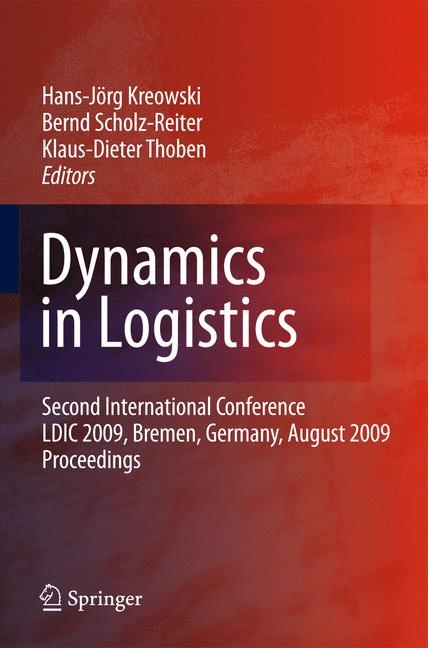
Dynamics in Logistics (eBook)
547 Seiten
Springer Berlin (Verlag)
978-3-642-11996-5 (ISBN)
Hans-Jörg Kreowski is full professor for Theoretical Computer Science at the University of Bremen and member of the Center for Computing and Communication Technologies (TZI), of the Research Cluster for Dynamics in Logistics (LogDynamics), of the Collaborative Research Centre 637 Autonomous Cooperating Logistic Processes and of the International Graduate School for Dynamics in Logistics. His main research topics are graph transformation, algebraic specification, formal modelling and their applications in computer science and logistics. He is member and former chair of the Working Group 1.3 Foundations of System Specification of the International Federation for Information Processing (IFIP). He (co)-authored and (co)-edited 18 books and published more than 150 scientific papers. Bernd Scholz-Reiter is a full professor and chair holder of the new chair of Planning and Control of Production Systems (PSPS) at the University of Bremen and also serves as director of the Bremen Institute of Industrial Technology and Applied Work Science (BIBA). His BIBA department Intelligent Production and Logistics Systems (IPS) is also a research centre for the German Logistics Association (BVL). He is initiator and speaker of the Collaborative Research Centre 637 Autonomous Cooperating Logistic Processes and speaker of the Bremen Research Cluster for Dynamics in Logistics as well as of the International Graduate School for Dynamics in Logistics. He is a member of the Berlin-Brandenburg Academy of Sciences and Humanities and of various other national and international organisations. Moreover, he is vice president of the German Research Foundation (Deutsche Forschungsgemeinschaft, DFG). Professor Scholz-Reiter is editor of the professional journals Industrie Management and PPS Management and member of the editorial board of the International Journal Production Planning & Control. He is author and co-author of about 300 scientific publications. Klaus-Dieter Thoben is full professor for IT Applications in Production Engineering at the University of Bremen and also serves as director of the Bremen Institute of Industrial Technology and Applied Work Science (BIBA) heading the department ICT Applications for Production. He is member of the Research Cluster for Dynamics in Logistics (LogDynamics), of the Collaborative Research Centre 637 Autonomous Cooperating Logistic Processes and of the International Graduate School for Dynamics in Logistics. He is member of the Working Group 5.7 Advances in Production Management Systems of the International Federation for Information Processing (IFIP). He is author and co-author, editor and co-editor of 20 monographs, collections and proceedings and is author and co-author of about 200 contributions in scientific journals, collections and proceedings.
Hans-Jörg Kreowski is full professor for Theoretical Computer Science at the University of Bremen and member of the Center for Computing and Communication Technologies (TZI), of the Research Cluster for Dynamics in Logistics (LogDynamics), of the Collaborative Research Centre 637 Autonomous Cooperating Logistic Processes and of the International Graduate School for Dynamics in Logistics. His main research topics are graph transformation, algebraic specification, formal modelling and their applications in computer science and logistics. He is member and former chair of the Working Group 1.3 Foundations of System Specification of the International Federation for Information Processing (IFIP). He (co)-authored and (co)-edited 18 books and published more than 150 scientific papers. Bernd Scholz-Reiter is a full professor and chair holder of the new chair of Planning and Control of Production Systems (PSPS) at the University of Bremen and also serves as director of the Bremen Institute of Industrial Technology and Applied Work Science (BIBA). His BIBA department Intelligent Production and Logistics Systems (IPS) is also a research centre for the German Logistics Association (BVL). He is initiator and speaker of the Collaborative Research Centre 637 Autonomous Cooperating Logistic Processes and speaker of the Bremen Research Cluster for Dynamics in Logistics as well as of the International Graduate School for Dynamics in Logistics. He is a member of the Berlin-Brandenburg Academy of Sciences and Humanities and of various other national and international organisations. Moreover, he is vice president of the German Research Foundation (Deutsche Forschungsgemeinschaft, DFG). Professor Scholz-Reiter is editor of the professional journals Industrie Management and PPS Management and member of the editorial board of the International Journal Production Planning & Control. He is author and co-author of about 300 scientific publications. Klaus-Dieter Thoben is full professor for IT Applications in Production Engineering at the University of Bremen and also serves as director of the Bremen Institute of Industrial Technology and Applied Work Science (BIBA) heading the department ICT Applications for Production. He is member of the Research Cluster for Dynamics in Logistics (LogDynamics), of the Collaborative Research Centre 637 Autonomous Cooperating Logistic Processes and of the International Graduate School for Dynamics in Logistics. He is member of the Working Group 5.7 Advances in Production Management Systems of the International Federation for Information Processing (IFIP). He is author and co-author, editor and co-editor of 20 monographs, collections and proceedings and is author and co-author of about 200 contributions in scientific journals, collections and proceedings.
Dynamics in Logistics 2
Preface of the Editors 4
Committees 6
Program 6
Organisation 6
Contents 8
Part I Mathematical Modeling in Transport and Production Logistics 14
1 Structural Properties of Third-Party Logistics Networks 15
1…Introduction 15
2…Related Approaches 17
3…Methodology 18
4…Optimization Scheme for the Operational Level 20
5…Optimization Scheme for the Network Topology 21
6…The Influence of the Cost Parameters on the Topology of the Reduced Network 22
7…Conclusions 24
Acknowledgments 25
References 25
2 Development of a Computational System to Determine the Optimal Bus-stop Spacing in order to Minimize the Travel Time of All Passengers 26
1…Introduction 26
2…Concepts of Voronoi Diagram 27
2.1 Definition of a Planar Ordinary Voronoi Diagram 28
2.2 Definition of a Multiplicatively Weighted Voronoi Diagram 28
2.3 Definition of an Additively Weighted Voronoi Diagram 29
2.4 Definition of a Compoundly Weighted Voronoi Diagram 30
3…Definition of the Problem 30
4…Formulation of the Model 31
5…The System 33
6…The Result 34
7…Conclusions 35
References 35
3 Some Remarks on Stability and Robustness of Production Networks Based on Fluid Models 37
1…Introduction 37
2…Description of the Fluid Model 38
2.1enspAdaption to Production Networks 40
3…Test Scenario 41
4…An Approach to Describe Robustness of Production Networks 42
5…Conclusions and Outlook 44
Acknowledgments 45
References 45
4 Online Optimization with Discrete Lotsizing Production and Rolling Horizons 46
1…The Production System 46
2…Process Model for On-line Scheduling 48
3…The Formulation of the On-line Schedule as DLSP Model 49
4…Competitiveness of the Approach 50
5…Conclusion 56
References 57
5 Dynamic Vehicle Routing in Over Congested Urban Areas 58
1…Introduction 58
2…The Proposed DVRP 59
3…Sequential Estimation 60
4…The Routing Model 62
5…Static and Dynamic Simulation of the DVRP 64
6…Conclusions and Research Prospects 66
References 67
6 Serving Multiple Urban Areas with Stochastic Customer Requests 68
1…Introduction 68
2…Related Work 69
3…Model and Solution Method 70
3.1 Optimality Equations 70
3.1.1 State Space Definition 71
3.1.2 Action Space Definition 71
3.1.3 State Dynamics and Goal 71
3.2 Approximate Dynamic Programming Approach 72
3.2.1 Value Function Approximation 72
3.2.2 Action Space Approximation 73
3.2.3 Learning Algorithm 73
4…The Case of Serving Multiple Urban Areas 73
4.1 Experimental Setup 74
4.2 Computational Results 74
5…Conclusions 75
References 76
7 Stability Analysis of Large Scale Networks of Autonomous Work Systems with Delays 78
1…Introduction 78
2…Model of Autonomous Work Systems 80
3…Stability Analysis 82
4…Numerical Results 84
5…Conclusion 85
Acknowledgments 85
6‡Appendix 85
References 86
8 Local Input-to-State Stability of Production Networks 88
1…Introduction 88
2…Model Description 89
3…Mathematical Background 90
4…Stability of the Model 93
5…Simulation Results 95
6…Conclusions and Outline 97
Acknowledgments 98
References 98
9 An Approach to Model Reduction of Logistic Networks Based on Ranking 99
1…Introduction 99
2…Adaptation of the PageRank Algorithm to Logistic Networks 100
3…Approaches for Network Model Reduction 103
3.1enspExclusion of Low-Ranked Locations Connected to Only One Location 104
3.2enspAggregation of Low-Ranked Locations 104
3.3enspExclusion of Sub-networks of Low-ranked Locations Connected to Only One Important Location 107
4…Conclusions and Future Research 109
Acknowledgment 111
References 111
10 Optimization of Spare Parts Lot Size for Supply of Equipment’s Park 112
1…Description of Manufacturing System 112
2…Construction of Mathematical Model and Its Analysis 113
3…Optimum Lot Size of Spare Parts 118
4…Conclusion 119
References 120
Part II Routing, Collaboration and Control 121
11 Weighted Multiplicative Decision Function for Distributed Routing in Transport Logistics 122
1…Introduction 122
2…The DLRP 123
3…The Decision Function 124
3.1 Decision Criteria 124
4…Simulations 126
5…Conclusions and Outlook 128
Acknowledgments 129
References 129
12 Distributed Decision Making in Combined Vehicle Routing and Break Scheduling 130
1…Introduction 130
2…EC Legislation on Driving and Working Hours 131
3…Combined Vehicle Routing and Break Scheduling as a Problem of Distributed Decision Making 132
4…Computational Experiments 135
5…Conclusions 137
Acknowledgments 138
References 138
13 Dynamic Routing Applied to Mobile Field Service 139
1…Introduction 139
2…Dynamic Vehicle Routing Problem (DVRP) and the Dynamic Repairman Travelling Problem (DRTP) 140
3…Methodology 141
3.1 The Conceptual and the Computational Model 141
3.2 Modelling the Nearest Neighbor Strategy (NN) 142
3.3 Modelling FCFS and PART Strategies 144
4…Application 145
4.1 Setting an Instance 145
4.2 Application 145
4.3 When to Apply: FCFS, NN, NN-e or PART 147
5…Conclusions 147
References 148
14 Intelligent Agent Control and Coordination with User-Configurable Key Performance Indicators 149
1…Introduction 149
2…Key Figure Systems 151
3…The Framework Components 151
3.1 Key Figure Assessment Model 151
3.2 Measured Values 152
3.3 Imported and Exported Key Figure Values 152
3.4 Key Figure Broker 153
3.5 Optimizer 153
3.6 Target Values 153
3.7 Constraints 154
3.8 Planner, Action Pool, Plan and Executor 154
4…The Key Figure Assessment Model 154
5…Global Agent Control and Coordination 156
5.1 Centralized Optimization without Local Models (I) 157
5.2 Distributed Optimization (II) 158
5.3 Centralized Optimization with Local Models (III) 159
5.4 Redundant Distributed Optimization (IV) 159
6…Application and Evaluation 160
7…Conclusion 161
References 162
15 Stockout Costs in Logistics Unconsidered 164
1…Introduction 164
2…Supplier and Production Characteristics 165
3…Service Level and Inventory Level 165
4…The Service Level Operating Curve 166
5…Components of Logistic Costs 166
6…Cost Minimized Service Level 167
7…Assembling Many Parts to One Product 168
8…Decision Support 169
References 169
16 Performance Measurement for Interorganisational Collaborations of SMEs 171
1…Introduction 171
2…Interorganisational Collaboration 172
2.1 Theoretical Backdrop of Interorganisational Collaboration 172
2.2 Classification and Characteristics of Collaboration 173
2.3 Motivation, Obstacles, and Success Factors 174
2.4 Complexity in Collaborations 176
3…Performance Measurement 177
3.1 Basic Requirements of a Performance Measurement Systems in Collaborations of SMEs 178
3.2 Evaluating Different Performance Measurement Systems 179
4…Development of a Performance Measurement Framework for Collaborations of SMEs 181
4.1 Structure 181
4.2 Contribution 182
4.3 Benefits 183
4.4 Process 183
4.5 Characteristics of the Measurement Framework 184
4.6 Applying the Framework 185
5…Conclusion 188
References 188
17 On the Formation of Operational Transport Collaboration Systems 192
1…Introduction 192
2…Operational Transport Collaboration 194
3…Strategic Decision Making Problems 195
4…Conclusions 200
Acknowledgments 201
References 201
18 Adaptive RBAC in Complex Event-Driven BPM Systems 203
1…Introduction 203
2…Related Work 205
3…Event and User-Role Assignment Definitions 205
4…Application 209
5…Conclusions 211
Acknowledgment 212
References 212
19 A Preliminary Investigation on a Bottleneck Concept in Manufacturing Control 213
1…Introduction 213
2…Literature Overview 214
2.1 Modification Control System Structures 214
2.2 Reconfiguration of Decision-making Based on Information 215
3…Bottleneck Concept 216
4…Experiment 217
4.1 Scenarios Introduction 218
4.2 First Evaluation 219
4.3 Fault Detection and Isolation 220
5…Conclusion 222
References 222
Part III Information, Communication, Autonomy,Adaption and Cognition 224
20 Synchronization of Material and Information Flows in Intermodal Freight Transport: An Industrial Case Study 225
1…Introduction 225
2…Problem Analysis 226
3…Available Identification and Communication Technologies 229
4…Conclusions 230
Acknowledgments 231
References 231
21 EURIDICE: Platform Architecture in Logistics for ‘‘The Internet of Things’’ 233
1…Introduction on Logistics and ‘‘Internet of Things’’ 233
1.1 Overview of EURIDICE and Issues Addressed 234
1.2 The Vision of EURIDICE 234
2…Overview of EURIDICE Architecture 234
2.1 Description of High Level Architecture 235
2.2 ‘‘Service-orientated Architecture’’ and ‘‘Enterprise Service Bus’’ 236
2.3 BPMN and BPEL 237
2.4 Intelligent Cargo 239
2.4.1 Reactivity 239
2.4.2 Proactiveness 239
2.4.3 Social Ability 239
2.4.4 Concepts about Embedding Sensing, Communication and Computation in Networked Physical Items 239
2.4.5 Multi Agent System 240
3…Challenges and Solutions 241
4…Outlook on Project and Further Developments 242
Acknowledgments 242
References 242
22 Initial Benefits of Using Intelligent Cargo Technology in Fresh Fishing Logistics Chain 243
1…Introduction 243
2…The Intelligent Cargo 244
3…Methodology 245
4…Results 248
4.1 Innovation Obtained Using the State of the Art Approach 248
4.2 Innovation Obtained Using the Intelligent Cargo 249
4.3 Possible Benefits from Using the IC 249
5…Conclusions 250
Acknowledgments 250
References 250
23 Autonomous Co-operation of ‘‘Smart-Parts’’: Contributions and Limitations to the Robustness of Complex Adaptive Logistics Systems 252
1…Introduction 252
2…Problems of Robustness in ‘‘Smart-Parts’’ CALS 254
2.1 ‘‘Smart-Parts’’ in CALS 254
2.2 The Need for Robustness in ‘‘Smart-Parts’’ CALS 255
3…Implementation of CALS 256
3.1 The Concept of Autonomous Co-operation 256
3.2 Achieving Autonomous Co-operation by ‘‘Smart-Parts’’ 258
4…Contributions and Limitations of Autonomous Co-operation to the Robustness of CALS 258
4.1 Influence of Autonomous Co-operation on Increasing System’s Stability 260
4.2 Influence of Autonomous Co-operation on Decreasing System’s Stability 260
4.3 Influence of Autonomous Co-operation on Increasing System’s Flexibility 261
4.4 Influence of Autonomous Co-operation on Decreasing System’s Flexibility 262
5…Conclusion 263
Acknowledgments 264
References 264
24 Decentralisation and Interaction Efficiency in Cooperating Autonomous Logistics Processes 266
1…Introduction 266
2…Cooperating Autonomous Logistics Processes 267
3…Problem Definition and Related Work 268
4…Team Formation Protocols for Autonomous Logistics 269
4.1 Minimising the Communication Effort by Broker 270
4.2 Maximising the Degree of Decentralisation by Multicasting 271
5…Protocol Analysis and Discussion 272
6…Implementation and Application 274
7…Conclusion 275
Acknowledgments 275
References 275
25 Design Aspects of Cognitive Logistic Systems 276
1…Introduction 276
2…The Cognitive Logistic System 277
3…The Scenario 278
4…Related Work 279
4.1 Category I: Central Decision with Autonomous Behavior 280
4.2 Category II: Local Decision with Autonomous Behavior 280
4.3 Category III: Local Decision with Swarm Behavior 281
4.4 Conclusion on the Related Work 281
5…The Cognitive Environment and its Sensors 282
6…Design Methodology 283
7…Conclusion and Future Work 284
Acknowledgments 284
References 284
26 Autonomous Units for Solving the Traveling Salesperson Problem Based on Ant Colony Optimization 286
1…Introduction 286
2…Ant Colony Systems 287
3…Communities of Autonomous Units 288
4…Modeling Ant Colony Systems by Communities 290
5…Conclusion 293
Acknowledgments 294
References 294
Part IV Radio Frequency Identification 296
27 Dynamic Management of Adaptor Threads for Supporting Scalable RFID Middleware 297
1…Introduction 297
2…Related Work 298
3…Problem Definition 299
4…Dynamic Thread Management 301
4.1 Triggering Condition of Dynamic Thread Management 301
4.1.1 Queue Processing Delay 301
4.1.2 Smoothing Delay 301
4.2 Technique of Dynamic Thread Management 302
4.2.1 Group Merging 302
4.2.2 Group Splitting 303
5…Performance Evaluation 303
5.1 Experiment Environment 303
5.2 Experiment Result 304
6…Conclusion 304
Acknowledgments 305
References 305
28 Tag-to-Tag Mesh Network Using Dual-Radio RFID System for Port Logistics 306
1…Introduction 306
2…Possible Solution for Dead-Zone 307
2.1 Deployment of Additional Readers 307
2.2 Development of Mobile Readers 308
2.3 Multi-Hop Tag-to-Tag Mesh Network 308
3…Solution to the Radio Frequency Interference 308
3.1 RFID Radio Frequency 309
3.2 Use of Multi-Channel 309
3.3 Use of Multi-Radio 309
4…Reader-Tag Communication 310
4.1 Standard for Reader-Tag Communication 310
4.2 Reader Command 310
5…Tag-to-Tag Mesh Network 310
5.1 IEEE 802.15.4 and ZigBee 311
5.2 Routing 311
6…Dual-Radio RFID System 311
6.1 Dual-Radio Tag Hardware 311
6.2 Dataflow in the System 312
6.2.1 Reader-Tag Communication Module 312
6.2.2 Tag-Tag Communication Module 313
6.3 Embedded OS Porting 313
6.3.1 AT91SAM7S256 313
6.3.2 ATmega128L 313
6.4 Management System 314
7…Experiment 314
8…Conclusion 316
Acknowledgments 316
References 316
29 Automation of Logistic Processes by Means of Locating and Analysing RFID-Transponder Data 318
1…Introduction 318
2…Problem 319
3…Methods and Approach 320
4…Summary and Prospects 322
References 322
30 Auto-Triggering of RFID-based Logistic Process in Inter-Workflow Using Complex Event 323
1…Introduction 323
2…Background 324
2.1 Related Previous Work 324
2.2 Basic Process Model and ECA Rule 325
3…Inter-Workflow Patterns 326
3.1 Pattern 1: Chained Service Model 326
3.2 Logistic Process Example with Inter-Workflow Pattern 326
4…Event Definitions 327
4.1 RFID Event and Business Process Event 328
4.2 Complex Event with RFE and BPE 330
5…Controlling Inter-Workflow Patterns 332
5.1 ECA Rules for Patterns 332
5.2 RFID-ECA Rules for Auto-Triggering Using Complex Event 332
6…Conclusions 332
Acknowledgments 332
References 332
31 Selectivity of EPC Data for Continuous Query Processing on RFID Streaming Events 334
1…Introduction 334
2…Related Work 335
2.1enspQueries of EPCIS 335
2.2enspQuery Index 336
2.3enspSelectivity of DBMS 336
3…Problem Definition 336
3.1enspTarget Environment 336
3.2enspProblem for Adopting Query Index to EPCIS 337
4…Selectivity Scheme of EPC Data 338
4.1enspBasic Approach 338
4.2enspDynamic Query Execution Plan 339
4.3enspSelectivity Estimation 339
4.3.1enspMin/Max Value 340
4.3.2enspData Rate in Index 340
4.3.3enspAggregation Transformation 340
5…Performance Evaluation 341
5.1enspExperimental Setup 341
5.2enspExperimental Result 341
6…Conclusions 342
Acknowledgments 342
References 342
32 Criticality Based Decentralised Decision Procedures for Manufacturing Networks Exploiting RFID and Agent Technology 344
1…Introduction 344
2…Criticality and Decisions in Network Improvements and Restructuring 345
2.1 Theoretical Foundation 345
2.2 Spaces of Activity and Criticality 345
2.3 Interrelated Criticalities for Network Decisions 346
3…Applications for Decentralised Manufacturing Execution Decisions (MES) 348
4…Implementation of RFID and MAS 350
5…Conclusions 354
References 355
33 The Application of the EPCglobal Framework Architecture to Autonomous Control in Logistics 357
1…Introduction 357
2…The EPCglobal Architecture Framework 358
2.1 The EPC Identifier 358
2.2 Application Level Events 359
2.3 EPC Information Services 359
2.3.1 EPCIS Events 360
2.3.2 EPCIS Capture and Query Interfaces 360
2.3.3 EPCIS Event Data Storage 360
2.4 Object Name Service 361
3…Integrating EPCIS into Autonomous Control in Logistics 361
3.1 Material Logistics Objects 362
3.2 Immaterial Logistics Objects 363
4…Summary and Conclusions 364
References 365
34 Design of Middleware Architecture for Active Sensor Tags 367
1…Introduction 367
2…Related Works 369
3…Middleware Requirements for Supporting Active Sensor Tags 370
3.1 Sensor Data Processing for Active Sensor Tags 370
3.2 Alarm Processing for Active Sensor Tags 370
3.3 Management for Active Sensor Tags 370
3.4 Reader Extensibility for Supporting Active Sensor Tags 371
4…Shortage of ALE for Supporting Active Sensor Tags 371
5…Extensions of ALE Interfaces for Active Sensor Tags 373
5.1 Extend ALE Reading Interface for Active Sensor Tag 373
5.2 Extend ALE Writing Interface for Active Sensor Tag 374
5.3 Reader Abstraction Interface 375
6…Design of Middleware Architecture 376
7…Conclusions 377
Acknowledgments 377
References 378
Part V Production Logistics 379
35 Investigation of the Influence of Capacities and Layout on a Job-Shop-System’s Dynamics 380
1…Dynamic Behaviour of Job-Shop-Systems 380
2…Aims and Course of Action 382
3…Model Description 383
4…Production Program and Initial Design 385
5…Simulation Runs, Data Analysis and Adjustments in Design 386
6…Summary and Outlook 387
Acknowledgments 388
References 388
36 Modelling Packaging Systems in the Furniture Industry 390
1…Introduction 390
2…The Value Stream Analysis 391
2.1 Basics 391
2.2 Application of the Value Stream Analysis to the Packaging System of the Furniture Industry 391
2.3 Creating Product Families 392
2.4 Analyze the Customer’s Demands 392
2.5 Mapping the Packaging System Flow 392
2.6 Search for Improvements 393
3…Additional Analysis for Packing Systems in the Furniture Industry 393
3.1 The Packing Process Level 393
3.2 The Packing Item Level 395
3.2.1 Splitting the Components 395
3.2.2 Arrange the Components 396
3.2.3 Void Fillers 396
3.2.4 Define the Fefco-Type 396
3.2.5 Define the Corrugated Cardboard 397
4…Conclusion 397
References 398
37 Monitoring Methodology for Productive Arrangements (Supply Chain) 399
1…Introduction 399
2…Supply Chains’ Concepts 400
3…Management Tools 401
3.1 Integrated Management System 402
3.2 Production Management 402
3.3 Products Development 404
3.4 Strategy Subsystem 404
3.5 Logistics Subsystem 404
3.6 Human Recourses’ Subsystem 404
3.7 Financial Subsystem 408
4…The Productive Arrangements System 408
5…System’s Benefits and Restrictions and an Application Example 409
6…Conclusion 410
References 410
38 Complexity-Based Evaluation of Production Strategies Using Discrete-Event Simulation 412
1…Introduction 412
2…Model Description 414
3…Heuristic Classification of the Dynamics Based on Inventory Levels 415
3.1enspChaos and Complexity in Manufacturing Systems 416
3.2enspQualitative Characterization of Dynamics 417
3.3enspQuantitative Characterization of Complexity 419
4…Conclusions 420
Acknowledgments 420
References 421
39 Converting Knowledge into Performance Within Global Production and Logistic Systems 422
1…Introduction 422
2…Global Production and Logistic Systems 423
3…Adaptation to Uncertain Situations 424
4…Knowledge into Performance 426
5…Conclusions 429
References 430
40 Dynamic Scheduling of Production and Inter-Facilities Logistic Systems 432
1…Introduction 432
2…Integrating Production and Transportation Scheduling 433
3…Proposed Formulation of the PTSP 435
3.1 Nomenclature 435
3.2 Model Assumptions 436
3.3 Mathematical Model 437
4…Computational Analysis of the Adapted PTSP 439
4.1 Test Case 439
4.2 Computational Results 440
5…Conclusions and Future Research 441
Acknowledgment 441
References 441
Part VI Ports, Container Terminals,Regions and Services 443
41 How can Electronic Seals Contribute to the Efficiency of Global Container System? 444
1…Introduction 444
2…Some Aspects of e-Seals Influence on Container Logistics 445
2.1 Competitive Advantages to Connect Ocean Terminals into a Global Info-Network 446
2.2 Automation of Containers Passes to the Territory of Port Terminals 447
2.3 Security and Safety of Containers 447
2.4 Control of Access to the Containers Contents 448
2.5 Identification of Containers and their Locations 448
2.6 Monitoring of Containers Movements 448
2.7 Improving the Congested Situation in the Ports 449
2.8 Benefits for Private Sector from Security Enhancement---GreenLane 449
2.9 Smooth Border Crossing and Port Gate Processing 450
2.10 Improve Process Flows 450
2.11 Protect the Brand Name and the Reputation 451
2.12 Anti-Temper System for Container Flows 451
2.13 Minimizing of Container Loss, Tampering/Theft or Cargo Pilferage 451
2.14 Loss of Insurance Claims 452
3…Conclusion 452
References 453
42 Resolution of the Berth Allocation Problem through a Heuristic Model Based on Genetic Algorithms 455
1…Introduction 455
2…Development of the Model 456
2.1 Restrictions 457
2.2 Decision Variables (When and Where to Allocate Each Vessel) 457
2.3 Formulation of the Problem: Heuristic Algorithm of Allocation 457
3…Genetic Algorithm for the Problem’s Solution 458
3.1 Conditions of the Proposed Heuristics 458
3.2 Genetic Algorithm 459
3.2.1 Representation and Genetic Operators 460
4…Numeric Validation 461
4.1 Parameters for the Search of the Solution 461
4.2 Simulated and Real Experiments 462
4.3 Results Obtained 463
5…Conclusions and Recommendations 465
References 466
43 Development of a Genetic Algorithm for the Maritime Transportation Planning of Car Carriers 467
1…Introduction 467
2…Literature Review 468
3…Routing for Car Carriers 468
3.1 Problem Definition 468
3.2 Maritime Transportation Planning Process of Car Carriers 468
3.3 Integer Programming Model 469
4…Genetic Algorithm for Maritime Transportation Planning of Car Carriers 470
4.1 Chromosome Representation 470
4.2 Initial Solution Generation 470
4.3 Genetic Operator 471
4.4 Revision Process of Solutions 472
5…Performance Evaluation 472
6…Conclusion 473
Acknowledgment 473
References 474
44 A Model of Wireless Sensor Networks Using Opportunistic Routing in Logistic Harbor Scenarios 475
1…Introduction 475
2…ODEUR+: An Enhanced Routing Protocol Based on ODEUR 477
2.1 Broadcasting Beacons 477
2.2 Sending Data 477
3…Model 478
4…Packet Formats 479
4.1 Beacon Format 480
4.2 Data Packet Format 480
5…Simulation 480
5.1 Scenario 1: Network with Mobility 481
5.2 Scenario 2: Multiple WSNs in Logistic Harbor Scenario 482
5.3 Confidence Interval 483
6…Conclusion 484
Acknowledgments 484
References 484
45 Logistics Service Providers in Brazil: A Comparison Between Different Developed Regions 486
1…Introduction 486
2…The Growth and the Main Trends of the LSP Industry 487
3…Regional Differences and Logistics Services Supply 489
4…Methodology 490
5…Results 491
6…Conclusions 494
Acknowledgments 495
References 495
46 Adapting Dynamic Logistics Processes and Networks: Advantages Through Regional Logistics Clusters 497
1…Introduction 497
2…Responsiveness and Flexibility: Logistics Clusters and Their Advantages 498
3…Research Framework 501
4…Case Study: Logistics Cluster Bremen 504
5…Further Research and Outlook 510
References 511
47 Quotation Behaviour of Profit Centres for Offers on Dynamic Logistic Services 513
1…Introduction 513
2…Problem and Objectives 516
3…Research Approach 516
4…Application of Poker Game Principles 517
5…Simplified Role Game 519
6…Modified Role Game 520
7…Conclusions 521
References 522
48 Long Haul Trucks Dynamic Assignment with Penalties 523
1…Introduction 523
2…Resources Allocation in Load Transportation 524
3…Methodology 525
3.1 Stochastic Dynamic Programming Model 526
3.2 Adaptive Dynamic Programming Strategy of Solution 527
3.3 Network Modeling 527
4…Model Application 529
5…Conclusions 530
References 531
| Erscheint lt. Verlag | 20.1.2011 |
|---|---|
| Zusatzinfo | XIV, 547 p. |
| Verlagsort | Berlin |
| Sprache | englisch |
| Themenwelt | Technik |
| Wirtschaft ► Betriebswirtschaft / Management ► Logistik / Produktion | |
| Schlagworte | autonomous logistic processes • Engineering Economics • logistic networks • logistic processes • logistics • maritime logistics • Production logistics • Radio Frequency Identification • Supply Chain Management |
| ISBN-10 | 3-642-11996-4 / 3642119964 |
| ISBN-13 | 978-3-642-11996-5 / 9783642119965 |
| Informationen gemäß Produktsicherheitsverordnung (GPSR) | |
| Haben Sie eine Frage zum Produkt? |
 PDF (Wasserzeichen)
DRM: Digitales Wasserzeichen
Dieses eBook enthält ein digitales Wasserzeichen und ist damit für Sie personalisiert. Bei einer missbräuchlichen Weitergabe des eBooks an Dritte ist eine Rückverfolgung an die Quelle möglich.
Dateiformat: PDF (Portable Document Format)
Mit einem festen Seitenlayout eignet sich die PDF besonders für Fachbücher mit Spalten, Tabellen und Abbildungen. Eine PDF kann auf fast allen Geräten angezeigt werden, ist aber für kleine Displays (Smartphone, eReader) nur eingeschränkt geeignet.
Systemvoraussetzungen:
PC/Mac: Mit einem PC oder Mac können Sie dieses eBook lesen. Sie benötigen dafür einen PDF-Viewer - z.B. den Adobe Reader oder Adobe Digital Editions.
eReader: Dieses eBook kann mit (fast) allen eBook-Readern gelesen werden. Mit dem amazon-Kindle ist es aber nicht kompatibel.
Smartphone/Tablet: Egal ob Apple oder Android, dieses eBook können Sie lesen. Sie benötigen dafür einen PDF-Viewer - z.B. die kostenlose Adobe Digital Editions-App.
Buying eBooks from abroad
For tax law reasons we can sell eBooks just within Germany and Switzerland. Regrettably we cannot fulfill eBook-orders from other countries.
aus dem Bereich