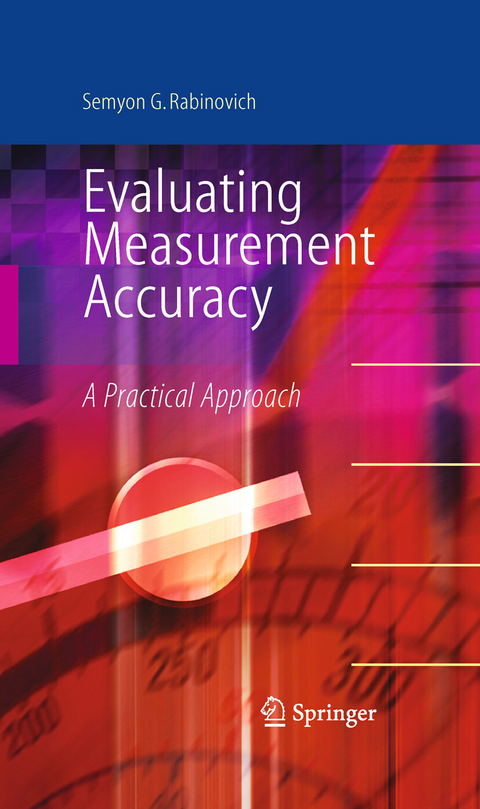
Evaluating Measurement Accuracy (eBook)
XVI, 272 Seiten
Springer New York (Verlag)
978-1-4419-1456-9 (ISBN)
'Evaluating Measurement Accuracy' is intended for anyone who is concerned with measurements in any field of science or technology. It reflects the latest developments in metrology and offers new results, but is designed to be accessible to readers at different levels: meteorologists, engineers and experimental scientists who use measurements as tools in their professions, graduate and undergraduate students in the natural sciences and engineering, and technicians performing complex measurements in industry, quality control, and trade.
The material of the book is presented from the practical perspective and offers solutions and recommendations for problems that arise in conducting real-life measurements. This inclusion is a notable and unique aspect of this title as complex measurements done in industry and trade are often neglected in metrological literature, leaving the practitioners of these measurements to devise their own ad-hoc techniques.
"e;Evaluating Measurement Accuracy"e; is intended for anyone who is concerned with measurements in any field of science or technology. It reflects the latest developments in metrology and offers new results, but is designed to be accessible to readers at different levels: meteorologists, engineers and experimental scientists who use measurements as tools in their professions, graduate and undergraduate students in the natural sciences and engineering, and technicians performing complex measurements in industry, quality control, and trade. The material of the book is presented from the practical perspective and offers solutions and recommendations for problems that arise in conducting real-life measurements. This inclusion is a notable and unique aspect of this title as complex measurements done in industry and trade are often neglected in metrological literature, leaving the practitioners of these measurements to devise their own ad-hoc techniques.
Evaluating
1
Preface
5
Contents
9
About the Author
13
Abbreviations
15
1 General Concepts in the Theory of Measurements 17
1.1 Basic Concepts and Terms 17
1.2 The Basic Metrological Problems 20
1.3 New Forms of International Cooperation in Metrology 26
1.4 Postulates of the Theory of Measurements 28
1.5 Classification of Measurements 34
1.6 Classification of Measurements Errors 38
1.7 General Approach to Evaluation of Measurement Inaccuracy 41
1.8 Presentation of Measurement Results 42
2 Measuring Instruments and Their Properties 46
2.1 Types of Measuring Instruments 46
2.2 Metrological Characteristics of Measuring Instruments 48
2.3 Rating of the Errors of Measuring Instruments 51
2.4 Dynamic Characteristics of Measuring Instruments 64
2.5 Calibration and Verification of Measuring Instruments 68
2.6 Designing a Calibration Scheme 73
2.7 Statistical Analysis of Measuring Instrument Errors 80
3 Statistical Methods for Experimental Data Processing 85
3.1 Methods for Describing Random Quantities 85
3.2 Requirements for Statistical Estimates 89
3.3 Evaluation of the Parameters of the Normal Distribution 90
3.4 Elimination of Outlying Data 94
3.5 Construction of Confidence Intervals 96
3.6 Testing Hypotheses about the Form of the Distribution Function 101
3.7 Testing for Homogeneity of Samples 103
3.8 Robust Estimates 109
3.9 Application of the Bayes' Theorem 113
4 Direct Measurements 115
4.1 Relation Between Single and Multiple Measurements 115
4.2 Classification of Elementary Errors 118
4.3 Modeling of Elementary Errors 122
4.3.1 Absolutely Constant Errors 123
4.3.2 Conditionally Constant Errors 123
4.3.3 Purely Random Errors 124
4.3.4 Quasirandom Errors 124
4.4 Composition of Uniform Distributions 125
4.5 Methods for Precise Measurements 131
4.6 Accuracy of Single Measurements Using Measuring Instruments Under Reference Conditions 133
4.7 Accuracy of Single Measurements Using Measuring Instruments Under Rated Conditions 136
4.8 Accuracy of Multiple Measurements 142
4.9 Comparison of Different Methods for Combining Systematic and Random Errors 150
5 Indirect Measurements 154
5.1 Terminology and Classification 154
5.2 Correlation Coefficient and Its Calculation 155
5.3 The Traditional Method of Experimental Data Processing 158
5.4 Merits and Shortcomings of the Traditional Method 162
5.5 The Method of Reduction 165
5.6 The Method of Transformation 167
5.7 Total Uncertainty of Indirect Measurements 174
5.8 Accuracy of Single Indirect Measurements 179
5.9 Accuracy of a Single Measurement with a Chain of Instruments 180
5.10 Application of the Monte Carlo Method 182
6 Combined and Simultaneous Measurements 185
6.1 General Remarks About the Method of Least Squares 185
6.2 Measurements with Linear Equally AccurateConditional Equations 187
6.3 Measurements with Linear Unequally Accurate Conditional Equations 190
6.4 Linearization of Nonlinear Conditional Equations 192
6.5 Examples of the Application of the Method of Least Squares 193
6.6 General Remarks on Determination of the Parameters in Formulas from Empirical Data 198
6.7 Construction of Transfer Functions of Measuring Transducers 200
7 Combining the Results of Measurements 205
7.1 Introductory Remarks 205
7.2 Theoretical Principles 205
7.3 Effect of the Error of the Weights on the Errorof the Weighted Mean 209
7.4 Combining the Results of Measurements with Predominately Random Errors 211
7.5 Combining the Results of Measurements Containing Both Systematic and Random Errors 213
7.6 Combining the Results of Single Measurements 216
8 Examples of Measurements and Measurement Data Processing 221
8.1 Voltage Measurement with a Pointer-Type Voltmeter 221
8.1.1 A Priori Estimation of Measurement Inaccuracy 221
8.1.2 Universal Estimation of Measurement Inaccuracy 224
8.1.3 Individual Estimation of Measurement Inaccuracy 226
8.2 Voltage Measurement with a Potentiometer and a Voltage Divider 227
8.3 Comparison of Mass Measures 232
8.4 Measurement of Electric Power at High Frequency 233
8.5 An Indirect Measurement of the Electrical Resistance of a Resistor 234
8.5.1 Application of the Traditional Method 234
8.5.2 Application of the Method of Reduction 237
8.6 Measurement of the Density of a Solid Body 238
8.6.1 Application of the Traditional Method 238
8.6.2 Application of the Method of Transformation 241
8.7 Measurement of Ionization Current 245
8.8 Measurement of the Activity of a Radioactive Source 247
9 Conclusion 251
9.1 Measurement Data Processing: Past, Present,and Next Steps 251
9.2 Remarks on the International Vocabulary of Metrology 253
9.3 Drawbacks of the ``Guide to the Expression of Uncertainty in Measurement'' 256
Appendix 261
Glossary 267
References 272
Erratum
275
Index 277
| Erscheint lt. Verlag | 11.12.2009 |
|---|---|
| Zusatzinfo | XVI, 272 p. 17 illus. |
| Verlagsort | New York |
| Sprache | englisch |
| Themenwelt | Naturwissenschaften ► Physik / Astronomie |
| Technik ► Maschinenbau | |
| Wirtschaft ► Betriebswirtschaft / Management | |
| Schlagworte | accuracy limits measurements • Calibration • Control • errors measurement book • experiments uncertainty evaluation • Mathematical measurement analysis • Measurement • Measurement error estimation • Measurement Uncertainty • Metrology • metrology fundamentals book • Monte Carlo Method • Normal • practical data processing • quality • Quality Control, Reliability, Safety and Risk • statis |
| ISBN-10 | 1-4419-1456-0 / 1441914560 |
| ISBN-13 | 978-1-4419-1456-9 / 9781441914569 |
| Informationen gemäß Produktsicherheitsverordnung (GPSR) | |
| Haben Sie eine Frage zum Produkt? |
 PDF (Wasserzeichen)
DRM: Digitales Wasserzeichen
Dieses eBook enthält ein digitales Wasserzeichen und ist damit für Sie personalisiert. Bei einer missbräuchlichen Weitergabe des eBooks an Dritte ist eine Rückverfolgung an die Quelle möglich.
Dateiformat: PDF (Portable Document Format)
Mit einem festen Seitenlayout eignet sich die PDF besonders für Fachbücher mit Spalten, Tabellen und Abbildungen. Eine PDF kann auf fast allen Geräten angezeigt werden, ist aber für kleine Displays (Smartphone, eReader) nur eingeschränkt geeignet.
Systemvoraussetzungen:
PC/Mac: Mit einem PC oder Mac können Sie dieses eBook lesen. Sie benötigen dafür einen PDF-Viewer - z.B. den Adobe Reader oder Adobe Digital Editions.
eReader: Dieses eBook kann mit (fast) allen eBook-Readern gelesen werden. Mit dem amazon-Kindle ist es aber nicht kompatibel.
Smartphone/Tablet: Egal ob Apple oder Android, dieses eBook können Sie lesen. Sie benötigen dafür einen PDF-Viewer - z.B. die kostenlose Adobe Digital Editions-App.
Buying eBooks from abroad
For tax law reasons we can sell eBooks just within Germany and Switzerland. Regrettably we cannot fulfill eBook-orders from other countries.
aus dem Bereich