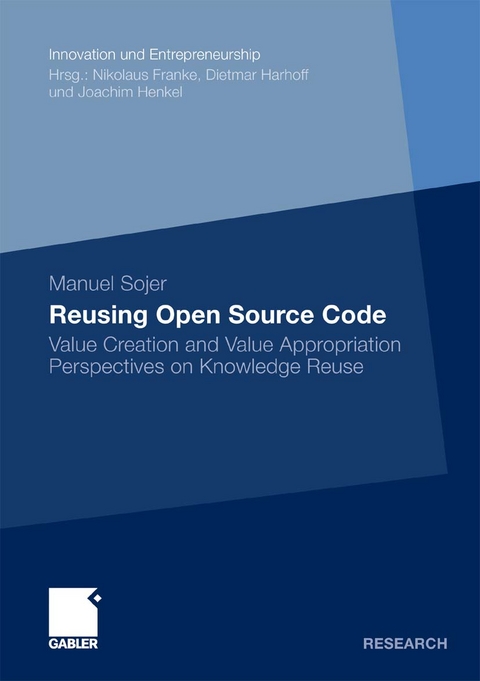
Reusing Open Source Code (eBook)
XXIV, 288 Seiten
Betriebswirtschaftlicher Verlag Gabler
978-3-8349-6390-1 (ISBN)
Dr. Manuel Sojer has been a researcher and lecturer at the Schöller Chair in Technology and Innovation Management of Prof. Dr. Joachim Henkel (Technische Universität München).
Dr. Manuel Sojer has been a researcher and lecturer at the Schöller Chair in Technology and Innovation Management of Prof. Dr. Joachim Henkel (Technische Universität München).
Preface 6
Foreword 7
Table of Contents 9
List of Figures 12
List of Tables 13
List of Abbreviations 14
Zusammenfassung 15
Abstract 18
1. Introduction 21
1.1. Motivation: The Cisco/Linksys case 22
1.2. Research objectives 23
1.3. Structure of the dissertation 28
2. Foundations of value creation and value appropriation 29
2.1. Concepts and terminology 30
2.2. Determinants of value creation 34
2.3. Determinants of value appropriation 35
2.4. Summary 38
3. Open source software developers’ perspectives on code reuse37 40
3.1. Introduction 40
3.2. Foundations of knowledge reuse 43
3.2.1. Knowledge reuse to create value 43
3.2.2. Knowledge reuse in software development 46
3.2.3. The not-invented-here syndrome 53
3.2.4. Intermediate conclusion 55
3.3. OSS and its development 56
3.3.1. History of OSS 57
3.3.2. OSS licenses56 59
3.3.3. OSS development 60
3.3.4. Motivations of OSS developers 65
3.3.5. Code reuse in OSS development 70
3.3.6. Intermediate conclusion and detailed research questions 73
3.4. Research model and hypotheses 74
3.4.1. The theory of planned behavior81 75
3.4.2. Qualitative pre-study 76
3.4.3. Determinants of code reuse behavior 77
3.5. Survey design and methodology 92
3.5.1. Data source and sample selection 92
3.5.2. Survey design 95
3.5.3. Pretest 97
3.5.4. Conducting the survey 97
3.6. Descriptive and exploratory analyses 99
3.6.1. Survey participants and their OSS projects 100
3.6.2. Importance and extent of code reuse 106
3.6.3. Developers’ reasons for and against code reuse 110
3.6.4. Component and snippet reuse 119
3.6.5. Developers’ sources to search for existing code to reuse 125
3.6.6. Summary 128
3.7. Multivariate analysis of determinants of code reuse 130
3.7.1. Hypotheses 130
3.7.2. Variables 131
3.7.3. Statistical methods used 135
3.7.4. Results 135
3.7.5. Discussion and summary 142
3.8. Conclusion 146
4. Commercial software developers’ perspectives on internet code reuse139 151
4.1. Introduction 151
4.2. Foundations of internet code reuse in commercial software development 155
4.2.1. Obligations from internet code reuse 155
4.2.2. Internet code reuse in commercial software development 161
4.2.3. Intermediate conclusion and detailed research questions 165
4.3. Research model and hypotheses 168
4.3.1. Theoretical models to predict ethical behavior 169
4.3.2. Qualitative pre-study 170
4.3.3. Determinants of violations of internet code reuse obligations 172
4.4. Survey design and methodology 188
4.4.1. Data source and sample selection 188
4.4.2. Survey design 189
4.4.3. Pretest 193
4.4.4. Conducting the survey 193
4.5. Descriptive and exploratory analyses 196
4.5.1. Survey participants and their firms 196
4.5.2. Developer awareness of internet code reuse obligations 200
4.5.3. Internet code reuse in commercial software development 206
4.5.4. Extent of (potential) violations of internet code obligations 211
4.5.5. Summary 213
4.6. Research model testing and results 215
4.6.1. Hypotheses 215
4.6.2. Statistical methods used 216
4.6.3. Measurement model assessment and descriptive statistics 218
4.6.4. Structural model assessment 228
4.6.5. Discussion and summary 232
4.7. Conclusion 237
5. Conclusion 248
Appendix 256
A.1. Code reuse in open source software development 257
A.1.1. Survey questionnaire among OSS developers 257
A.1.2. Multivariate analyses of determinants of code reuse 267
A.2. Code reuse in commercial software development 269
A.2.1. ACM code of ethics and professional conduct: IP case 269
A.2.2. Survey questionnaire among commercial software developers 270
A.2.3. Internet code reuse quiz 278
A.2.4. Discriminant validity of model constructs 279
Bibliography 281
| Erscheint lt. Verlag | 4.11.2010 |
|---|---|
| Reihe/Serie | Innovation und Entrepreneurship | Innovation und Entrepreneurship |
| Zusatzinfo | XXIV, 288 p. 29 illus. |
| Verlagsort | Wiesbaden |
| Sprache | englisch |
| Themenwelt | Mathematik / Informatik ► Informatik ► Netzwerke |
| Wirtschaft ► Betriebswirtschaft / Management ► Logistik / Produktion | |
| Schlagworte | information systems • License violations • multivariate analysis • Survey • Technology and innovation management |
| ISBN-10 | 3-8349-6390-9 / 3834963909 |
| ISBN-13 | 978-3-8349-6390-1 / 9783834963901 |
| Informationen gemäß Produktsicherheitsverordnung (GPSR) | |
| Haben Sie eine Frage zum Produkt? |
 PDF (Wasserzeichen)
DRM: Digitales Wasserzeichen
Dieses eBook enthält ein digitales Wasserzeichen und ist damit für Sie personalisiert. Bei einer missbräuchlichen Weitergabe des eBooks an Dritte ist eine Rückverfolgung an die Quelle möglich.
Dateiformat: PDF (Portable Document Format)
Mit einem festen Seitenlayout eignet sich die PDF besonders für Fachbücher mit Spalten, Tabellen und Abbildungen. Eine PDF kann auf fast allen Geräten angezeigt werden, ist aber für kleine Displays (Smartphone, eReader) nur eingeschränkt geeignet.
Systemvoraussetzungen:
PC/Mac: Mit einem PC oder Mac können Sie dieses eBook lesen. Sie benötigen dafür einen PDF-Viewer - z.B. den Adobe Reader oder Adobe Digital Editions.
eReader: Dieses eBook kann mit (fast) allen eBook-Readern gelesen werden. Mit dem amazon-Kindle ist es aber nicht kompatibel.
Smartphone/Tablet: Egal ob Apple oder Android, dieses eBook können Sie lesen. Sie benötigen dafür einen PDF-Viewer - z.B. die kostenlose Adobe Digital Editions-App.
Buying eBooks from abroad
For tax law reasons we can sell eBooks just within Germany and Switzerland. Regrettably we cannot fulfill eBook-orders from other countries.
aus dem Bereich