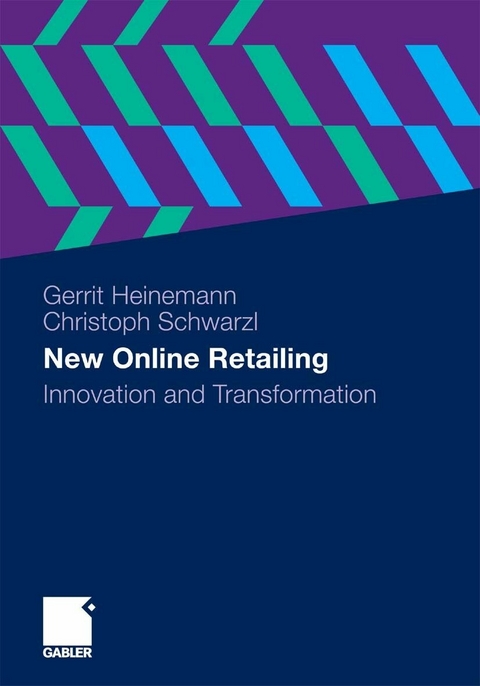
New Online Retailing (eBook)
XVII, 261 Seiten
Betriebswirtschaftlicher Verlag Gabler
978-3-8349-6378-9 (ISBN)
Gerrit Heinemann is a professor of business, management and trade at the
Niederrhein University of Applied Sciences, Mönchengladbach, Germany.
Christoph Schwarzl is Managing Director and Retail Industry Principal at Accenture,
Düsseldorf, Germany.
Gerrit Heinemann is a professor of business, management and trade at the Niederrhein University of Applied Sciences, Mönchengladbach, Germany. Christoph Schwarzl is Managing Director and Retail Industry Principal at Accenture, Düsseldorf, Germany.
Foreword 6
Table of Contents 7
Abbreviations 12
1 Online Retailing in Transition – Revolution, not Evolution 15
1.1 The New Generation of Online Retail 15
1.2 Private Consumption Growing Online 18
1.3 Untapped Potential in Online Retailing 20
1.4 Efficient Starting Time for Online Retailing 23
1.5 The Internet's Underlying Influence on Buyer Behaviour 25
1.6 Digital Natives on the March 30
1.7 Fast Broadband Networks Drive Online Growth 31
2 New Online Retailing — What Does It Mean? 33
2.1 Basic Principles of New Online Retailing 33
2.1.1 Technological Principles of Online Retailing 33
2.1.2 Media-Specific Fundamentals 39
2.1.3 Company-Specific Groundwork for Online Commerce 41
2.2 Special Features of New Online Retail 43
2.2.1 Online Commerce as a Form of Distance Trade 43
2.2.2 Core Competencies and Capabilities in Online Commerce 44
2.2.3 Business Systems in New Online Retail 47
2.3 Marketing and Sales Policy in New Online Retail 49
2.3.1 Product Line Policy in Online Selling 49
2.3.2 Price Policy in Online Selling 52
2.3.3 Selling and Distribution Policy in Online Trade 53
2.3.4 Communication Policy in Online Retailing 56
2.4 CRM as a Basic Instrument of New Online Retailing 59
2.4.1 CRM Standard Strategies in Online Commerce 61
2.4.2 Customer Loyalty in Online Selling 62
2.4.3 Acquiring New Customers in Online Commerce 69
2.4.4 Customer Conversion in Online Commerce 73
2.4.5 Cutting off Customers in Online Commerce 76
2.4.6 Cost-Effectiveness of CRM in Online Commerce 79
2.5 Forms of New Online Retailing 80
2.5.1 Pure Online Commerce 81
2.5.2 Cooperative Online Commerce 82
2.5.3 Multi-Channel Retailing 83
2.5.4 Hybrid Online Retailing 84
2.5.5 Vertical Online Retailing 87
2.6 Mobile Shopping and New Online Retailing 89
2.6.1 Status of M-Shopping 90
2.6.2 Fundamentals and Limitations of M-Shopping 91
2.6.3 Technical Fundamentals of M-Shopping 92
2.6.4 M-Shopping Product Suitability for Fashion 94
2.6.5 M-Shopping Prospects 97
2.7 Innovation: From Retail to Me-tail 98
2.7.1 Role of Stores Will Change Dramatically 99
2.7.2 Consumers Will Demand Real Multi-Channel Retailing 100
2.7.3 "Fast Fashion" Will Be the De Facto Industry Standard 101
2.7.4 Supply Chains Will Be Optimised Along the Product's Total Life Cycle 102
2.7.5 Consumers Themselves Will Help Form the Communities of Talent 102
2.8 Transformation: Roadmap for Success 103
3 Eight Success Factors in New Online Retailing 106
3.1 Determining Success Factors in Online Commerce 106
3.2 Shop Appeal and Selling Proposition as Success Factor No. 1 109
3.2.1 Attraction Marketing and Customer Value Orientation 109
3.2.2 Killer Differentiators 111
3.2.3 Multimedia Presentation and Multidimensionality 113
3.2.4 E-Branding, E-Brand USP and E-Brand Pull 115
3.2.5 External Promotion of E-Store Brands 121
3.3 Social Targeting and Societing as Success Factor No. 2 122
3.3.1 Online Market Segmentation and Target Marketing 123
3.3.2 Integrated Community Marketing 124
3.3.3 Community-Based Brand Leadership 128
3.3.4 Consumer-Generated Advertising 130
3.3.5 Linking Value 131
3.4 Service and Search Solutions as Success Factor No. 3 133
3.4.1 Eye Tracking Optimised Web Usability 134
3.4.2 Navigation, Selection and Evaluation Help 135
3.4.3 Service-Oriented Dialogue Elements 140
3.4.4 Self-Service Functionalities 142
3.4.5 Pre- and Post-Sales Services 144
3.4.6 Customer Feedback 145
3.5 Singularity Customisation and Personalisation as Success Factor No. 4 148
3.5.1 One-to-One Marketing 148
3.5.2 Individualised Offers 150
3.5.3 Personalised Consultation and Presentation 152
3.5.4 Mass Customisation 154
3.5.5 Open Innovation 158
3.6 System and Supply Chain Excellence as Success Factor No. 5 160
3.6.1 Complexity Performance 160
3.6.2 Acceleration and Cycle Time Reduction 162
3.6.3 Strategic IT Deployment 164
3.6.4 Automation 165
3.7 Security Standards and Reputation as Success Factor No. 6 166
3.7.1 Risk Perception in Online Commerce 167
3.7.2 Payment Security and Flexibility 169
3.7.3 Data Security and Protection 171
3.7.4 Following Basic Legal Conditions 172
3.7.5 Security Regarding General Terms and Conditions 173
3.8 Supplementary and Support Channel Strategy as Success Factor No. 7 175
3.8.1 The Channel Hopping Option as Customer Added Value 177
3.8.2 Internet as Lead Channel with Additional Brick and Mortar Channels 180
3.8.3 Integrated Multi-Channel Systems 181
3.8.4 Comparison of Channel Attributes 185
3.9 Sourcing Concept and Strategic Alliances as Success Factor No. 8 187
3.9.1 Global Sourcing 190
3.9.2 E-Sourcing 192
3.9.3 Outsourcing 195
3.9.4 Strategic and Virtual Partnerships 197
4 Best Practices in New Online Retailing 201
4.1 Success Stories in New Online Retailing 201
4.1.1 Best Practices in Pure Online Retailing 201
4.1.2 Best Practices in Cooperative Online Commerce 206
4.1.3 Best Practices in Multi-Channel Retailing 209
4.1.4 Best Practices in Hybrid Online Commerce 213
4.1.5 Best Practices in Vertical Online Commerce 214
4.2 Examples of Successful Online Management 216
4.2.1 Best Practices in Front-Office Functions 216
4.2.2 Best Practices in Back-Office Functions and Supply Chains 219
4.3 Lessons Learned – 20 Rules for New Online Retail 222
5 Risks and Benefits of New Online Retailing 224
5.1 Risks and Benefits of Pure Online Commerce 224
5.1.1 Risks and Benefits from an Online Retail Perspective 225
5.1.2 Risks and Benefits from an Online Customer Perspective 226
5.2 Risks and Benefits of Multi-Channel Retail 229
5.2.1 Risks and Benefits from a Multi-Channel Retail Perspective 229
5.2.2 Risks and Benefits from a Multi-Channel Customer Perspective 234
5.3 Risks of Non-Compliance with German Civil Law in Online Commerce 236
5.3.1 New Revocation Regulation 236
5.3.2 Regulations for Product Individualisation 236
5.3.3 Comparison of Vendors 238
5.4 Further Prospects: Cross-Channel Management and Integration 239
References 246
Index 272
| Erscheint lt. Verlag | 1.11.2010 |
|---|---|
| Zusatzinfo | XVII, 261 p. |
| Verlagsort | Wiesbaden |
| Sprache | englisch |
| Themenwelt | Wirtschaft ► Betriebswirtschaft / Management ► Marketing / Vertrieb |
| Wirtschaft ► Betriebswirtschaft / Management ► Unternehmensführung / Management | |
| Wirtschaft ► Volkswirtschaftslehre | |
| Schlagworte | Cross-Channel-Management • Distance Selling • eCommerce • Internet • mCommerce • Multi-Channel-Retailing • Retail • Retailing |
| ISBN-10 | 3-8349-6378-X / 383496378X |
| ISBN-13 | 978-3-8349-6378-9 / 9783834963789 |
| Informationen gemäß Produktsicherheitsverordnung (GPSR) | |
| Haben Sie eine Frage zum Produkt? |
 PDF (Wasserzeichen)
DRM: Digitales Wasserzeichen
Dieses eBook enthält ein digitales Wasserzeichen und ist damit für Sie personalisiert. Bei einer missbräuchlichen Weitergabe des eBooks an Dritte ist eine Rückverfolgung an die Quelle möglich.
Dateiformat: PDF (Portable Document Format)
Mit einem festen Seitenlayout eignet sich die PDF besonders für Fachbücher mit Spalten, Tabellen und Abbildungen. Eine PDF kann auf fast allen Geräten angezeigt werden, ist aber für kleine Displays (Smartphone, eReader) nur eingeschränkt geeignet.
Systemvoraussetzungen:
PC/Mac: Mit einem PC oder Mac können Sie dieses eBook lesen. Sie benötigen dafür einen PDF-Viewer - z.B. den Adobe Reader oder Adobe Digital Editions.
eReader: Dieses eBook kann mit (fast) allen eBook-Readern gelesen werden. Mit dem amazon-Kindle ist es aber nicht kompatibel.
Smartphone/Tablet: Egal ob Apple oder Android, dieses eBook können Sie lesen. Sie benötigen dafür einen PDF-Viewer - z.B. die kostenlose Adobe Digital Editions-App.
Buying eBooks from abroad
For tax law reasons we can sell eBooks just within Germany and Switzerland. Regrettably we cannot fulfill eBook-orders from other countries.
aus dem Bereich