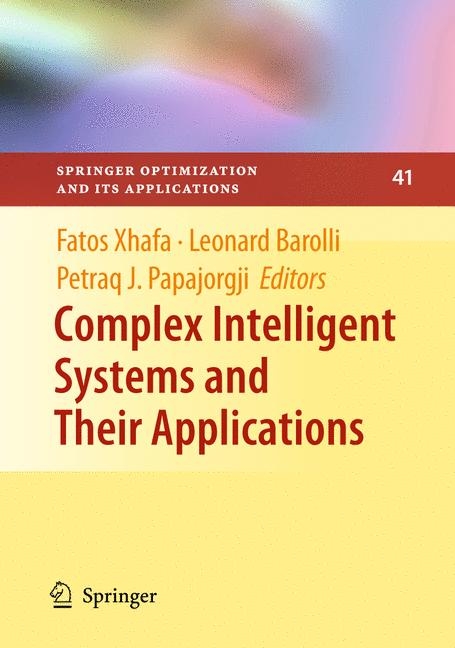
Complex Intelligent Systems and Their Applications (eBook)
XIV, 274 Seiten
Springer New York (Verlag)
9781441916365 (ISBN)
"e;Complex Intelligent Systems and Applications"e; presents the most up-to-date advances in complex, software intensive and intelligent systems. Each self-contained chapter is the contribution of distinguished experts in areas of research relevant to the study of complex, intelligent, and software intensive systems. These contributions focus on the resolution of complex problems from areas of networking, optimization and artificial intelligence. The book is divided into three parts focusing on complex intelligent network systems, efficient resource management in complex systems, and artificial data mining systems. Through the presentation of these diverse areas of application, the volume provides insights into the multidisciplinary nature of complex problems. Throughout the entire book, special emphasis is placed on optimization and efficiency in resource management, network interaction, and intelligent system design. This book presents the most recent interdisciplinary results in this area of research and can serve as a valuable tool for researchers interested in defining and resolving the types of complex problems that arise in networking, optimization, and artificial intelligence.
Preface 6
Acknowledgements 8
Contents 9
List of Contributors 11
Efficient Integration of Complex Information Systems in the ATM Domain with Explicit Expert Knowledge Models 14
Introduction and Motivation 15
Objectives and Contribution 16
Related Work 18
Semantic Data Integration 18
Ontologies for Semantic Integration 20
Making Integration Knowledge Explicit 22
Abstract Integration Scenario Ontology 22
Domain-Specific Ontology 22
Integration System Ontology 23
SEEK-ATM Process Description 24
Traditional Integration Approach 24
SEEK-ATM Integration Approach 24
Added Value from Explicit Knowledge 26
Automated Identification of Integration Partner Candidates 26
Generation of Transformation Instructions 26
Generation of System Integration Configuration 27
Evaluation 27
Integration Effort 27
QA Efficiency 29
Model Complexity 29
Level of Automation Support 29
Conclusion and Future Work 30
References 31
An Ontology-Based Approach for Supporting Business-IT Alignment 33
Introduction 34
Background 34
What is Business-IT Alignment? 34
The B-SCP Framework 35
Seven-Eleven Japan Example 37
Related Work 38
Objectives and Contributions 43
Adding Semantics to the B-SCP Framework 43
Why an Ontology Based Approach? 44
Business Motivation Model Ontology 45
Discussion and Results 47
Future Work 51
Conclusion 51
References 52
EPCIS-Based Supply Chain Event Management 55
Introduction 56
EPCglobal Network 58
EPCglobal Architecture Framework 58
Electronic Product Code 60
EPC Information Services 60
Business Application 62
Decentralized EPCIS-Based SCEM 64
Data Layer 64
Protocol Layer 65
Application Layer 69
Quantitative Comparison of Two Architecture Approaches 70
EPCIS-Based Event Sharing Using Event Pull 70
EPCIS-Based SCEM Using Event Push (Our Proposal) 72
Evaluation 72
Parameters 73
Efficient Use of Network Capacity 73
Efficient Use of Storage Capacity 74
Reliability 75
Results 76
Discussion 77
Conclusions and Future Work 78
References 79
Cost-Benefit Analysis to Hedge with Third-Party Producers in Demand-Driven Production 81
Introduction 81
Related Work 82
Cost-Benefit Analysis to Hedge with Third-Party Producers 86
Probabilistic Approach for Cost-Benefit Analysis to Hedge with Third-Party Producers 89
Conclusion 92
References 93
A Security Assurance Model to Holistically Assess the Information Security Posture 94
Why Is Information Security Assessment a Complex Task? 94
Traditional Assessment Procedures 95
New Challenges Regarding the Assessment of InfoSec 96
A New Multidimensional InfoSec Assessment Framework 97
Assurance Analysis for an Effective and Efficient InfoSec Assessment Framework 99
Security Assurance Principles 99
An Assurance Related Concept: The Trust 100
An Holistic InfoSec Assurance Assessment Model (ISAAM) 102
The Structure 102
Lessons Learned from the Current Methodologies Related to the InfoSec Assurance Structure 102
The Holistic InfoSec Assurance Assessment Model (ISAAM) Structure 105
The Security Quality 107
State of the Art Related to the Quality Issues 107
Quality Aspects within the Holistic InfoSec Assurance Assessment Model (ISAAM) 109
The Requirements Side (Maturity Levels) 110
State of the Art Regarding the InfoSec Maturity Levels 110
The Holistic InfoSec Assurance Assessment Model (ISAAM) Maturity Level 112
Level 1: Fortuitous 112
Level 2: Structured 112
Level 3: Functional 113
Level 4: Analyzable 113
Level 5: Effective 113
Expected Outputs of the ISAA Evaluation Model 114
Conclusion 117
References 117
Risk-Aware Business Process Management-Establishing the Link Between Business and Security 120
Introduction 121
Related Work 122
Steps Required to Perform Risk-Aware Business Process Management 132
Perform Program Management 133
Determine As-Is Situation 133
Reengineer Processes 134
Implement Processes 135
Review and Evaluate 136
A Reference Model for Risk-Aware Business Process Management 136
Application Scenarios 139
Conclusion 143
References 145
Self-Optimised Tree Overlays Using Proximity-Driven Self-Organised Agents 147
Introduction 147
Objectives and Contributions 148
Applications 148
Problem Statement 149
Self-Organisation 149
Self-Optimisation 150
Application Independence 150
System Overview 151
Related Work 151
Literature Review 152
Application Domain 152
Optimisation Metrics 152
Complementary Overlays 153
Build and Maintenance 153
Decentralisation Level 154
Proactiveness vs. Reactiveness 154
Open Issues 154
Approach 155
Application Agent 156
Robustness (r) 156
Node Degree (n) 156
Expected Response Time (tr) 156
Register 157
Build 157
Connect 157
Unregister 157
Self-Organisation Agent 157
Knowledge 157
Random View (R) 158
Proximity View (M) 158
Tree View (T) 158
Components 159
Proximity Manager 159
Random Sampling 159
Proximity Sampling 159
Reconfiguration Manager 159
Tree Manager 161
Reaction Manager 162
Service Layer Architecture 162
PAROS 162
ARMOS 162
ATOM 162
System Control Agent 163
Bootstrapping 163
Termination 163
Evaluation of the Proposed Approach 164
Simulation Settings 164
Results 165
Discussion of Experimental Results 167
Conclusions and Future Work 169
References 169
Filtering Order Adaptation Based on Attractor Selection for Data Broadcasting System 172
Introduction 172
Information Filtering System 173
Mobile Environment 173
Filtering Architecture 174
Filtering Cost 175
Attractor Selection 176
Adaptive Response by Attractor Selection 176
Advantages of Attractor Selection 178
Proposed Methods 179
Attractor Selection (AS) Method 179
Calculation of the Filtering Cost 180
Calculation of the Activity 180
Calculation of the Selection Priority 180
Flow Chart 181
Problems of the AS Method 182
Extended Methods 182
AS-M Method 182
AS-P Method 183
AS-MP Method 183
Evaluation 183
Simulation Environment 184
Comparison Methods 185
Evaluation Criteria 186
Simulation Results 187
Impact of Calculation Cycle in the Cyclic Adaptation Method 187
Comparison among Methods 187
Impact of beta on the AS Method 191
Impact of gamma on the AS Method 191
Impact of delta on the AS Method 191
Impact of x on the AS Method 192
Impact of ci 192
Impact of the Number of Filters 194
Conclusions 194
References 195
StreamAPAS: Query Language and Data Model 196
Introduction 196
Data Stream Processing 197
Query Language 202
Structure of Query Language 202
Syntax of Unit and Task 204
Attribute Tree 205
Functions 207
Linear Road Benchmark 208
CQL 209
Example Queries in StreamAPAS 210
Further Work 211
Related Work 212
Conclusion 213
References 213
Agent-Supported Programming of Multicore Computing Systems 215
Introduction 216
Recent Developments in Parallel Computing Systems 217
Parallel and Distributed Programming 217
Compilation Techniques 219
Multi-Core Architectures 220
Intelligent Programming of Multi-Core Systems 222
Methodology 222
Model-Driven Development (MDD) 222
Parallel Building Blocks 223
Intelligent Software Agents 223
Programming Environment 224
High-level Program Composition 224
Design Space Exploration 225
Resource Usage Optimization 225
Example 226
Related Work 228
Conclusions 229
References 230
Multimodal and Agent-Based Human-Computer Interaction in Cultural Heritage Applications: an Overview 233
Introduction 233
Multimodal Human-Computer Interaction in Cultural Heritage Applications 234
A Timeline of Cultural Heritage Fruition Applications 235
Multimodal Mobile Access to Services and Contents in Cultural Heritage Sites 237
Agent-Based Human-Computer Interaction in Cultural Heritage Applications 242
Multi-Agent System-Based Solutions for AB-HCI 245
Conversational Agent Based Solutions for AB-HCI 247
Discussions and Comparisons 248
Conclusions 250
References 251
Reinforced Operators in Fuzzy Clustering Systems 254
Introduction 254
Fusion Operators 255
Fusion Operators in Fuzzy Sets and Possibility Theory 256
The Triple Pi Operator 258
The Mean Triple Pi 259
The Mean Triple Pi 259
The Mean Reinforcement 261
LAMDA Clustering System 263
Experimental Results 266
Uncertainties and Maximum of Modulus of Wavelet Transform 267
Classification and Maximum of Modulus of Wavelet Transform 268
The Continuous Wavelet Transform 268
Maximum into the Classification 271
Conclusion 272
References 272
Index 274
| Erscheint lt. Verlag | 3.8.2010 |
|---|---|
| Reihe/Serie | Springer Optimization and Its Applications | Springer Optimization and Its Applications |
| Zusatzinfo | XIV, 274 p. |
| Verlagsort | New York |
| Sprache | englisch |
| Themenwelt | Mathematik / Informatik ► Informatik ► Netzwerke |
| Informatik ► Theorie / Studium ► Künstliche Intelligenz / Robotik | |
| Informatik ► Weitere Themen ► Hardware | |
| Mathematik / Informatik ► Mathematik ► Angewandte Mathematik | |
| Mathematik / Informatik ► Mathematik ► Wahrscheinlichkeit / Kombinatorik | |
| Technik | |
| Wirtschaft ► Betriebswirtschaft / Management ► Planung / Organisation | |
| Schlagworte | Agents • Artificial Intelligence • ATM • broadcast • CISIS Conference • Complex Intelligent Systems • Complex System • Complex Systems • Computational Optimization Methods • Data Mining • fuzzy • information system • Intelligent Network Systems • Knowledge • Nonlinear Optimization Techniques • Optimization • overlay • Roadcasting • Software Intensive Systems • System |
| ISBN-13 | 9781441916365 / 9781441916365 |
| Informationen gemäß Produktsicherheitsverordnung (GPSR) | |
| Haben Sie eine Frage zum Produkt? |
 PDF (Wasserzeichen)
DRM: Digitales Wasserzeichen
Dieses eBook enthält ein digitales Wasserzeichen und ist damit für Sie personalisiert. Bei einer missbräuchlichen Weitergabe des eBooks an Dritte ist eine Rückverfolgung an die Quelle möglich.
Dateiformat: PDF (Portable Document Format)
Mit einem festen Seitenlayout eignet sich die PDF besonders für Fachbücher mit Spalten, Tabellen und Abbildungen. Eine PDF kann auf fast allen Geräten angezeigt werden, ist aber für kleine Displays (Smartphone, eReader) nur eingeschränkt geeignet.
Systemvoraussetzungen:
PC/Mac: Mit einem PC oder Mac können Sie dieses eBook lesen. Sie benötigen dafür einen PDF-Viewer - z.B. den Adobe Reader oder Adobe Digital Editions.
eReader: Dieses eBook kann mit (fast) allen eBook-Readern gelesen werden. Mit dem amazon-Kindle ist es aber nicht kompatibel.
Smartphone/Tablet: Egal ob Apple oder Android, dieses eBook können Sie lesen. Sie benötigen dafür einen PDF-Viewer - z.B. die kostenlose Adobe Digital Editions-App.
Buying eBooks from abroad
For tax law reasons we can sell eBooks just within Germany and Switzerland. Regrettably we cannot fulfill eBook-orders from other countries.
aus dem Bereich