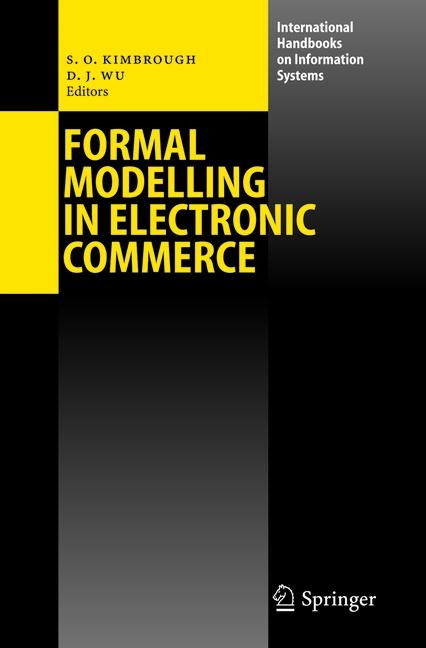
Formal Modelling in Electronic Commerce (eBook)
XII, 562 Seiten
Springer Berlin (Verlag)
978-3-540-26989-2 (ISBN)
Advances in automation for electronic commerce require improved understanding and formalization of the objects, processes, and policies of commerce itself. These include business objects such as bills of lading and contracts; processes such as workflows and trade procedures; and policies covering such problems as contract or procedure validation and strategic behaviour. This book is about theory, formalization, and proof-of-concept implementation of these and related matters. In addition to presenting state-of-the-art results, the book places this work in the context of nearly twenty years of developments in formal modelling for electronic commerce. A comprehensive bibliography and index are provided.
Editors 4
Preface 6
Contents 8
FMEC: Overview and Interpretation 14
1 Introduction 14
2 Formalisms 15
3 Themes 18
4 Topics 19
5 A Brief Guide to the Volume 20
6 Upwards and Onwards 26
Embodied Research 28
7 Acknowledgements 31
A FMEC Bibliographic History 31
References 37
Part I Representation: Objects, Processes & Policies
Practical Contract Storage, Checking, and 44
Enforcement for Business Process Automation 44
1 Introduction 44
2 Contributions 46
3 Application Scenario 47
4 Overview 48
5 Occurrences 51
6 Kimbrough’s Disquotation Theory 56
7 An Implementation of Kimbrough’s Disquotation 58
Theory 58
8 Contract Provision Monitoring 70
9 Contract Performance and Enforcement 72
10 Software Implementation 76
11 Related Work 82
12 Conclusions 83
13 Acknowledgements 84
A Coverage Checking Rules 85
References 85
Legitimacy Checking in Communicative Workflow Design 89
1 Introduction 89
2 The Extended Workflow Loop 91
3 Extended Workflow Loop Norms 92
4 Workflow Loop Schemas 96
5 A Method for Legitimacy Checking 99
6 Conclusions 107
References 108
CANDID Specification of Commercial and Financial Contracts: A Formal Semantics Approach to Knowledge Representation, Part I: Syntax & Formal Semantics of CANDID
1 Introduction 110
2 The Language L1 112
3 Re-Interpretation of Predicates 115
4 Many-Sorted, Type-Theoretic Languages 116
5 . Abstraction 117
6 Operations, Definite Reference 119
7 Summary of the Language Lv 120
8 Character Strings, Labels 123
9 Numbers and Measurement 124
10 Time, Realization, Change 126
11 Possible Worlds, Intensions 131
12 Summary of the Language IL 134
13 Action 139
14 Modals, Deontic Operators 140
15 Summary of the Language CANDID 145
References 151
CANDID Specification of Commercial and Financial Contracts: A Formal Semantics Approach to Knowledge Representation, Part II: Formal Description of Economics Actors and Objects 153
1 Introduction 153
2 Economic Actors 158
3 Economic Objects 161
4 Summary 165
References 166
CANDID Specification of Commercial and Financial Contracts: A Formal Semantics Approach to Knowledge Representation, Part III: CANDID Specification of Financial Concepts 167
1 Introduction 167
2 Additional Definitions, Notational Conventions 168
3 Elementary Financial Concepts 169
4 Financial Instruments 175
5 Concluding Remarks 184
References 184
Performatives, Performatives Everywhere but Not a Drop of Ink 185
1 Performative Aspects of Commerce and Public 185
Administration 185
2 Issues for Open Electronic Commerce 194
3 From Ink to Bits: Original, Signed Writings 196
4 Computational Modeling of Documentary 200
Procedures 200
5 Protocols for Procedure Adoption 202
6 Discussion and Further Research Directions 205
7 Acknowledgments 206
References 206
EDI, XML, and the Transparency Problem in Electronic Commerce 209
1 EDI and the Transparency Problem 210
2 XML’s Pertinent Virtues and Limitations 211
3 Communications Requisites 214
4 microFLBC and the Transparency Problem 219
5 Back to XML 229
6 Conclusion 232
References 233
Part II Applications 236
Designing Control Mechanisms for Value Exchanges in Network Organisations 237
1 Introduction 237
2 A Methodology for Designing Control Mechanisms 239
3 Modelling Business Value Models 240
4 Modelling Sub-Ideal Situations 242
5 Distinguishing Different Types of Control 249
Mechanisms 249
6 Conclusions 250
References 250
Sim-I-Space: An Agent-Based Modelling Approach to Knowledge Management Processes 253
1 Introduction 253
2 Model Architecture 254
3 Model Components 258
4 Acknowledgements 269
A Description of Variables 269
B Detailed Model Specification with Example 284
References 300
Part III Communication 301
On Representing Special Languages with FLBC: Message Markers and Reference Fixing in SeaSpeak 302
1 Introduction 302
2 Special Languages 303
3 Two Problems 305
4 Background on SeaSpeak 307
5 Prototype Example: INFORMATION 309
6 Problems of Reference Fixing 312
7 Formalizing Distributed Descriptions into FLBC 317
8 Analysis of the Remaining SeaSpeak Message 320
Markers 320
9 Discussion and Conclusion 325
References 327
A Note on Modelling Speech Acts as Signalling Conventions 330
1 Introduction 330
2 Asserting: Two Prototypes 331
3 Other Speech Acts 335
4 Discussion: Towards Deployment 339
5 Summary and Conclusion 344
References 345
Dynamic Conversation Structures: An Extended Example 348
1 Introduction 348
2 Extended Example 350
3 Conclusion 364
References 364
Part IV Agents and Strategic Interactions 366
Investigating the Value of Information and Computational Capabilities by Applying Genetic Programming to Supply Chain Management 367
1 Introduction 367
2 The Evolutionary Process 370
3 Plan of Investigation 384
4 Summary 391
A Terminals and Functions 392
B Settings for a Scenario 393
C Computing-Related Information 394
References 395
Multi-Agent Simulation of Financial Markets 396
1 Introduction 396
2 Automation of Modern Financial Markets 397
3 Simulation of Financial Markets 402
4 A Multi-Agent Environment for Financial Market Simulation 407
5 Conclusions 419
References 420
Adaptive Agents in Coalition Formation Games 423
1 Introduction 423
2 Background and Description 424
3 Learning Models 427
4 Results 432
5 Conclusion 437
6 Acknowledgements 439
A Parameter Estimates 440
References 444
On Learning Negotiation Strategies by Artificial Adaptive Agents in Environments of Incomplete Information 446
1 Introduction 446
2 Overview of the Approach 449
3 AAA Platform 449
4 Structure of the Bargaining Space 452
5 Experimental Testing and Results 454
6 Conclusion 460
References 461
A Note on Strategic Learning in Policy Space 463
1 Introduction 463
2 Background: Games and Decisions 463
3 Repeated Games 466
4 Simple Reinforcement Learning 467
5 Learning in Policy Space 469
6 Discussion 473
7 Acknowledgements 474
References 474
Learning and Tacit Collusion by Artificial Agents in Cournot Duopoly Games 476
1 Introduction 476
2 The Duopoly Game: Holt’s Cournot Model 477
3 Background and Application Context: Electricity 478
Markets 478
4 Framework for Agent Learning 480
5 Molecular Strategies in the Cournot Game 482
6 Summary of Results 485
7 Discussion 486
8 Acknowledgements 489
References 489
A Note on Working Memory in Agent Learning 492
1 Introduction 492
2 The Exchange Game 493
3 Learning Mechanism 496
4 Experiments on Working Memory 498
5 Discussion 503
6 Conclusion 504
7 Acknowledgements 505
A Parameter Values 505
References 505
Investigations of Granularity and Payoffs in 2×2 Games under Replicator Dynamics 507
1 Introduction 507
2 The Games 508
3 Methodology 512
4 Discussion of Findings 514
5 Acknowledgements 523
A Summary of Simulations 523
References 523
Part V References and Index 526
References 527
Index 552
| Erscheint lt. Verlag | 17.1.2006 |
|---|---|
| Reihe/Serie | International Handbooks on Information Systems | International Handbooks on Information Systems |
| Zusatzinfo | XII, 562 p. |
| Verlagsort | Berlin |
| Sprache | englisch |
| Themenwelt | Wirtschaft ► Allgemeines / Lexika |
| Wirtschaft ► Volkswirtschaftslehre | |
| Schlagworte | Applied Logic • Artificial Agents • Automation • Business objects • Communication • Design • Electronic Commerce • Electronic Data Interchange • knowledge management • learning • Memo • Modeling • organization • programming • search engine marketing (SEM) • Simulation • Workflow |
| ISBN-10 | 3-540-26989-4 / 3540269894 |
| ISBN-13 | 978-3-540-26989-2 / 9783540269892 |
| Informationen gemäß Produktsicherheitsverordnung (GPSR) | |
| Haben Sie eine Frage zum Produkt? |
 PDF (Wasserzeichen)
DRM: Digitales Wasserzeichen
Dieses eBook enthält ein digitales Wasserzeichen und ist damit für Sie personalisiert. Bei einer missbräuchlichen Weitergabe des eBooks an Dritte ist eine Rückverfolgung an die Quelle möglich.
Dateiformat: PDF (Portable Document Format)
Mit einem festen Seitenlayout eignet sich die PDF besonders für Fachbücher mit Spalten, Tabellen und Abbildungen. Eine PDF kann auf fast allen Geräten angezeigt werden, ist aber für kleine Displays (Smartphone, eReader) nur eingeschränkt geeignet.
Systemvoraussetzungen:
PC/Mac: Mit einem PC oder Mac können Sie dieses eBook lesen. Sie benötigen dafür einen PDF-Viewer - z.B. den Adobe Reader oder Adobe Digital Editions.
eReader: Dieses eBook kann mit (fast) allen eBook-Readern gelesen werden. Mit dem amazon-Kindle ist es aber nicht kompatibel.
Smartphone/Tablet: Egal ob Apple oder Android, dieses eBook können Sie lesen. Sie benötigen dafür einen PDF-Viewer - z.B. die kostenlose Adobe Digital Editions-App.
Buying eBooks from abroad
For tax law reasons we can sell eBooks just within Germany and Switzerland. Regrettably we cannot fulfill eBook-orders from other countries.
aus dem Bereich