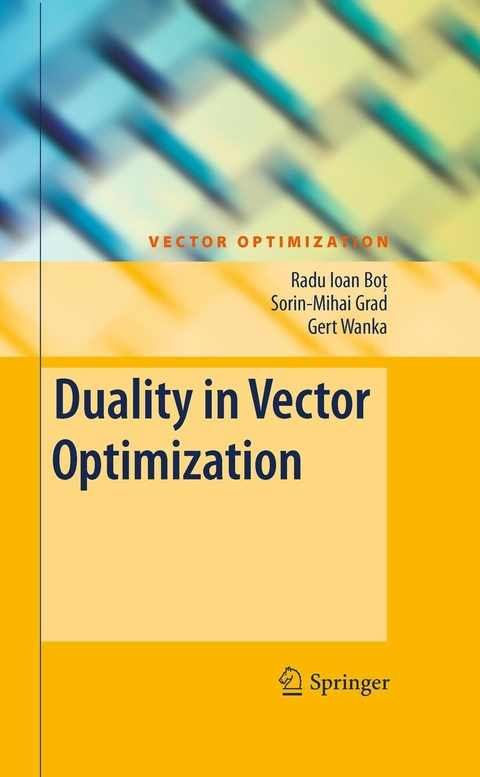
Duality in Vector Optimization (eBook)
XVI, 400 Seiten
Springer Berlin (Verlag)
978-3-642-02886-1 (ISBN)
This book presents fundamentals and comprehensive results regarding duality for scalar, vector and set-valued optimization problems in a general setting. One chapter is exclusively consecrated to the scalar and vector Wolfe and Mond-Weir duality schemes.
Preface 7
Contents 9
List of symbols and notations 13
1 Introduction 16
2 Preliminaries on convex analysis and vectoroptimization 23
2.1 Convex sets 23
2.1.1 Algebraic properties of convex sets 23
2.1.2 Topological properties of convex sets 28
2.2 Convex functions 33
2.2.1 Algebraic properties of convex functions 33
2.2.2 Topological properties of convex functions 39
2.3 Conjugate functions and subdifferentiability 44
2.3.1 Conjugate functions 44
2.3.2 Subdifferentiability 52
2.4 Minimal and maximal elements of sets 56
2.4.1 Minimality 56
2.4.2 Weak minimality 59
2.4.3 Proper minimality 60
2.5 Vector optimization problems 71
3 Conjugate duality in scalar optimization 76
3.1 Perturbation theory and dual problems 76
3.1.1 The general scalar optimization problem 76
3.1.2 Optimization problems having the composition with a linearcontinuous mapping in the objective function 79
3.1.3 Optimization problems with geometric and cone constraints 81
3.2 Regularity conditions and strong duality 86
3.2.1 Regularity conditions for the general scalar optimizationproblem 86
3.2.2 Regularity conditions for problems having the compositionwith a linear continuous mapping in the objective function 89
3.2.3 Regularity conditions for problems with geometric and coneconstraints 93
3.3 Optimality conditions and saddle points 99
3.3.1 The general scalar optimization problem 99
3.4 The composed convex optimization problem 113
3.4.1 A first dual problem to (PCC) 113
3.4.2 A second dual problem to (PCC) 118
3.5 Stable strong duality and formulae for conjugatefunctions and subdifferentials 122
3.5.1 Stable strong duality for the general scalar optimizationproblem 123
3.5.2 The composed convex optimization problem 124
3.5.3 Problems having the composition with a linear continuousmapping in the objective function 127
3.5.4 Problems with geometric and cone constraints 130
4 Conjugate vector duality via scalarization 135
4.1 Fenchel type vector duality 135
4.1.1 Duality with respect to properly efficient solutions 135
4.1.2 Duality with respect to weakly efficient solutions 142
4.2 Constrained vector optimization: a geometricapproach 144
4.2.1 Duality with respect to properly efficient solutions 144
4.2.2 Duality with respect to weakly efficient solutions 149
4.3 Constrained vector optimization: a linearscalarization approach 151
4.3.1 A general approach for constructing a vector dual problemvia linear scalarization 152
4.3.2 Vector dual problems to (PV C) as particular instances ofthe general approach 156
4.3.3 The relations between the dual vector problems to (PV C) 160
4.3.4 Duality with respect to weakly efficient solutions 165
4.4 Vector duality via a general scalarization 171
4.4.1 A general duality scheme with respect to a generalscalarization 172
4.4.2 Linear scalarization 177
4.4.3 Maximum(-linear) scalarization 178
4.4.4 Set scalarization 180
4.4.5 (Semi)Norm scalarization 182
4.5 Linear vector duality 185
4.5.1 The duals introduced via linear scalarization 185
4.5.2 Linear vector duality with respect to weakly efficientsolutions 188
4.5.3 Nakayama’s geometric dual in the linear case 190
5 Conjugate duality for vector optimizationproblems with finite dimensional image spaces 193
5.1 Another Fenchel type vector dual problem 193
5.1.1 Duality with respect to properly efficient solutions 194
5.1.2 Comparisons to (DV A) and (DV ABK) 204
5.1.3 Duality with respect to weakly efficient solutions 206
5.2 A family of Fenchel-Lagrange type vector duals 210
5.2.1 Duality with respect to properly efficient solutions 211
5.2.2 Duality with respect to weakly efficient solutions 221
5.2.3 Duality for linearly constrained vector optimization problems 224
5.3 Comparisons between different duals to (PV FC) 230
5.4 Linear vector duality for problems with finitedimensional image spaces 239
5.4.1 Duality with respect to properly efficient solutions 239
5.4.2 Duality with respect to weakly efficient solutions 244
5.5 Classical linear vector duality in finite dimensionalspaces 247
5.5.1 Duality with respect to efficient solutions 247
5.5.2 Duality with respect to weakly efficient solutions 256
6 Wolfe and Mond-Weir duality concepts 260
6.1 Classical scalar Wolfe and Mond-Weir duality 260
6.1.1 Scalar Wolfe and Mond-Weir duality: nondifferentiable case 260
6.1.2 Scalar Wolfe and Mond-Weir duality: differentiable case 262
6.1.3 Scalar Wolfe and Mond-Weir duality under generalizedconvexity hypotheses 265
6.2 Classical vector Wolfe and Mond-Weir duality 271
6.2.1 Vector Wolfe and Mond-Weir duality: nondifferentiable case 272
6.2.2 Vector Wolfe and Mond-Weir duality: differentiable case 275
6.2.3 Vector Wolfe and Mond-Weir duality with respect to weaklyefficient solutions 280
6.3 Other Wolfe and Mond-Weir type duals and specialcases 286
6.3.1 Scalar Wolfe and Mond-Weir duality without regularityconditions 287
6.3.2 Vector Wolfe and Mond-Weir duality without regularityconditions 291
6.3.3 Scalar Wolfe and Mond-Weir symmetric duality 294
6.3.4 Vector Wolfe and Mond-Weir symmetric duality 296
6.4 Wolfe and Mond-Weir fractional duality 301
6.4.1 Wolfe and Mond-Weir duality in scalar fractionalprogramming 301
6.4.2 Wolfe and Mond-Weir duality in vector fractionalprogramming 305
6.5 Generalized Wolfe and Mond-Weir duality: aperturbation approach 313
6.5.1 Wolfe type and Mond-Weir type duals for general scalaroptimization problems 313
6.5.2 Wolfe type and Mond-Weir type duals for different scalaroptimization problems 314
6.5.3 Wolfe type and Mond-Weir type duals for general vectoroptimization problems 317
7 Duality for set-valued optimization problemsbased on vector conjugacy 321
7.1 Conjugate duality based on efficient solutions 321
7.1.1 Conjugate maps and the subdifferential of set-valued maps 321
7.1.2 The perturbation approach for conjugate duality 329
7.1.3 A special approach - vector k-conjugacy and duality 340
7.2 The set-valued optimization problem withconstraints 344
7.2.1 Duality based on general vector conjugacy 345
7.2.2 Duality based on vector k-conjugacy 352
7.2.3 Stability criteria 356
7.3 The set-valued optimization problem having thecomposition with a linear continuous mapping in theobjective function 362
7.3.1 Fenchel set-valued duality 362
7.3.2 Set-valued gap maps for vector variational inequalities 366
7.4 Conjugate duality based on weakly efficient solutions 370
7.4.1 Basic notions, conjugate maps and subdifferentiability 370
7.4.2 The perturbation approach 376
7.5 Some particular instances of (PSVGw) 382
7.5.1 The set-valued optimization problem with constraints 382
7.5.2 The set-valued optimization problem having the compositionwith a linear continuous mapping in the objective map 387
7.5.3 Set-valued gap maps for set-valued equilibrium problems 389
References 394
Index 405
| Erscheint lt. Verlag | 12.8.2009 |
|---|---|
| Reihe/Serie | Vector Optimization | Vector Optimization |
| Zusatzinfo | XVI, 400 p. |
| Verlagsort | Berlin |
| Sprache | englisch |
| Themenwelt | Mathematik / Informatik ► Informatik ► Theorie / Studium |
| Mathematik / Informatik ► Mathematik ► Angewandte Mathematik | |
| Mathematik / Informatik ► Mathematik ► Wahrscheinlichkeit / Kombinatorik | |
| Technik | |
| Wirtschaft ► Betriebswirtschaft / Management ► Planung / Organisation | |
| Schlagworte | Conjugacy • Duality • Optimality conditions • Optimization • set-valued analysis • Subdifferentiability • Vector Optimization |
| ISBN-10 | 3-642-02886-1 / 3642028861 |
| ISBN-13 | 978-3-642-02886-1 / 9783642028861 |
| Informationen gemäß Produktsicherheitsverordnung (GPSR) | |
| Haben Sie eine Frage zum Produkt? |
 PDF (Wasserzeichen)
DRM: Digitales Wasserzeichen
Dieses eBook enthält ein digitales Wasserzeichen und ist damit für Sie personalisiert. Bei einer missbräuchlichen Weitergabe des eBooks an Dritte ist eine Rückverfolgung an die Quelle möglich.
Dateiformat: PDF (Portable Document Format)
Mit einem festen Seitenlayout eignet sich die PDF besonders für Fachbücher mit Spalten, Tabellen und Abbildungen. Eine PDF kann auf fast allen Geräten angezeigt werden, ist aber für kleine Displays (Smartphone, eReader) nur eingeschränkt geeignet.
Systemvoraussetzungen:
PC/Mac: Mit einem PC oder Mac können Sie dieses eBook lesen. Sie benötigen dafür einen PDF-Viewer - z.B. den Adobe Reader oder Adobe Digital Editions.
eReader: Dieses eBook kann mit (fast) allen eBook-Readern gelesen werden. Mit dem amazon-Kindle ist es aber nicht kompatibel.
Smartphone/Tablet: Egal ob Apple oder Android, dieses eBook können Sie lesen. Sie benötigen dafür einen PDF-Viewer - z.B. die kostenlose Adobe Digital Editions-App.
Buying eBooks from abroad
For tax law reasons we can sell eBooks just within Germany and Switzerland. Regrettably we cannot fulfill eBook-orders from other countries.
aus dem Bereich