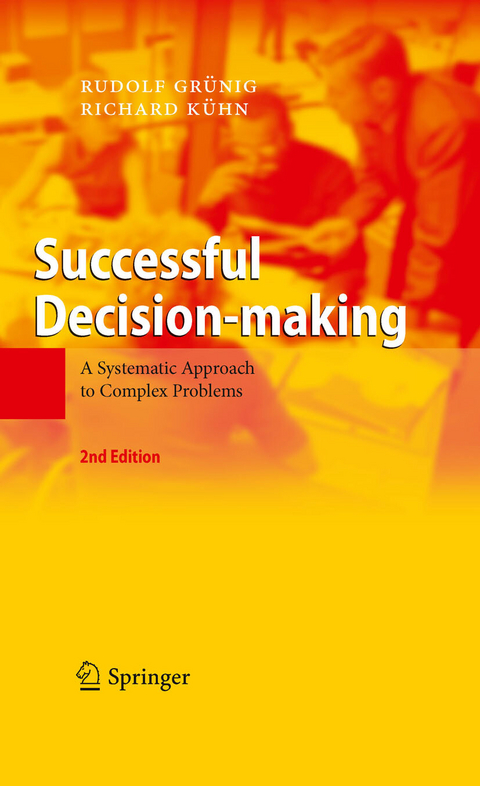
Successful Decision-making (eBook)
XVII, 239 Seiten
Springer Berlin (Verlag)
9783642008542 (ISBN)
Unlike other publications on decision making, the book focuses on discovering the problem, analyzing it and on developing and assessing solution options.
One whole chapter describes a case study. It illustrates how the proposed decision making procedure is used in practice.
Executives get an approach to systematically and successfully solving complex problems.
Contents 7
List of figures 11
List of insets 16
Introduction 17
Part One: Decision problems and decisionmaking procedures 20
1 Decision problems 21
1.1 The decision problem 21
1.2 Ways of solving decision problems 21
1.3 Types of decision problems 24
2 Goal and problem-finding systems as requirements for the discovery of decision problems 30
2.1 The functions of goal and problem-finding systems in the discovery of decision problems 30
2.2 Goal systems 31
2.3 Problem-finding systems 35
3 Rational decisions 41
3.1 The sequence of events in decision-making procedures as a framework for rational decisions 41
3.2 The requirements of a rational decision process 47
3.3 Support for rational decision making from management science 51
4 Decision-making procedures 52
4.1 Decision-making procedure defined 52
4.2 The different types of decision-making procedures 53
Part Two: A general heuristic decision-making procedure 67
5 Overview of the decision-making procedure 69
5.1 The value of a general heuristic decision-making procedure 69
5.2 The proposed sequence of tasks 70
5.3 A brief explanation of the tasks 73
5.4 The basis of the general heuristic decision-making procedure 79
6 Discovering and analyzing the decision problem 83
6.1 Discovering the decision problem 83
6.2 Analyzing the decision problem 87
7 Developing and evaluating options 101
7.1 Developing options 101
7.2 Defining the decision criteria 107
7.3 Drawing up possible scenarios 112
7.4 The configuration of the decision problem as result of Steps 3, 4 and 5 117
7.5 Determining the consequences of the options 119
8 Establishing the overall consequences of the options and making the final decision 125
8.1 General considerations 125
8.2 Overview of the decision maxims and their applicability 129
8.3 Decision maxims for overcoming polyvalence 133
8.4 Decision maxims for overcoming risk 140
8.5 Decision maxims for overcoming uncertainty 148
8.6 Using decision maxims in combination to overcome polyvalence and risk or polyvalence and uncertainty 152
8.7 Evaluation of the decision maxims 156
9 A case study illustrating the application of the procedure 158
9.1 The situation 158
9.2 Discovering and analyzing the problem 160
9.3 Developing and evaluating options 170
9.4 Making the decision 179
Part Three: Special issues and approaches to resolving them 180
10 Decision sequences 182
10.1 What do we mean by a decision sequence? 182
10.2 Using decision trees to represent decision sequences 183
10.3 Choosing the best option in a decision sequence 185
10.4 Case study with a decision sequence 187
11 Information procurement decisions 194
11.1 Information procurement as a decision at the meta-level 194
11.2 Recommendations for decisions on information procurement 195
12 Collective decisions 206
12.1 Collective decisions and their growing importance in companies 206
12.2 Group goal systems and group decision behaviour 208
12.3 Rules for making collective decisions 214
Final remarks 228
Glossary 229
Index 236
Bibliography 242
| Erscheint lt. Verlag | 1.9.2009 |
|---|---|
| Übersetzer | Anthony Clark, Claire O'Dea |
| Zusatzinfo | XVII, 239 p. 102 illus. |
| Verlagsort | Berlin |
| Sprache | englisch |
| Themenwelt | Wirtschaft ► Betriebswirtschaft / Management ► Unternehmensführung / Management |
| Schlagworte | Complex Problems • Decision Making • Heuristic Decision Making • linear optimization • organization • Problem Solving • Solving Complex Problems |
| ISBN-13 | 9783642008542 / 9783642008542 |
| Informationen gemäß Produktsicherheitsverordnung (GPSR) | |
| Haben Sie eine Frage zum Produkt? |
 PDF (Wasserzeichen)
DRM: Digitales Wasserzeichen
Dieses eBook enthält ein digitales Wasserzeichen und ist damit für Sie personalisiert. Bei einer missbräuchlichen Weitergabe des eBooks an Dritte ist eine Rückverfolgung an die Quelle möglich.
Dateiformat: PDF (Portable Document Format)
Mit einem festen Seitenlayout eignet sich die PDF besonders für Fachbücher mit Spalten, Tabellen und Abbildungen. Eine PDF kann auf fast allen Geräten angezeigt werden, ist aber für kleine Displays (Smartphone, eReader) nur eingeschränkt geeignet.
Systemvoraussetzungen:
PC/Mac: Mit einem PC oder Mac können Sie dieses eBook lesen. Sie benötigen dafür einen PDF-Viewer - z.B. den Adobe Reader oder Adobe Digital Editions.
eReader: Dieses eBook kann mit (fast) allen eBook-Readern gelesen werden. Mit dem amazon-Kindle ist es aber nicht kompatibel.
Smartphone/Tablet: Egal ob Apple oder Android, dieses eBook können Sie lesen. Sie benötigen dafür einen PDF-Viewer - z.B. die kostenlose Adobe Digital Editions-App.
Buying eBooks from abroad
For tax law reasons we can sell eBooks just within Germany and Switzerland. Regrettably we cannot fulfill eBook-orders from other countries.
aus dem Bereich