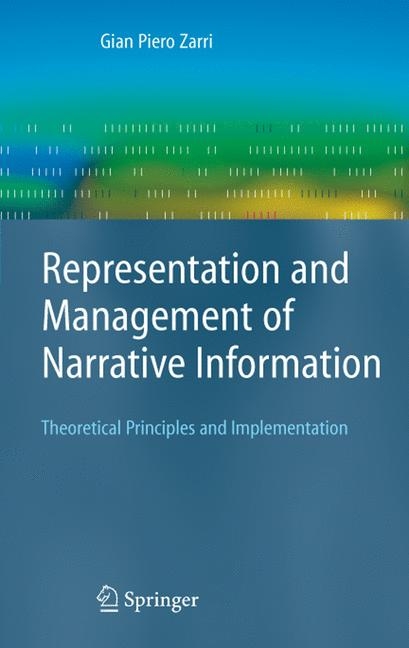
Representation and Management of Narrative Information (eBook)
X, 302 Seiten
Springer London (Verlag)
9781848000780 (ISBN)
A big amount of important, 'economically relevant' information, is buried within the huge mass of multimedia documents that correspond to some form of 'narrative' description.
Due to the ubiquity of these 'narrative' resources, being able to represent in a general, accurate, and effective way their semantic content - i.e., their key 'meaning' - is then both conceptually relevant and economically important. In this book, we present the main properties of NKRL ('Narrative Knowledge Representation Language'), a language expressly designed for representing, in a standardised way, the 'meaning' of complex multimedia narrative documents. NKRL is a fully implemented language/environment. The software exists in two versions, an ORACLE-supported version and a file-oriented one.
Written from a multidisciplinary perspective, this exhaustive description of NKRL and of the associated knowledge representation principles will be an invaluable source of reference for practitioners, researchers, and graduates.
A big amount of important, 'economically relevant' information, is buried within the huge mass of multimedia documents that correspond to some form of 'narrative' description.Due to the ubiquity of these narrative resources, being able to represent in a general, accurate, and effective way their semantic content i.e., their key meaning is then both conceptually relevant and economically important. In this book, we present the main properties of NKRL ( Narrative Knowledge Representation Language ), a language expressly designed for representing, in a standardised way, the meaning of complex multimedia narrative documents. NKRL is a fully implemented language/environment. The software exists in two versions, an ORACLE-supported version and a file-oriented one.Written from a multidisciplinary perspective, this exhaustive description of NKRL and of the associated knowledge representation principles will be an invaluable source of reference for practitioners, researchers, and graduates.
Contents 9
Preface 5
Chapter 1 Basic Principles 11
Narrative Information in an NKRL Context 12
Narratology and NKRL 12
‘‘Fictional’’ and ‘‘Nonfictional’’ Narratives 13
Informal Definition of an NKRL ‘‘Narrative’’ 15
The Notion of ‘‘Event’’ in an NKRL Context 17
A Kimian-like Analysis 18
A Davidsonian-like Analysis 20
Final Notes on the Linguistic Theories about ‘‘Events’’ 22
Knowledge Representation and NKRL 23
‘‘Standard’’ Ontologies and the ‘‘n-ary’’ Problem 24
Introducing the n-ary Problem 24
The W3C Suggestions 27
A Plain ‘‘n-ary’’ Solution and Some Related Problems 31
Previous n-ary Conceptual Realizations 32
Possible Problems Affecting Existing n-ary Solutions 39
In the Guise of Winding Up 43
Chapter 2 The Knowledge Representation Strategy 48
Architecture of NKRL: the Four ‘‘Components’’ 48
The Data Structures of the Four Components 51
Definitional/Enumerative Data Structures 52
General Principles of the HClass ‘‘Frames’’ 52
Prototype Slots 54
Categories of Properties 57
‘‘Relation-type’’ Properties 58
‘‘Attribute-type’’ Properties 60
‘‘Procedure-type’’ Properties 61
NKRL Instances (Individuals) 62
Descriptive/Factual Data Structures 64
General Format of the Descriptive/Factual Structures 65
Semantic Predicates, Roles, Templates and Occurrences 65
Semantic Predicates as Primitives 66
Introducing the NKRL Roles 68
The NKRL Templates and the ‘‘Catalogue’’ 70
Deriving a Predicative Occurrence from a Template 75
Structured Arguments and the AECS Sub-language 77
The AECS Sub-language 77
Determiners (Attributes) 79
Modulators 80
Temporal Modulators 80
Deontic Modulators 80
Modal Modulators 82
Concurrent Utilization of Several Modulators 82
Locations 84
Temporal Determiners (Attributes) 85
NKRL, Timestamps and Intervals 89
Categories and Perspectives 91
Second-order Structures 95
The Completive Construction 96
Binding Occurrences 100
The Binding Operators 100
Priority Rule and Generalization to Templates 102
Correspondence between ‘‘Expansion’’ and ‘‘Binding’’ Operators 103
Using Template Labels within Binding Structures 104
Binding Operators and Temporal Representation 106
In the Guise of Winding Up 107
Chapter 3 The Semantic and Ontological Contents 111
The Organization of the HClass Hierarchy 111
General Notions about Ontologies 111
Ontologies, Taxonomies, and Concepts 112
The Semantic Web Solutions 113
A Quick Reminder of some OWL, etc. Features 114
Some General Remarks about the Semantic Web Solutions 117
The Search for a ‘‘Standard Upper Ontology’’ 121
Recent SUO-like and SUO-oriented Efforts 121
Some Examples of Upper Level Ontologies 123
HClass Architecture 131
Non-sortal Concepts 134
The ‘‘property_’’ Concepts 134
Representing the ‘‘General Quantifier’’ Concepts 136
The ‘‘NKRL idioms’’ of the property_ type 137
The ‘‘pseudo_sortal_concept’’ Concepts 140
Sortal Concepts 143
The Organization of the HTemp Hierarchy 145
Recent Examples of ‘‘Structured’’ Ontological Systems 146
Main Features of Some Specific HTemp Structures 157
Behave: Templates 158
The Behave:HumanProperty Templates 159
Acting to Obtain a Given Result 161
The Behave:Attitude Templates 163
Exist: Templates 163
Experience: Templates 167
Move: Templates 170
Own: Templates 175
Produce: Templates 177
Receive: Templates 182
In the Guise of Winding Up 185
Chapter 4 The Query and Inference Procedures 190
‘‘Search Patterns’’ and Low-level Inferences 190
The Algorithmic Structure of Fum 192
Basic Principles 193
Unification/Filtering of Expansions 194
A Possible Extension of the AECS Query Language 199
Temporal Information and Indexing 201
The Three Indexing Levels 202
The Selection Algorithm 205
High-level Inference Procedures 208
General Remarks about Some Reasoning Paradigms 210
Hypothesis Rules 212
Transformation Rules 219
Integrating the Two Main Inferencing Modes of NKRL 223
Strategies for the Coordinated Inference Processing 225
The Correspondence among Variables 226
Some Examples 228
Additional Examples 235
Some Remarks about the Software Solutions 238
Inference Rules and Internet Filtering 241
In the Guise of Winding Up 246
Chapter 5 Conclusion 251
Technological Enhancements 251
Theoretical Enhancements 254
Appendix A 257
NKRL Software 257
The Two Versions of the Software 257
The Main Interface 258
The ‘‘Visualization’’ Modules 260
The ‘‘Construction and Management’’ Modules 261
The ‘‘Querying and Inferencing’’ Modules 267
Appendix B 272
Plural Entities in NKRL 272
A General Survey of the NKRL Solution 273
Quantification of Plural Sentences 277
Final Remarks 280
References 283
Index 299
| Erscheint lt. Verlag | 29.6.2009 |
|---|---|
| Reihe/Serie | Advanced Information and Knowledge Processing | Advanced Information and Knowledge Processing |
| Zusatzinfo | X, 302 p. 55 illus. |
| Verlagsort | London |
| Sprache | englisch |
| Themenwelt | Informatik ► Datenbanken ► Data Warehouse / Data Mining |
| Informatik ► Theorie / Studium ► Künstliche Intelligenz / Robotik | |
| Mathematik / Informatik ► Informatik ► Web / Internet | |
| Mathematik / Informatik ► Mathematik ► Finanz- / Wirtschaftsmathematik | |
| Sozialwissenschaften ► Politik / Verwaltung | |
| Wirtschaft ► Allgemeines / Lexika | |
| Schlagworte | Advanced Inference Techniques • Artificial Intelligence • Computational Linguistics • Conceptual Modelling • Formalisation of Narrative Techniques • inference engines • Information Retrieval • Intelligence • Intelligent Database Systems • intelligent information retrieval • knowledge base • knowledge management • Knowledge Representation • Languages for the Semantic Web (W3C Languages • Linguistics • Ontology • semantic web |
| ISBN-13 | 9781848000780 / 9781848000780 |
| Informationen gemäß Produktsicherheitsverordnung (GPSR) | |
| Haben Sie eine Frage zum Produkt? |
 PDF (Wasserzeichen)
DRM: Digitales Wasserzeichen
Dieses eBook enthält ein digitales Wasserzeichen und ist damit für Sie personalisiert. Bei einer missbräuchlichen Weitergabe des eBooks an Dritte ist eine Rückverfolgung an die Quelle möglich.
Dateiformat: PDF (Portable Document Format)
Mit einem festen Seitenlayout eignet sich die PDF besonders für Fachbücher mit Spalten, Tabellen und Abbildungen. Eine PDF kann auf fast allen Geräten angezeigt werden, ist aber für kleine Displays (Smartphone, eReader) nur eingeschränkt geeignet.
Systemvoraussetzungen:
PC/Mac: Mit einem PC oder Mac können Sie dieses eBook lesen. Sie benötigen dafür einen PDF-Viewer - z.B. den Adobe Reader oder Adobe Digital Editions.
eReader: Dieses eBook kann mit (fast) allen eBook-Readern gelesen werden. Mit dem amazon-Kindle ist es aber nicht kompatibel.
Smartphone/Tablet: Egal ob Apple oder Android, dieses eBook können Sie lesen. Sie benötigen dafür einen PDF-Viewer - z.B. die kostenlose Adobe Digital Editions-App.
Buying eBooks from abroad
For tax law reasons we can sell eBooks just within Germany and Switzerland. Regrettably we cannot fulfill eBook-orders from other countries.
aus dem Bereich