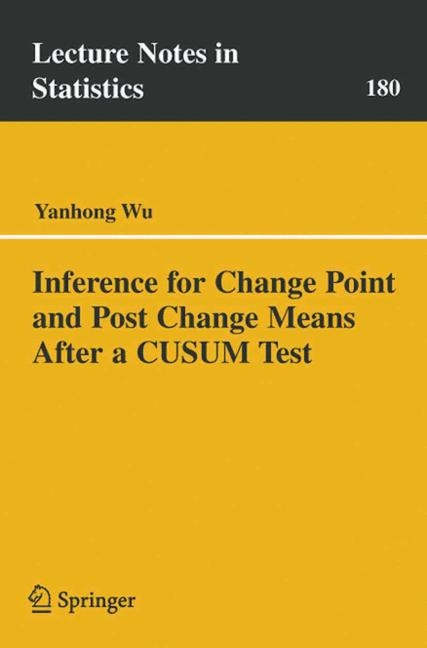
Inference for Change Point and Post Change Means After a CUSUM Test (eBook)
XIII, 158 Seiten
Springer New York (Verlag)
978-0-387-26269-7 (ISBN)
The change-point problem has attracted many statistical researchers and practitioners during the last few decades. Here, we only concentrate on the sequential change-point problem. Starting from the Shewhart chart with app- cations to quality control [see Shewhart (1931)], several monitoring procedures have been developed for a quick detection of change. The three most studied monitoring procedures are the CUSUM procedure [Page (1954)], the EWMA procedure [Roberts (1959)] and the Shiryayev?Roberts procedure [Shiryayev (1963) and Roberts (1966)]. Extensive studies have been conducted on the p- formancesofthesemonitoringproceduresandcomparisonsintermsofthedelay detection time. Lai (1995) made a review on the state of the art on these charts and proposed several possible generalizations in order to detect a change in the case of the unknown post-change parameter case. In particular, a wind- limited version of the generalized likelihood ratio testing procedure studied by Siegmund and Venkatraman (1993) is proposed for a more practical treatment even when the observations are correlated. In this work, our main emphasis is on the inference problem for the chan- point and the post-change parameters after a signal of change is made. More speci?cally, due to its convenient form and statistical properties, most d- cussions are concentrated on the CUSUM procedure. Our goal is to provide some quantitative evaluations on the statistical properties of estimators for the change-point and the post-change parameters.
Preface 5
Contents 9
List of Tables 12
1 CUSUM Procedure 13
1.1 CUSUM Procedure for Exponential Family 13
1.2 Operating Characteristics 14
1.3 Strong Renewal Theorem and Ladder Variables 16
1.4 ARL in the Normal Case 22
2 Change-Point Estimation 26
2.1 Asymptotic Quasistationary Bias 26
2.2 Second-Order Approximation 28
2.3 Two Examples 35
2.4 Case Study 37
3 Confidence Interval for Change-Point 47
3.1 A Lower Con.dence Limit 47
3.2 Asymptotic Results 48
3.3 Second-Order Approximation 50
3.4 Estimated Lower Limit 52
3.5 Confidence Set 53
4 Inference for Post-Change Mean 55
4.1 Inference for . When .. = . 55
4.2 Post-Change Mean 61
4.3 Numerical Examples and Discussions 67
4.4 Proofs 69
4.5 Case Study 74
5 Estimation After False Signal 76
5.1 Conditional RandomWalk with Negative Drift 76
5.2 Corrected Normal Approximation 80
5.3 Numerical Comparison and Discussion 87
6 Inference with Change in Variance 89
6.1 Introduction 89
6.2 Change-Point Estimation 90
6.3 Bias of .. and .s2 93
6.4 Corrected Con.dence Interval 99
6.5 Numerical Evaluation 103
6.6 Appendix 105
6.7 Case Study 107
7 Sequential Classi.cation and Segmentation 111
7.1 Introduction 111
7.2 Online Classification 113
7.3 Offline Segmentation 116
7.4 Second-Order Approximations 118
7.5 Discussion and Generalization 120
7.6 Proofs 122
8 An Adaptive CUSUM Procedure 124
8.1 Definition 124
8.2 Examples 125
8.3 Simple Change Model 126
8.4 Biases of Estimators 132
8.5 Discussions 135
8.6 Appendix 136
8.7 Case Study 137
9 Dependent Observation Case 140
9.1 Introduction 140
9.2 Model-based CUSUM Procedure 141
9.3 Numerical Results 148
10 Other Methods and Remarks 151
10.1 Shiryayev-Roberts Procedure 151
10.2 Comparison with CUSUM Procedure 153
10.3 Case Study: Nile River Data 153
10.4 Concluding Remarks 155
Bibliography 157
Index 163
| Erscheint lt. Verlag | 29.12.2007 |
|---|---|
| Reihe/Serie | Lecture Notes in Statistics | Lecture Notes in Statistics |
| Zusatzinfo | XIII, 158 p. |
| Verlagsort | New York |
| Sprache | englisch |
| Themenwelt | Mathematik / Informatik ► Mathematik ► Statistik |
| Mathematik / Informatik ► Mathematik ► Wahrscheinlichkeit / Kombinatorik | |
| Technik | |
| Wirtschaft ► Betriebswirtschaft / Management | |
| Schlagworte | classification • Estimator • Quality Control, Reliability, Safety and Risk • Sets • Statistics • stochastic model • stochastic models • Time Series • Variance |
| ISBN-10 | 0-387-26269-5 / 0387262695 |
| ISBN-13 | 978-0-387-26269-7 / 9780387262697 |
| Informationen gemäß Produktsicherheitsverordnung (GPSR) | |
| Haben Sie eine Frage zum Produkt? |
 PDF (Wasserzeichen)
DRM: Digitales Wasserzeichen
Dieses eBook enthält ein digitales Wasserzeichen und ist damit für Sie personalisiert. Bei einer missbräuchlichen Weitergabe des eBooks an Dritte ist eine Rückverfolgung an die Quelle möglich.
Dateiformat: PDF (Portable Document Format)
Mit einem festen Seitenlayout eignet sich die PDF besonders für Fachbücher mit Spalten, Tabellen und Abbildungen. Eine PDF kann auf fast allen Geräten angezeigt werden, ist aber für kleine Displays (Smartphone, eReader) nur eingeschränkt geeignet.
Systemvoraussetzungen:
PC/Mac: Mit einem PC oder Mac können Sie dieses eBook lesen. Sie benötigen dafür einen PDF-Viewer - z.B. den Adobe Reader oder Adobe Digital Editions.
eReader: Dieses eBook kann mit (fast) allen eBook-Readern gelesen werden. Mit dem amazon-Kindle ist es aber nicht kompatibel.
Smartphone/Tablet: Egal ob Apple oder Android, dieses eBook können Sie lesen. Sie benötigen dafür einen PDF-Viewer - z.B. die kostenlose Adobe Digital Editions-App.
Buying eBooks from abroad
For tax law reasons we can sell eBooks just within Germany and Switzerland. Regrettably we cannot fulfill eBook-orders from other countries.
aus dem Bereich