


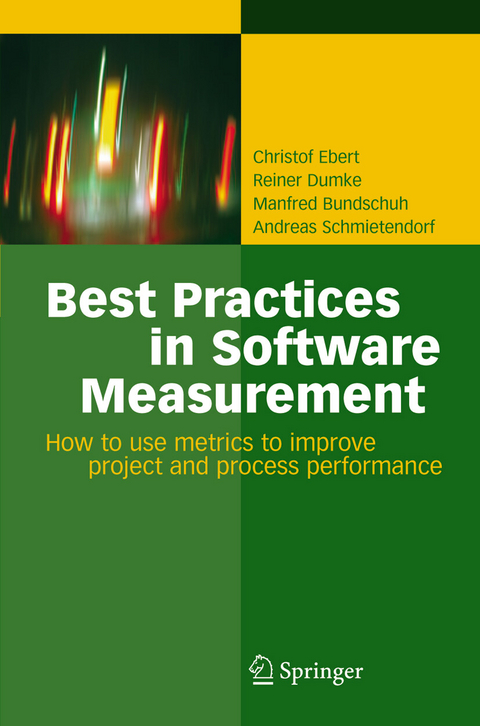
Best Practices in Software Measurement (eBook)
296 Seiten
Springer Berlin (Verlag)
978-3-540-26734-8 (ISBN)
Reiner Dumke is since 1994 a full professor in software engineering at the university of Magdeburg. His research interests include SW metrics, measurement programs, tools, web security and performance engineering. He is speaker of the german Informatics Society (GI) Expert group on Metrics. He has published and lectured extensively on SW metrics and related topics. Christof Ebert is Director Software Coordination and Process Improvement of Alcatel in Paris, France. He drives R&D innovation and effectiveness programs within Alcatel. Before, he lead the biggest Alcatel Business Unit to CMM L3, achieving substantial quality improvements and cycle time reduction. Dr. Ebert is IEEE Software associate Editor-In-Chief and serves as keynote speaker and on program committees of various software engineering conferences. Manfred Bundschuh is President of DASMA e.V., the German metrics organisation, as well as appointed Professor for Project Management and Teamwork at the University of Applied Sciences, Cologne, Dept. of Informatics and IT Quality Manager in AXA Service AG, Cologne. Manfred Bundschuh is author and editor of several books and more than 40 publications. Andreas Schmietendorf works as competence manager for system- and software development in the information technology department of Deutsche Telekom AG. As chief architect within the development center Berlin Dr. Schmietendorf is mainly responsible for integration- and migration-projects. He is an active member in the German society of computer science (GI) and the Central Europe Computer Measurement Group (CECMG). Furthermore Dr. Schmietendorf teach as guest-lecturer at the University of Magdeburg and FHTW Berlin (University of applied science).
Contents 7
1 Introduction 12
2 Making Metrics a Success – The Business Perspective 20
2.1 The Business Need for Measurement 20
2.2 Managing by the Numbers 24
2.2.1 Extraction 24
2.2.2 Evaluation 28
2.2.3 Execution 31
2.3 Metrics for Management Guidance 33
2.3.1 Portfolio Management 33
2.3.2 Technology Management 35
2.3.3 Product and Release Planning 37
2.3.4 Making the Business Case 38
2.4 Hints for the Practitioner 40
2.5 Summary 43
3 Planning the Measurement Process 46
3.1 Software Measurement Needs Planning 46
3.2 Goal-Oriented Approaches 47
3.2.1 The GQM Methodology 47
3.2.2 The CAME Approach 49
3.3 Measurement Choice 51
3.4 Measurement Adjustment 53
3.5 Measurement Migration 54
3.6 Measurement Efficiency 56
3.7 Hints for the Practitioner 56
3.8 Summary 58
4 Performing the Measurement Process 59
4.1 Measurement Tools and Software e-Measurement 59
4.2 Applications and Strategies of Metrics Tools 60
4.2.1 Software process measurement and evaluation 60
4.2.2 Software Product Measurement and Evaluation 61
4.2.3 Software Process Resource Measurement and Evaluation 64
4.2.4 Software Measurement Presentation and Statistical Analysis 64
4.2.5 Software Measurement Training 65
4.3 Solutions and Directions in Software e-Measurement 66
4.4 Hints for the Practitioner 71
4.5 Summary 72
5 Introducing a Measurement Program 73
5.1 Making the Measurement Program Useful 73
5.2 Metrics Selection and Definition 73
5.3 Roles and Responsibilities in a Measurement Program 76
5.4 Building History Data 78
5.5 Positive and Negative Aspects of Software Measurement 79
5.6 It is People not Numbers! 82
5.7 Counter the Counterarguments 84
5.8 Information and Participation 85
5.9 Hints for the Practitioner 86
5.10 Summary 89
6 Measurement Infrastructures 90
6.1 Access to Measurement Results 90
6.2 Introduction and Requirements 90
6.2.1 Motivation: Using Measurements for Benchmarking 90
6.2.2 Source of Metrics 91
6.2.3 Dimensions of a Metrics Database 92
6.2.4 Requirements of a Metrics Database 93
6.3 Case Study: Metrics Database for Object-Oriented Metrics 95
6.3.1 Prerequisites for the Effective Use of Metrics 95
6.3.2 Architecture and Design of the Application 96
6.3.3 Details of the Implementation 97
6.3.4 Functionality of the Metrics Database (Users’ View) 99
6.4 Hints for the Practitioner 102
6.5 Summary 103
7 Size and Effort Estimation 104
7.1 The Importance of Size and Cost Estimation 104
7.2 A Short Overview of Functional Size Measurement Methods 105
7.3 The COSMIC Full Function Point Method 109
7.4 Case Study: Using the COSMIC Full Function Point Method 112
7.5 Estimations Can Be Political 115
7.6 Establishing Buy-In: The Estimation Conference 116
7.7 Estimation Honesty 117
7.8 Estimation Culture 117
7.9 The Implementation of Estimation 118
7.10 Estimation Competence Center 120
7.11 Training for Estimation 122
7.12 Hints for the Practitioner 122
7.13 Summary 123
8 Project Control 124
8.1 Project Control and Software Measurement 124
8.2 Applications of Project Control 127
8.2.1 Monitoring and Control 127
8.2.2 Forecasting 133
8.2.3 Cost Control 135
8.3 Hints for the Practitioner 139
8.4 Summary 140
9 Defect Detection and Quality Improvement 142
9.1 Improving Quality of Software Systems 142
9.2 Fundamental Concepts 144
9.2.1 Defect Estimation 144
9.2.3 Defect Detection, Quality Gates and Reporting 146
9.3 Early Defect Detection 147
9.3.1 Reducing Cost of Non-Quality 147
9.3.2 Planning Early Defect Detection Activities 149
9.4 Criticality Prediction – Applying Empirical Software Engineering 151
9.4.1 Identifying Critical Components 151
9.4.2 Practical Criticality Prediction 153
9.5 Software Reliability Prediction 155
9.5.1 Practical Software Reliability Engineering 155
9.5.2 Applying Reliability Growth Models 157
9.6 Calculating ROI of Quality Initiatives 159
9.7 Hints for the Practitioner 163
9.8 Summary 164
10 Software Process Improvement 166
10.1 Process Management and Process Improvement 166
10.2 Software Process Improvement 169
10.2.1 Making Change Happen 169
10.2.2 Setting Reachable Targets 172
10.2.3 Providing Feedback 175
10.2.4 Practically Speaking: Implementing Change 177
10.2.5 Critical Success Factors 178
10.3 Process Management 179
10.3.1 Process Definition and Workflow Management 179
10.3.2 Quantitative Process Management 182
10.3.3 Process Change Management 183
10.4 Measuring the Results of Process Improvements 184
10.5 Hints for the Practitioner 186
10.6 Summary 188
11 Software Performance Engineering 190
11.1 The Method of Software Performance Engineering 190
11.2 Motivation, Requirements and Goals 192
11.2.1 Performance-related Risk of Software Systems 192
11.2.2 Requirements and Aims 193
11.3 A Practical Approach of Software Performance Engineering 194
11.3.1 Overview of an Integrated Approach 194
11.3.2 Establishing and Resolving Performance Models 194
11.3.3 Generalization of the Need for Model Variables 196
11.3.4 Sources of Model Variables 198
11.3.5 Performance and Software Metrics 199
11.3.6 Persistence of Software and Performance Metrics 201
11.4 Case Study: EAI 202
11.4.1 Introduction of a EAI Solution 202
11.4.2 Available Studies 203
11.4.3 Developing EAI to Meet Performance Needs 204
11.5 Costs of Software Performance Engineering 207
11.5.1 Performance Risk Model (PRM) 207
11.6 Hints for the Practitioner 208
11.7 Summary 210
12 Service Level Management 211
12.1 Measuring Service Level Management 211
12.2 Web Services and Service Management 212
12.2.1 Web Services at a Glance 212
12.2.2 Overview of SLAs 214
12.2.3 Service Agreement and Service Provision 215
12.3 Web Service Level Agreements 217
12.3.1 WSLA Schema Specification 217
12.3.2 Web Services Run-Time Environment 218
12.3.3 Guaranteeing Web Service Level Agreements 219
12.3.4 Monitoring the SLA Parameters 220
12.3.5 Use of a Measurement Service 221
12.4 Hints for the Practitioner 222
12.5 Summary 224
13 Case Study: Building an Intranet Measurement Application 225
13.1 Applying Measurement Tools 225
13.2 The White-Box Software Estimation Approach 226
13.3 First Web-Based Approach 229
13.4 Second Web-Based Approach 230
13.5 Hints for the Practitioner 231
13.6 Summary 231
14 Case Study: Measurements in IT Projects 233
14.1 Estimations: A Start for a Measurement Program 233
14.2 Environment 234
14.2.1 The IT Organization 234
14.2.2 Function Point Project Baseline 234
14.3 Function Point Prognosis 237
14.4 Conclusions from Case Study 238
14.4.1 Counting and Accounting 238
14.4.2 ISO 8402 Quality Measures and IFPUG GSCs 239
14.4.3 Distribution of Estimated Effort to Project Phases 241
14.4.4 Estimation of Maintenance Tasks 242
14.4.5 The UKSMA and NESMA Standard 243
14.4.6 Enhancement Projects 244
14.4.7 Software Metrics for Maintenance 245
14.4.8 Estimation of Maintenance Effort After Delivery 246
14.4.9 Estimation for (Single) Maintenance Tasks 247
14.4.10 Simulations for Estimations 247
14.4.11 Sensitivity analysis. 249
14.5 Hints for the Practitioner 249
14.6 Summary 250
15 Case Study: Metrics in Maintenance 251
15.1 Motivation for a Tool-based Approach 251
15.2 The Software System under Investigation 252
15.3 Quality Evaluation with Logiscope 253
15.4 Application of Static Source Code Analysis 259
15.5 Hints for the Practitioner 262
15.6 Summary 264
16 Metrics Communities and Resources 266
16.1 Benefits of Networking 266
16.2 CMG 266
16.4 COSMIC 267
16.6 German GI Interest Group on Software Metrics 268
16.7 IFPUG 268
16.8 ISBSG 269
16.9 ISO 272
16.10 SPEC 273
16.11 The MAIN Network 273
16.12 TPC 274
16.13 Internet URLs of Measurement Communities 274
16.14 Hints for the Practitioner and Summary 275
Glossary 276
Literature 285
Index 296
| Erscheint lt. Verlag | 12.9.2005 |
|---|---|
| Zusatzinfo | XII, 296 p. |
| Verlagsort | Berlin |
| Sprache | englisch |
| Themenwelt | Mathematik / Informatik ► Informatik ► Datenbanken |
| Mathematik / Informatik ► Informatik ► Software Entwicklung | |
| Wirtschaft ► Betriebswirtschaft / Management ► Logistik / Produktion | |
| Wirtschaft ► Betriebswirtschaft / Management ► Unternehmensführung / Management | |
| Wirtschaft ► Betriebswirtschaft / Management ► Wirtschaftsinformatik | |
| Schlagworte | business • Capability Maturity Model • CMMI • Control • Controlling • Information Technology (IT) • ISO 19761 • Management • Performance • Software • software metrics • Software Performance Engineering • Software Portfolio Management • software process improvement • ST |
| ISBN-10 | 3-540-26734-4 / 3540267344 |
| ISBN-13 | 978-3-540-26734-8 / 9783540267348 |
| Informationen gemäß Produktsicherheitsverordnung (GPSR) | |
| Haben Sie eine Frage zum Produkt? |
 PDF (Wasserzeichen)
DRM: Digitales Wasserzeichen
Dieses eBook enthält ein digitales Wasserzeichen und ist damit für Sie personalisiert. Bei einer missbräuchlichen Weitergabe des eBooks an Dritte ist eine Rückverfolgung an die Quelle möglich.
Dateiformat: PDF (Portable Document Format)
Mit einem festen Seitenlayout eignet sich die PDF besonders für Fachbücher mit Spalten, Tabellen und Abbildungen. Eine PDF kann auf fast allen Geräten angezeigt werden, ist aber für kleine Displays (Smartphone, eReader) nur eingeschränkt geeignet.
Systemvoraussetzungen:
PC/Mac: Mit einem PC oder Mac können Sie dieses eBook lesen. Sie benötigen dafür einen PDF-Viewer - z.B. den Adobe Reader oder Adobe Digital Editions.
eReader: Dieses eBook kann mit (fast) allen eBook-Readern gelesen werden. Mit dem amazon-Kindle ist es aber nicht kompatibel.
Smartphone/Tablet: Egal ob Apple oder Android, dieses eBook können Sie lesen. Sie benötigen dafür einen PDF-Viewer - z.B. die kostenlose Adobe Digital Editions-App.
Buying eBooks from abroad
For tax law reasons we can sell eBooks just within Germany and Switzerland. Regrettably we cannot fulfill eBook-orders from other countries.
aus dem Bereich


