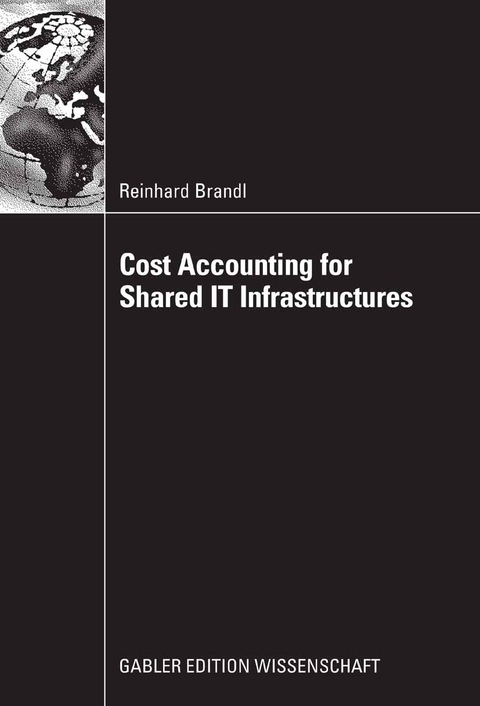
Cost Accounting for Shared IT Infrastructures (eBook)
XX, 225 Seiten
Betriebswirtschaftlicher Verlag Gabler
978-3-8349-9699-2 (ISBN)
Dr. Reinhard Brandl promovierte bei Prof. Dr. Martin Bichler am Lehrstuhl für Internetbasierte Geschäftssysteme der Technischen Universität München. Während seiner Promotion war er als Doktorand am Kompetenzzentrum IT-Architekturen der BMW Group tätig.
Dr. Reinhard Brandl promovierte bei Prof. Dr. Martin Bichler am Lehrstuhl für Internetbasierte Geschäftssysteme der Technischen Universität München. Während seiner Promotion war er als Doktorand am Kompetenzzentrum IT-Architekturen der BMW Group tätig.
Foreword 7
Preface 9
Contents 11
List of Figures 15
List of Tables 18
Chapter 1 Introduction 20
1.1 Problem Statement 20
1.2 Research Approach 24
1.3 Overview of the Thesis 26
Chapter 2 IT Infrastructure Cost Allocation 29
2.1 IT Cost Accounting and Chargeback 29
2.2 Survey of Literature 41
2.3 Requirements and Objectives 54
2.4 Practiced Approaches 57
2.5 Discussion 61
Chapter 3 Cost Allocation based on Resource Profiles 64
3.1 Scope 64
3.2 Concept 66
3.3 Model Hypotheses 72
3.4 Requirements on Resource Profiles 74
3.5 Software Support 75
3.6 Overview of Validation Approaches 95
3.7 Related Work 100
Chapter 4 Experiments: Resource Profiles 102
4.1 Experimental Setup 102
4.2 Overview of Experiments 110
4.3 Experimental Results 113
4.4 Summary 130
Chapter 5 Experiments: Analytical Models 132
5.1 Motivation 132
5.2 IT Capacity Planning Methods 133
5.3 Queueing Network Theory 136
5.4 Software Support 146
5.5 Experimental Setup 153
5.6 Experimental Results 155
5.7 Related Experimental Results 161
5.8 Summary 166
Chapter 6 Proof of Concept: BMW Group 167
6.1 Motivation 167
6.2 Organizational Context 168
6.3 Feasibility Study: Java/J2EE Application tems Sys 176
6.4 Summary 187
Chapter 7 Conclusions 189
7.1 Summary of Results 189
7.2 Outlook 191
Bibliography 194
Chapter 2 IT Infrastructure Cost Allocation (S. 11-12)
2.1 IT Cost Accounting and Chargeback
2.1.1 Classification
There are several possibilities to structure the .eld of IT Cost Accounting and Chargeback. In the present context, the Management Accounting and Information Management perspective are of particular relevance. In the following, we briefly introduce both perspectives and provide references for further reading. Management Accounting supports managers in planning and controlling their operations.
In contrast to Financial Accounting, which addresses the needs of external parties (e.g., investors, creditors and tax authorities), the focus of Management Accounting lies inside the organization. The objective is to motivate and to assist managers in attaining their organizational objectives in a timely, e.cient and e.ective manner (Kaplan and Atkinson, 1998, p. 1). Management Accounting is not constrained by external reporting requirements and can be designed according to an organization’s needs. Relevance is more important than objectivity and auditability. Nevertheless, the data used must be defensible and transparent to internal participants (Kaplan and Atkinson, 1998, p. 1).
One of the most important input types for Management Accounting is cost information. Costs arise from the acquisitions and use of organizational resources, such as people, equipment, materials and facilities (Kaplan and Atkinson, 1998, p. 13). Cost Accounting tracks, records and analyzes this information and reports costs associated with products or activities of the organization back to the management. Therefore, traditional costing systems implement a two-stage process. First, costs are assigned to cost centers (e.g., departments, subsidies) and, second, to cost objects (e.g., products produced by a department). Accordingly, costs can be categorized into direct and indirect costs.
Direct costs are incurred by and can be directly traced to a cost center or a cost object. Examples of direct costs are direct raw materials or direct wages. Indirect costs or overhead costs cannot be fully traced back, because they are incurred by a number of cost centers or cost objects (Owen and Law, 2005, p. 211). Costs can be further categorized into variable and .xed costs. Variable costs change in direct proportion to the production or sales volume, while .xed costs remain constant over a certain period of time. Direct and indirect costs can either be .xed or variable.
Costing systems di.er by the cost categories they take into account. In a full-cost approach, .xed and variable costs are allocated to the cost object. In a variable-cost approach, only direct costs plus variable overhead costs are allocated (Owen and Law, 2005, p. 252). The reported product costs are meant to reflect the marginal costs of manufacturing (Cooper and Kaplan, 1987, p. 205). However, not all departments (cost centers) directly produce or distribute the organization’s output (cost objects). Typically, two di.erent types of departments can be distinguished: production departments and service departments. The costs of service departments should be assigned to production departments to promote cost control and e.ciency by (Kaplan and Atkinson, 1998, p. 62).
| Erscheint lt. Verlag | 21.8.2008 |
|---|---|
| Vorwort | Prof. Dr. Martin Bichler |
| Zusatzinfo | XX, 225 p. |
| Verlagsort | Wiesbaden |
| Sprache | englisch |
| Themenwelt | Wirtschaft ► Allgemeines / Lexika |
| Wirtschaft ► Betriebswirtschaft / Management | |
| Schlagworte | Cost Accounting • Information Technology (IT) • IT Capacity Planning • IT Controlling • IT process • Queuing Network Models |
| ISBN-10 | 3-8349-9699-8 / 3834996998 |
| ISBN-13 | 978-3-8349-9699-2 / 9783834996992 |
| Informationen gemäß Produktsicherheitsverordnung (GPSR) | |
| Haben Sie eine Frage zum Produkt? |
 PDF (Wasserzeichen)
DRM: Digitales Wasserzeichen
Dieses eBook enthält ein digitales Wasserzeichen und ist damit für Sie personalisiert. Bei einer missbräuchlichen Weitergabe des eBooks an Dritte ist eine Rückverfolgung an die Quelle möglich.
Dateiformat: PDF (Portable Document Format)
Mit einem festen Seitenlayout eignet sich die PDF besonders für Fachbücher mit Spalten, Tabellen und Abbildungen. Eine PDF kann auf fast allen Geräten angezeigt werden, ist aber für kleine Displays (Smartphone, eReader) nur eingeschränkt geeignet.
Systemvoraussetzungen:
PC/Mac: Mit einem PC oder Mac können Sie dieses eBook lesen. Sie benötigen dafür einen PDF-Viewer - z.B. den Adobe Reader oder Adobe Digital Editions.
eReader: Dieses eBook kann mit (fast) allen eBook-Readern gelesen werden. Mit dem amazon-Kindle ist es aber nicht kompatibel.
Smartphone/Tablet: Egal ob Apple oder Android, dieses eBook können Sie lesen. Sie benötigen dafür einen PDF-Viewer - z.B. die kostenlose Adobe Digital Editions-App.
Buying eBooks from abroad
For tax law reasons we can sell eBooks just within Germany and Switzerland. Regrettably we cannot fulfill eBook-orders from other countries.
aus dem Bereich