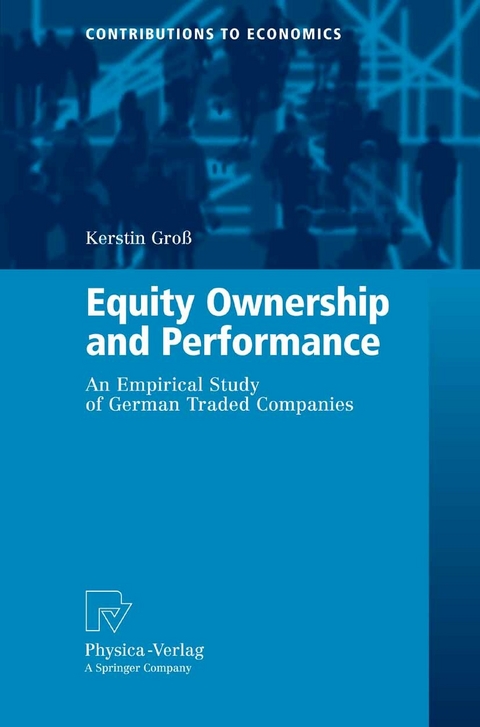
Equity Ownership and Performance (eBook)
XIII, 373 Seiten
Physica (Verlag)
9783790819342 (ISBN)
The empirical studies presented in this book model the endogeneity by applying the simultaneous equations methodology on the relation of ownership and financial performance as well as on different ownership dimensions themselves. Its final model comprises a four equations system containing performance, general ownership concentration, managerial and institutional ownership.
Foreword 9
Preface 10
Contents 12
1 Introduction 15
1.1 Motivation 15
1.2 Objectives 17
1.3 Outline 19
2 Basic Aspects of Ownership Structure and Performance 23
2.1 Introduction 23
2.2 Ownership Structure and its Measures 23
2.2.1 General Aspects of Ownership Structure and its Measures 24
2.2.2 Non-metric Measures 27
2.2.3 Metric Measures 31
2.2.4 Summary 33
2.3 Ownership Characteristics in Germany and Around the World 33
2.4 Forms of Financial Performance Measures 37
2.4.1 Introduction 37
2.4.2 Market-based Performance Measures 37
2.4.3 Accounting-based Performance Measures 40
2.4.4 Hybrid Performance Measures 42
2.4.5 Summary 47
3 Theoretical Background and Hypotheses 49
3.1 General Remarks 49
3.2 Theoretical Background 50
3.3 Ownership Concentration and Performance 55
3.3.1 E.ect of Ownership Concentration on Performance 55
?, 57
3.3.2 E.ect of Performance on Ownership Concentration 59
3.3.3 Summary of Hypotheses on Ownership Concentration 61
3.4 Insider Ownership and Performance 62
3.4.1 E.ect of Insider Ownership on Performance 62
3.4.2 E.ect of Performance on Insider Ownership 67
3.4.3 Summary of Hypotheses on Insider Ownership 69
3.5 Institutional Ownership and Performance 70
3.5.1 E.ect of Institutional Ownership on Performance 71
3.5.2 E.ect of Performance on Institutional Ownership 75
3.5.3 Summary of Hypotheses on Institutional Ownership 76
3.6 Ownership Concentration, Insider and Institutional Ownership 77
3.6.1 General Discussion 77
3.6.2 E.ect of Ownership Concentration on Insider Ownership 78
3.6.3 E.ect of Institutional Ownership on Insider Ownership 79
3.6.4 Summary of Hypotheses of Ownership Concentration, Institutional Ownership and Insider Ownership 80
3.7 Summary of Hypotheses 81
4 Model, Methodology and Data 83
4.1 Introduction 83
4.2 Model Speci.cations 83
4.2.1 Linearity and Monotonousness 83
4.2.2 Timing of E.ects 88
4.2.3 Endogeneity, Simultaneousness and Causation 89
4.2.4 Summary 92
4.3 Methodology 92
4.3.1 General Aspects of Simultaneous Equations Systems 92
4.3.2 Estimation of Simultaneous Equations Systems 95
4.3.3 E.ect Decomposition after Simultaneous Equations Estimation 97
4.4 Sample Selection and Variables Used 99
4.4.1 Sample Selection Data Needs and Data Sources 99
Sample Restrictions 100
4.4.2 Ownership Variables 103
4.4.3 Financial Performance Variables 105
4.4.4 Further Control Variables 107
Firm Size 107
Financial Leverage 109
Investment Activities 111
Liquidity 112
Ease of Monitoring 113
Risk 113
Growth 114
Diversi.cation 115
Other Control Variables 116
Summary of Hypothesized E.ects 116
4.4.5 Descriptives Statistics 117
5 Empirical Analyses 123
5.1 Analysis Procedure 123
5.2 General Ownership Concentration 125
5.2.1 Endogeneity Tests 125
5.2.2 Model Speci.cation 127
5.2.3 Results E . ect of Ownership Concentration 130
E.ect of Tobin’s Q 136
E.ect of Control Variables on Tobin’s Q 140
E.ect of Control Variables on Ownership Concentration 142
5.2.4 Robustness Checks 143
5.2.5 Summary 147
5.3 Insider Ownership 148
5.3.1 Endogeneity Tests 148
5.3.2 Model Speci.cation 149
5.3.3 Results E . ect of Endogenous Variables 151
E.ect of Control Variables 151
5.3.4 Robustness Concerning the Insider De.nition 153
5.3.5 Further Robustness Checks 160
5.3.6 Summary 162
5.4 Institutional Ownership 163
5.4.1 Endogeneity Tests 164
5.4.2 Model Speci.cation 165
5.4.3 Results E . ects of Endogenous Variables 165
Table 5.28: 165
E.ects of Control Variables 169
5.4.4 Robustness Checks 171
5.4.5 Summary 174
5.5 Combined Model 174
5.5.1 Results 176
Table 5.34: 176
E.ect of Ownership Structure on Tobin’s Q 177
E.ects of Tobin’s Q on Ownership 179
Interactions of Ownership 180
E.ects of Control Variables 182
5.5.2 Robustness Checks 185
5.5.3 Summary 185
5.6 Comparison and Summary of Results 189
6 Conclusion 197
List of Abbreviations 201
List of Symbols 203
References 205
A Appendices 231
A.1 Results of ” Global Investor Opinion Survey 2002” by McKinsey 231
A.2 Detailed Data on National Ownership Structures 234
A.3 Example on Argument of Constant Market Return 237
A.4 Historic Tobin’s Qs 239
Table A.6: 239
A.5 Overview over Selected Studies 243
A.6 Decomposition of E.ects in Simultaneous Equation Models 326
A.6.1 Decomposition of Total Association in Causal and Noncausal E . ects 326
A.6.2 Decomposition into Direct and Indirect E.ects 326
A.7 Detailed Skewness and Kurtosis 328
A.8 Detailed and Additional Results of Empirical Analyses 329
A.8.1 Simultaneous Equations Model of General Ownership Endogeneity Tests of roe 329
Table A.12: 329
Simultaneous Equations Results 332
Table A.13: 332
Table A.17: 337
Robustness Checks 341
Table A.21: 342
Table A.22: 344
A.8.2 Simultaneous Equations Model of Insider Ownership Endogeneity Tests of ROE 347
Simultaneous Equations Results 347
Table A.24: 347
Robustness regarding the Insider De.nition 352
Table A.29: 353
Robustness Checks 354
Table A.30: 355
Table A.31: 357
A.8.3 Simultaneous Equations Model of Institutional Ownership Endogeneity Tests of roe 359
Simultaneous Equations Results 359
Table A.33: 359
Robustness Checks 365
Table A.39: 366
Table A.40: 368
A.8.4 Combined Simultaneous Equations Model Simultaneous Equations Results 371
Table A.41: 371
Calculation of the E.ects 375
Robustness Checks 377
Table A.43: 377
Table A.44: 380
Table A.45: 382
Table A.46: 384
2 Basic Aspects of Ownership Structure and Performance (p. 9-10)
2.1 Introduction
To introduce the subject, the following chapter starts by taking a closer look on the concept and the di.erent aspects of ownership structure. This is implemented by an elaboration on the di.erent measures and their development in literature. The section will make clear that ownership is not summarizable in one single or a few variables, but that it constitutes rather a large spectrum of measures due to its di.erent aspects and dimensions. Therefore, ownership variables can always mirror only a part of the real ownership structure, which makes the variable selection an important issue in the ownership and performance literature.
Next Section 2.3 states some statistics on the ownership structure of di.erent countries and compares them to the characteristics of the German market. This will verify the advantageousness of German corporations as research objects. Finally, the literature also uses varying forms of performance measures. They can be distinguished by the applied data type, market-based, accountingbased and hybrid measures. Each type raises di.erent problems. The measures of .nancial performance and their appropriateness in the ownership literature are discussed in the Section 2.4.
2.2 Ownership Structure and its Measures
The following section introduces the reader to the concept of ownership structure. This is done by an elaboration on the di.erent aspects of ownership structure and the resulting measures. The discussion of the various forms of measures and the way they are mirroring the ownership structure is of further importance for the later variable selection.
After assessing some general issues of ownership information, di.erent forms of ownership measures are explained. They are examined by their classi .cation into non-metric and metric measures. Finally, some concluding remarks summarize the topic.
2.2.1 General Aspects of Ownership Structure and its Measures
Ownership structure is a multidimensional construct which therefore cannot be mirrored by a single variable. Two major dimensions structuring ownership information are ownership concentration and owner type.
The ownership concentration renders quantitative information on ownership, representing a share size or the sum of shares or a concentration index, e.g., Her.ndahl coe.cient. The second dimension, the owner’s identity, is the qualitative information about the type of shareholder. This information is important since di.erent owner types have di.erent incentives, utility functions and means of control.2 Widely researched identities are management insiders, with the subgroups of o.cers and directors, and institutional investors. These also constitute the main focus of this work. Further identities like families, company founders, strategic investors and governmental organizations have also gained importance, but are not considered in the course of the dissertation.
| Erscheint lt. Verlag | 6.5.2007 |
|---|---|
| Reihe/Serie | Contributions to Economics | Contributions to Economics |
| Zusatzinfo | XIII, 373 p. |
| Verlagsort | Heidelberg |
| Sprache | englisch |
| Themenwelt | Wirtschaft ► Betriebswirtschaft / Management ► Finanzierung |
| Wirtschaft ► Volkswirtschaftslehre | |
| Schlagworte | Assessment • Corporate Governance • Financial Performance • Institutional Ownership • Managerial Ownership • Modeling • Performance • Research • Sets • Statistical Analysis • Value-at-Risk |
| ISBN-13 | 9783790819342 / 9783790819342 |
| Informationen gemäß Produktsicherheitsverordnung (GPSR) | |
| Haben Sie eine Frage zum Produkt? |
 PDF (Wasserzeichen)
DRM: Digitales Wasserzeichen
Dieses eBook enthält ein digitales Wasserzeichen und ist damit für Sie personalisiert. Bei einer missbräuchlichen Weitergabe des eBooks an Dritte ist eine Rückverfolgung an die Quelle möglich.
Dateiformat: PDF (Portable Document Format)
Mit einem festen Seitenlayout eignet sich die PDF besonders für Fachbücher mit Spalten, Tabellen und Abbildungen. Eine PDF kann auf fast allen Geräten angezeigt werden, ist aber für kleine Displays (Smartphone, eReader) nur eingeschränkt geeignet.
Systemvoraussetzungen:
PC/Mac: Mit einem PC oder Mac können Sie dieses eBook lesen. Sie benötigen dafür einen PDF-Viewer - z.B. den Adobe Reader oder Adobe Digital Editions.
eReader: Dieses eBook kann mit (fast) allen eBook-Readern gelesen werden. Mit dem amazon-Kindle ist es aber nicht kompatibel.
Smartphone/Tablet: Egal ob Apple oder Android, dieses eBook können Sie lesen. Sie benötigen dafür einen PDF-Viewer - z.B. die kostenlose Adobe Digital Editions-App.
Buying eBooks from abroad
For tax law reasons we can sell eBooks just within Germany and Switzerland. Regrettably we cannot fulfill eBook-orders from other countries.
aus dem Bereich