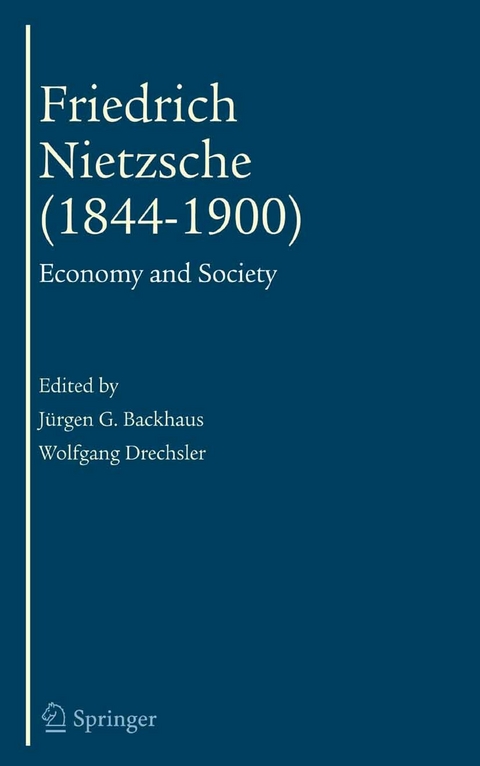
Friedrich Nietzsche (1844-1900) (eBook)
246 Seiten
Springer US (Verlag)
978-0-387-32980-2 (ISBN)
Friedrich Nietzsche's influence on the development of modern social sciences has not been well documented. This volume reconsiders some of Nietzsche's writings on economics and the science of state, pioneering a line of research up to now unavailable in English. The authors intend to provoke conversation and inspire research on the role that this much misunderstood philosopher and cultural critic has played - or should play - in the history of economics.
Nietzsche - Economy and Society: The Closed and the Open Questions a b Jurgen G. Backhaus and Wolfgang Drechsler a University of Erfurt, Germany b Tallinn University of Technology, Estonia Nietzsche's impact and in?uence anywhere in and on our civilization was and is immense. This has by now been widely recognized in almost all areas, even in the "e;hard sciences"e; (see Babich 1999), but Nietzsche is still completely understudied in the ?eld of economics. This is all the more surprising because in?uence paths, both serious (e. g. , Joseph A. Schumpeter) and pop ones (e. g. , Ayn Rand), seem obvious, and because in some of his works, especially M- schliches, Allzumenschliches (1878-1886), a focus on economics is hard to miss. It would thus be only likely that he had some sort of signi?cant in?uence there; yet, one can ?nd hardly any references in the Nietzsche or economics 1 literature on what kind of in?uence that might have been or still is. To remedy this situation, the idea to plan an exploratory conference on Nietzsche and Economics arose. Because of the dif?cult and indeed unusual topic, we found it necessary to even start with a pre-conference, where the issues, questions, sources and possible approaches would be discussed. This pre-conference took place in Heilbronn, in the framework of the Heilbronn Symposia on Economics and the Social Sciences, in June 2000.
Table of Contents 7
Contributors 8
Preface Nietzsche- Economy and Society: The Closed and the Open Questions 9
NOTES 10
REFERENCES 11
1. Friedrich Nietzsche and Economics: Research Problems 12
1. WHY IS NIETZSCHE INTERESTING FOR US? 12
2. RESEARCH PROBLEMS 13
3. WHERE DO WE GO FROM HERE? 16
NOTES 17
REFERENCES 18
2. The Influence of Nietzsche on the History of Economic Thought 20
1. INTRODUCTION 20
2. THE HISTORIES OF ECONOMIC THOUGHT 22
3. THE PERIODICAL LITERATURE 26
4. OTHER EVIDENCE 36
5. DISCUSSION 39
6. CONCLUSION 43
NOTE 43
REFERENCES 43
3. Nietzsche and Economics 50
1. QUOTED ECONOMISTS 51
2. ECONOMIC STATEMENTS 54
3. CONCLUSION 60
NOTES 61
REFERENCES 64
4. Creative Destruction in Economics: Nietzsche, Sombart, Schumpeter 66
1. CREATIVE DESTRUCTION IN VOGUE 66
2. CREATIVE DESTRUCTION BEFORE NIETZSCHE 69
3. NIETZSCHE AND CREATIVE DESTRUCTION 73
4. NIETZSCHE IN ECONOMICS: FROM SOMBART TO SCHUMPETER 83
5. NIETZSCHE AND ECONOMICS AT THE CENTENARY OF HIS DEATH 85
NOTES 89
REFERENCES 94
5. The Word of Honour 98
INTRODUCTION 98
INSERTION I 105
INSERTION II 109
III. THE BASIC INSTITUTIONS OF A MARKET ECONOMY – RECONSIDERED: PRICE INDICES 116
NOTES 119
REFERENCES 119
6. An " All too Human" Question: Nietzsche, Die Soziale Frage, and the German Historical School of Economics 122
1. INTRODUCTION: NIETZSCHE AND THE LATE 19TH- CENTURY ECONOMIC AGENDA 122
2. THE SOCIAL QUESTION AND THE GERMAN ECONOMIC PROGRAMME OF THE 1870’ S 125
3. A HUMAN, ALL TOO HUMAN SOCIAL QUESTION 129
4. NIETZSCHE’S GLANCE AT THE STATE 133
5. CONCLUSIONS 139
NOTES 142
REFERENCES 145
7. Nietzsche and Business Ethics 148
1. DEFINITIONS 148
2. THEORIES 150
3. CONCLUSION 153
NOTES 153
REFERENCES 154
8. On the Anticipation of Knightian Uncertainty in Nietzsche’s 156
1. INTRODUCTION 156
2. PHILOSOPHICAL CONTEXT 158
3. NIETZSCHE 160
4. PRAGMATIC PHILOSOPHY 167
5. CONCLUSION 172
NOTES 173
REFERENCES 176
9. On the Nietzsche-Reception in the GDR 184
1. INTRODUCTION 184
2. THE VIEW FROM " OUTSIDE” 186
3. PHASES OF A HISTORY OF RECEPTION 187
4. CONCLUSION 194
NOTES 194
REFERENCES 196
10. Wolfgang Harich and Friedrich Nietzsche- A Chapter of the East German Nietzsche Debate 202
1. INTRODUCTION 202
2. SOME REMARKS ONWOLFGANG HARICH AND HIS BIOGRAPHY 203
3. HARICH’S VIEW REGARDING NIETZSCHE 207
4. GEORG LUKACS’ CONCEPT OF THE LATE BOURGEOIS PHILOSOPHY – THE INTELLECTUAL MAIN SOURCE OF HARICH’S NIETZSCHE INTERPRETATION 212
5. CONCLUSION 214
NOTES 215
REFERENCES 216
11. Justice and Economy from All Too Human to Thus Spake Zarathustra 220
1. 220
2. 221
3. 223
4. 225
5. 226
6. 228
7. 229
NOTES 229
REFERENCES 235
12. Democracy and Aristocracy in Nietzsche’s Late Writings 240
1. NIETZSCHE’S BELIEF IN HIS DIVINITY 240
2. DIONYSOS AS SYMBOL OF THE UNIVERSAL TRUTH OF LIFE 242
3. THE DEATH OF GOD AS THE END OF MORAL RESPONSIBILITY 243
4. DIONYSOS AS A SYMBOL OF THE ETERNAL PROCESS OF COMING TO BE AND PASSING AWAY 244
5. THE ETERNAL RECURRENCE OF THE SAME AND THE SO CALLED SUPERMAN 245
6. NIETZSCHE AS A CRITIC OF THE LIBERAL AND SOCIALDEMOCRATIC TENDENCIES OF HIS PRESENT 247
7. DEMOCRACY AS A FORERUNNER OF A NEW ARISTOCRACY 251
8. CONDITIONS AND MEANS FOR THE ORIGIN OF A NEW ARISTOCRACY 252
9. SUMMARY AND OUTLOOK 254
NOTES 256
REFERENCES 262
Reading rehearsal currently not available.
| Erscheint lt. Verlag | 11.10.2006 |
|---|---|
| Reihe/Serie | The European Heritage in Economics and the Social Sciences | The European Heritage in Economics and the Social Sciences |
| Zusatzinfo | XII, 246 p. |
| Verlagsort | New York |
| Sprache | englisch |
| Themenwelt | Wirtschaft ► Allgemeines / Lexika |
| Wirtschaft ► Volkswirtschaftslehre | |
| Schlagworte | Business Ethics • Creative Destruction • Democracy and Aristocracy • Justice • Nietzsche and Economics • Nietzsche Debate in the GRD • Philosophy • Schumpeter • Social Selection |
| ISBN-10 | 0-387-32980-3 / 0387329803 |
| ISBN-13 | 978-0-387-32980-2 / 9780387329802 |
| Informationen gemäß Produktsicherheitsverordnung (GPSR) | |
| Haben Sie eine Frage zum Produkt? |
 PDF (Wasserzeichen)
Größe: 1,5 MB
DRM: Digitales Wasserzeichen
Dieses eBook enthält ein digitales Wasserzeichen und ist damit für Sie personalisiert. Bei einer missbräuchlichen Weitergabe des eBooks an Dritte ist eine Rückverfolgung an die Quelle möglich.
Dateiformat: PDF (Portable Document Format)
Mit einem festen Seitenlayout eignet sich die PDF besonders für Fachbücher mit Spalten, Tabellen und Abbildungen. Eine PDF kann auf fast allen Geräten angezeigt werden, ist aber für kleine Displays (Smartphone, eReader) nur eingeschränkt geeignet.
Systemvoraussetzungen:
PC/Mac: Mit einem PC oder Mac können Sie dieses eBook lesen. Sie benötigen dafür einen PDF-Viewer - z.B. den Adobe Reader oder Adobe Digital Editions.
eReader: Dieses eBook kann mit (fast) allen eBook-Readern gelesen werden. Mit dem amazon-Kindle ist es aber nicht kompatibel.
Smartphone/Tablet: Egal ob Apple oder Android, dieses eBook können Sie lesen. Sie benötigen dafür einen PDF-Viewer - z.B. die kostenlose Adobe Digital Editions-App.
Zusätzliches Feature: Online Lesen
Dieses eBook können Sie zusätzlich zum Download auch online im Webbrowser lesen.
Buying eBooks from abroad
For tax law reasons we can sell eBooks just within Germany and Switzerland. Regrettably we cannot fulfill eBook-orders from other countries.
aus dem Bereich