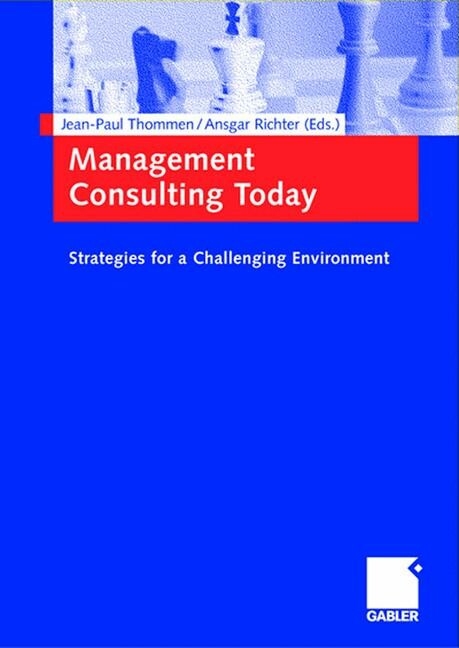
Management Consulting Today (eBook)
181 Seiten
Gabler Verlag
9783409125840 (ISBN)
Leading management consultants and academics discuss the development of the consulting industry and of the firms that have decisively shaped the sector. The authors provide in-depth insights into the leadership of top management consultancies, the strategy and structure of consulting firms, the changing dynamics of consultant-client relationships and the development of new consulting approaches.
The Editors
Prof. Dr. Jean-Paul Thommen is Professor of Business Administration, in particular Organisational Behaviour and Human Resource Management, at the European Business School in Oestrich-Winkel, Germany. He is also Adjunct Professor at the University of Zurich and a Visiting Lecturer at the University of St Gallen.
Ansgar Richter, PhD, is Assistant Professor of Organisation and Human Resources Management at the European Business School in Oestrich-Winkel, Germany.
The Authors
FIONA CZERNIAWSKA, PhD is the Director of the UK Management Consultancies Association’s Think Tank, and Founder and Managing Director of Arkimeda, a firm that specialises in researching and consulting on strategic issues in the consulting industry. Fiona Czerniawska has more than 15 years experience as a management consultant, primarily working in the areas of marketing and strategy, and now speaks and writes extensively on the consulting industry and related issues. Her books include: Management Consultancy: What Next? (2001) and Value-Based Consulting (2002). She is also the author of a variety of commercial reports on the consulting industry, including The European Consulting Market (2002) and Offshore Consulting: Benchmarking Future Success (2003) Her most recent book is The Intelligent Client (2002). Fiona Czerniawska graduated from Oxford and has a PhD from the University of London.
JONATHAN DAY is the Managing Director, Europe, of the Monitor Group’s Human Assets practice. Monitor is an international firm with a range of advisory and merchant banking services, all aimed at helping clients become more competitive. Monitor’s Human Assets practice helps clients on matters of leadership and organisational development. At the time this chapter was written, Jonathan Day was a Partner in the London office of McKinsey & Company, which he joined in 1990. His focus in McKinsey was on organisation, leadership and corporate strategy for global industrial firms. His undergraduate degree is from the Johns Hopkins University, with graduate studies at Johns Hopkins, Stanford University and the University of Chicago. Before joining McKinsey, Jonathan Day was the founder of The Amethyst Corporation, a Chicago-based consulting firm, and an Adjunct Professor at Carnegie-Mellon University, Pittsburgh.
Dr. JOACHIM DEINLEIN is a Project Manager at Booz Allen Hamilton, based in the Munich office. He received his degree in 1997 from the Otto-Friedrich-University in Bamberg and his doctorate from the EUROPEAN BUSINESS SCHOOL, Schloss Reichartshausen in 2003. He joined Booz Allen Hamilton in April 1998. After two years of broad exposure to diverse industries, Joachim Deinlein has specialised since 2000 in strategy and operations work in the automotive sector. His dominant focus is on sales and marketing topics such as retail network development, asset lifetime value, campaign effectiveness, aftersales, telematics, and back office efficiency.
Dr. KLAUS-PETER GUSHURST is a Partner with Booz Allen Hamilton, based in the Munich office. He is the Managing Director for Germany, Switzerland and Austria, and a member of the Global Board of Directors of Booz Allen Hamilton. He studied economics, business and political science at the Albert-Ludwigs- University in Freiburg where he received his degree in economics in 1988 and completed his doctorate in business studies in 1990, both with honours. Klaus- Peter Gushurst joined Booz Allen Hamilton in 1990, and in his more than 15 years in consulting has worked in several industries gaining a wealth of experience in strategy and operations work. Klaus-Peter Gushurst has led several assignments for key clients in Europe, the US and Japan. His main interests are in the financial services and the automotive industry with a functional focus on strategy-based transformation programmes and corporate governance, the role of the board of management, CEO/CFO issues, and the organisational set-up of multinational industries. Klaus-Peter Gushurst lives with his family south of Munich.
Dr. DIETER HEUSKEL is a Senior Vice President in the Düsseldorf office of The Boston Consulting Group, a member of BCG's worldwide Executive Committee, and Chair of BCG's Management Team for Germany, Austria, and Greece. He joined BCG in 1980 and is co-founder of the Düsseldorf office. His main areas of expertise include strategy development and portfolio management for diversified companies and change projects. In his many interviews and articles he presents innovative and often controversial concepts on topics such as ‘premium conglomerates’, business migration, and deconstruction. He is the author of the book Wettbewerb jenseits von Industriegrenzen. Aufbruch zu neuen Wachstumsstrategien (1999). He has been a member of the Board of Editors for the Zeitschrift für Betriebswirtschaftslehre since 1999, and in the same year he initiated BCG's Europe-wide pro bono project business@school. Dieter Heuskel lives with his family near Düsseldorf.
DAVID H. MAISTER is a Consultant specialising in advising professional service firms worldwide. For more than two decades he has advised these firms on the full range of managerial and strategic issues. He is the author of five best-selling books about professional firms, including Managing the Professional Service Firm (1993) and First Among Equals (2002). Prior to launching his consulting practice, he was a Professor at the Harvard Business School. A native of Great Britain, David Maister was educated at the University of Birmingham, the London School of Economics and the Harvard Business School. He lives with his wife in Boston, Massachusetts.
ANSGAR RICHTER, PhD is an Assistant Professor in the Department of International Management & Consulting at the EUROPEAN BUSINESS SCHOOL (ebs), Schloss Reichartshausen near Frankfurt, Germany. Before joining the ebs in summer 2002, he worked as a management consultant with McKinsey & Company, Inc. He studied philosophy and economics in Frankfurt and Bochum before joining the London School of Economics where he completed an M.Sc. in Industrial Relations and Personnel Management and a PhD in Management. He also spent some time as a visiting scholar at the University of California at Berkeley. Ansgar Richter's special areas of interest include strategic organisation and the internal structure of consulting firms, and he has published extensively on these and other topics. He is married and lives with his wife and two children in Frankfurt.
FRANK RIEMENSPERGER is the Managing Partner of Accenture´s ‘Products’ Business Unit in Germany, Switzerland and Austria. Furthermore, he is the Deputy Country Managing Director of Accenture Germany. In this function, he is responsible for, among others, devising business strategy and coordinating new business opportunities across industries. During his career Frank Riemensperger has specialised in defining and delivering large-scale business transformation programmes. He studied in Germany and the United States and holds a degree in business information systems. He is married and lives with his wife and three children in the Rhein-Main Area.
Dr. BURKHARD SCHWENKER is Spokesman of the Executive Committee of Roland Berger Strategy Consultants. He studied mathematics and business administration at the University of Bielefeld from 1977 to 1981. He launched his professional career at PWA Papierwerke Waldhof-Aschaffenburg AG, where he last worked as a board assistant. He was awarded a doctoral degree by the University of Flensburg for his dissertation on competition in service companies in 1989. In the same year, he joined the Corporate Strategy and Organization Competence Center of Roland Berger Strategy Consultants and started to build up the Hamburg office. He was elected Partner in 1992 and appointed Head of the Competence Center in 1994. Burkhard Schwenker was a key figure in the management buyout negotiations with Deutsche Bank in 1998, the year in which the Partners elected him to the Executive Committee. In this capacity, he was in charge of corporate development, financial planning and analysis, product development and knowledge management. In July 2003 Burkhard Schwenker became Spokesman of the Executive Committee of Roland Berger Strategy Consultants, taking over from the company's founder, Roland Berger. He is married, has three children and lives in Hamburg.
Dr. FRANZ-JOSEF SEIDENSTICKER is the Managing Director of Bain & Company Germany, Inc. He has worked extensively in a wide range of industries throughout Europe, including engineering, high-tech, telecommunication and process industry. Franz-Josef Seidensticker specialises in strategy and corporate development, logistics and distribution, organisation and re-engineering. He earned a degree in business administration from the University of Paderborn, an MBA from the Worcester Polytechnic Institute in the USA, and his doctoral degree from the University of St. Gallen.
Prof. Dr. TOM SOMMERLATTE is Chairman of Arthur D. Little GmbH. He has over thirty years of international consulting experience, mainly in the areas of strategy and innovation consulting for large global corporations in industries with substantial R&D content. As the Managing Director of Arthur D. Little Europe, he led the development of the firm in Germany, Austria, Switzerland, France, the UK, Scandinavia, the Benelux, Italy, Spain/Portugal, and Eastern Europe. He has also been a spearhead of Arthur D. Little's global Technology and Innovation Management Consulting Practice. He studied physical chemistry and chemical engineering at the Universities of Berlin, Rochester/N.Y. and Paris and obtained his doctoral degree at the latter. He also obtained an MBA at the European Institute of Business Administration, INSEAD. He is the author of over 15 books on management issues. He served as President of the German Association of Management Consultants of which he is now an honorary member. He holds a Professorship at the University of Kassel where he lectures on Systems Research and Design. Tom Sommerlatte is married and has eleven children.
Prof. Dr. JEAN-PAUL THOMMEN is Professor of Business Administration, in particular Organisational Behaviour and Human Resource Management at the EUROPEAN BUSINESS SCHOOL, Schloss Reichartshausen, Germany. He also holds an Adjunct Professorship at the University of Zurich and is Visiting Lecturer at the University of St. Gallen. Professor Thommen is a member of numerous academic associations and committees, and serves on several boards. His main areas of research are general business administration, business ethics, change management, organisational learning and coaching. He has published extensively in these and other areas. Professor Thommen is married and lives with his wife in Zürich.
MICHAEL TRÄM is Chairman of the Management Board of the globally operating management consultancy A.T. Kearney. He studied economics and law in Saarbrücken and New York. Before joining A.T. Kearney in 1989, he worked for the lawyer’s office Coudert Brothers in the United States and for Banque Populaire in France. As a consultant Michael Träm works with the worldwide leading enterprises, e.g. in banking, telecommunications and high tech, and in the automotive industry. His main consulting focus is on the preparation and implementation of mergers and acquisitions, a subject on which he has published several books and articles.
DR. WOLFGANG ZILLESSEN is Managing Partner with Deloitte, based in Frankfurt. He leads the German Manufacturing Practice and is a member of the European Consulting Leadership Team. Wolfgang Zillessen has 15 years of professional experience in management consulting. His focus is on corporate strategy, restructuring and reorganisation, as well as on mergers and acquisitions and transaction support for private equity firms and corporates. Before joining Deloitte, Wolfgang Zillessen worked for four years for the Dutch electronics group Philips and spent 12 years with Arthur D. Little, prior to his departure as Managing Director for their German operations. He studied economics at the RWTH Aachen and the University of Cologne and obtained a doctoral degree in business administration and computer science.
Editorial Preface 6
Foreword 8
Where do we get new skills? 8
Do we really know how organisations work? 8
Do we know how to manage people? Do we do it? 9
Do we manage? 10
References 10
Contents 12
PART I THE CHANGING NATURE OF CONSULTING 14
The Truth Seekers 16
1. Strategies, not stories 16
2. Insight – Diversity yields wisdom 17
2.1 The Experience Curve (1966) 19
2.2 The Portfolio Matrix (1972) 20
2.3 Time-based Competition (1988) 21
2.4 Deconstruction (1997) 21
3. Impact – From insights to results 23
4. Trust – The future of consulting 25
References 27
Dynamics of the Client-Consultant Relationship 28
1. Introduction 28
2. The setting of the client-consultant relationship 29
3. Levels of value added 30
4. The client’s perspective 33
5. Roles within the client-consultant relationship 34
6. Development of the consulting profession 37
7. A higher level of value added 38
8. Outlook for consulting and consulting firms 40
References 41
From Exchangeable Methods to Implementable Results – The Utilization of Tools and Solution Competencies in Strategy Consulting 42
1. Management methods: From trademark to tool kit 42
2. Method know-how in consulting 45
3. The use of methods in strategy consulting 47
4. A system of coordinates for strategy development 49
References 52
Thought Leadership – In Action 54
1. A.T. Kearney as example of an organisation striving for excellence 54
2. Clients: Working with them - not for them 55
3. People: Develop consultants individually 57
4. Intellectual capital: Share knowledge 59
PART II MANAGING CONSULTING FIRMS 62
The Challenge of Growth – How to Manage a Consultancy 64
1. Introduction 64
2. The specifics of consultancies 64
3. How to manage a consultancy – and its growth 71
3.1 Clear responsibilities 72
3.2 Quality assurance 74
3.3 Systems 76
3.4 Internal services 77
3.5 Corporate culture 78
4. Times are changing. Are consultancies fit for the future? 81
5. Conclusion 83
The Third Revolution of Business Value Creation 84
1. Introduction 84
2. The first and the second revolution of business value creation 84
3. The third revolution of business value creation 86
4. The potential of the outsourcing market 87
5. Consulting and implementation from a single source 89
6. Business Innovation Partnerships 90
7. How does the client-service provider relationship change? 92
8. How are service providers changing? 93
9. Business model 94
10. Changing workforce model 95
11. Accenture’s company culture 96
12. Leadership within Accenture 97
13. Conclusion 97
References 98
Consulting Management in a Multi-Disciplinary Advisory Firm 100
1. Introduction 100
2. Defining the multi-disciplinary advisory firm 101
3. Go-to-market approach 105
4. Operating model 107
5. How to grow a successful consulting business in an MDF environment 109
The Changing Balance of Power in the Consulting Market and Its Effects on Consulting Firms 112
1. Introduction 112
2. The changing balance of power in the consulting market 113
2.1 General economic conditions and the demand for consulting services 113
2.2 Supply of consulting services 115
2.3 The changing balance of power in the consulting market 118
3. Organisational systems for competing in a changing market space 120
3.1 Ownership and governance 120
3.2 Organisational design 123
3.3 Alternative systems of consulting firms 125
3.4 The bifurcation in the consulting market 128
References 130
PART III THE DEVELOPMENT OF THE CONSULTING INDUSTRY 132
Life Cycle Phenomena in the Consulting Sector – Driving Forces of Fundamental Value Changes 134
1. From craftsmanship to a maturing industry 134
2. What are the driving forces of change? 135
3. What are the business dynamics? 136
4. We are experiencing another transition 137
5. Which consulting firms can gain credibility for the new value propositions? 138
6. Will the consulting sector overcome its symptoms of maturing? 139
References 141
The Role of Governance and Values in the Consulting Industry 142
1. Introduction 142
2. Current challenges in consulting, and critical success factors going forward 143
2.1 Turbulent times for consultants 144
2.2 Critical success factors going forward 145
2.3 Governance, ownership, consulting and values 147
3. The value compass - its importance in business, and in a demanding economic climate 149
3.1 Values – the economic benefit 150
3.2 Which values? 151
3.3 Shifting values 152
3.4 New values 153
3.5 Lived values 153
3.6 Incentivising values 154
3.7 Importance of CEO leadership 155
4. The importance of value systems for consulting firms 156
4.1 The Booz Allen Hamilton governance model and value system 157
4.2 Lived values at Booz Allen Hamilton 158
5. Summary 160
References 161
The Impact of Offshoring on the Consulting Industry 162
1. Introduction 162
2. The uncertainties of demand 163
2.1 How important is face-to-face contact? 164
2.2 How risky will offshoring be perceived to be? 166
3. Four scenarios for the future of offshoring 166
3.1 Scenario 1: Constant confrontation (High Risk – Low Interaction) 167
3.2 Scenario 2: Profitable distrust (High Risk – High Interaction) 168
3.3 Scenario 3: Onshore returns (Low Risk – High Interaction) 169
3.4 Scenario 4: Offshore Rules (Low Risk – Low Interaction) 169
4. Winners and losers 170
4.1 Scenario 1: Constant confrontation 170
4.2 Scenario 2: Profitable distrust 171
4.3 Scenario 3: Onshore returns 171
4.4 Scenario 4: Offshore rules 172
About the Authors 174
Index of Names 180
The Changing Balance of Power in the Consulting Market and Its Effects on Consulting Firms (p. 111-112)
Ansgar Richter
1. Introduction
In a recent interview, a partner in one of the major consulting firms told me: "I joined this firm only eight years ago, but I have the feeling that this is not any longer the firm I entered". When asked what had changed, he said: "Through the downturn of the last few years, our company has become so much more businesslike. I never thought about my firm as a business. For me, it had always been an institution which had to be nurtured and upheld for its own sake. We did not even have anything like a strategy, and nobody thought we needed one. Now, everybody is talking about revenue streams, cost controls and utilisation ratios. To be sure, there are many good aspects to that. I believe that the firm is now on a much sounder footing than it used to be, and as the market is picking up again, we can reap the fruits of many of the measures we have taken. But I do not think this firm will ever return to the old regime, and somehow, that is sad". Similar sentiments can be heard frequently when talking to senior consultants from a cross-section of firms.
From their work in the industries of their clients, consultants understand that the shape of firms reflects the realities of their industries, and of the economy at large. They know that in times of economic crisis and adverse industry conditions, companies in many industries tend to reduce the size of their head offices, cut perks, and eliminate staff positions that add little value. Yet for consultants, it may be difficult to see how the conditions in their own sector affect the structure of their own organisations. In this chapter, I look into these transmission mechanisms.
My overall argument is that the organisational changes that we see among consulting firms reflect a fundamental shift in the relative abilities of consultants and clients to appropriate the rents generated from consulting services. As the balance of power shifts away from consultants in favour of clients, lower rents are left for the internal stakeholders of consulting firms (employed professionals, partners, support staff). In a tighter market environment, consultants adopt new strategies – they seek to occupy new market niches, which had hitherto appeared unattractive – and develop organisational forms that match these new strategic requirements. As a result, we see the landscape of consulting organisations changing.
During the boom period of the 1950s to the early 1970s, the so-called professional partnership model had become the dominant organisational form for consulting firms. In the 1980s and 1990s, the professional partnership model was complemented by managed professional businesses. Under the current pressures in the consulting market, the bifurcation between these two types of firms is increasing. Weaker players are increasingly excluded from entering the circle of professional partnership firms; they will seek to establish business models of a more operational type, diversify away from consulting, or leave the market altogether. Overall, the shift away from the consultants to clients in terms of their relative ability to appropriate value will lead to fundamental changes in the shape of consulting firms. The old order in the consulting market will never be established again.
2. The changing balance of power in the consulting market
Standard economics tells us that the purpose of the transformation of input factors into outputs is to generate added value. Customers buy goods or services because their value exceeds the price they need to pay for them. That price, in turn, has to exceed the total costs of the input factors (supplies, financial capital, labour) plus any additional costs such as taxes required to generate the outputs concerned in the first place, at least if the producer is to work profitably. As a result, under normal circumstances both buyers and suppliers of goods and services reap rents, in the form of a share of the total value added by the generation and consumption of goods and services. Shifts in the distribution of value between suppliers and buyers, however, are indicative of the relative ability of these various parties to appropriate value.
Market conditions are among the main drivers of such shifts. With respect to the consulting market, the balance of power between consultants as the providers of consulting services and clients as buyers has shifted significantly over the past few years, and indications are that this process is likely to continue. Overall, the shift has benefited clients, and reduced the relative ability of consultants to appropriate a share of the value generated by the rendering of their services. In this context, it is worth considering both the demand and the supply side factors that have contributed to this development.
| Erscheint lt. Verlag | 1.1.2004 |
|---|---|
| Sprache | englisch |
| Themenwelt | Wirtschaft ► Betriebswirtschaft / Management ► Unternehmensführung / Management |
| ISBN-13 | 9783409125840 / 9783409125840 |
| Informationen gemäß Produktsicherheitsverordnung (GPSR) | |
| Haben Sie eine Frage zum Produkt? |
 PDF (Wasserzeichen)
Größe: 1,4 MB
DRM: Digitales Wasserzeichen
Dieses eBook enthält ein digitales Wasserzeichen und ist damit für Sie personalisiert. Bei einer missbräuchlichen Weitergabe des eBooks an Dritte ist eine Rückverfolgung an die Quelle möglich.
Dateiformat: PDF (Portable Document Format)
Mit einem festen Seitenlayout eignet sich die PDF besonders für Fachbücher mit Spalten, Tabellen und Abbildungen. Eine PDF kann auf fast allen Geräten angezeigt werden, ist aber für kleine Displays (Smartphone, eReader) nur eingeschränkt geeignet.
Systemvoraussetzungen:
PC/Mac: Mit einem PC oder Mac können Sie dieses eBook lesen. Sie benötigen dafür einen PDF-Viewer - z.B. den Adobe Reader oder Adobe Digital Editions.
eReader: Dieses eBook kann mit (fast) allen eBook-Readern gelesen werden. Mit dem amazon-Kindle ist es aber nicht kompatibel.
Smartphone/Tablet: Egal ob Apple oder Android, dieses eBook können Sie lesen. Sie benötigen dafür einen PDF-Viewer - z.B. die kostenlose Adobe Digital Editions-App.
Zusätzliches Feature: Online Lesen
Dieses eBook können Sie zusätzlich zum Download auch online im Webbrowser lesen.
Buying eBooks from abroad
For tax law reasons we can sell eBooks just within Germany and Switzerland. Regrettably we cannot fulfill eBook-orders from other countries.
aus dem Bereich