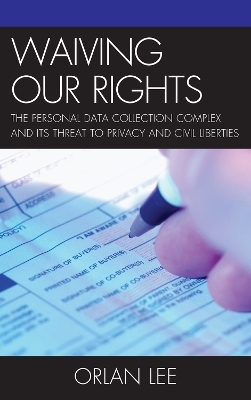
Waiving Our Rights
Lexington Books (Verlag)
978-0-7391-6799-1 (ISBN)
- Titel ist leider vergriffen;
keine Neuauflage - Artikel merken
The United States is not a police state, but Congress is subject to special interests lobbying in pursuit of abusive commercial practices that leave a lot to be desired for transparency and accountability. It is illegal to data-mine personal files held by government agencies, schools and universities, or medical facilities. It is illegal to collect and publish defamatory gossip and hearsay about private citizens. But it is legal to oblige Americans to “waive” their rights to privacy and their right to sue for invasion of privacy for defamation by anonymous third-parties in order to receive essential services or apply for employment.
Americans are obliged to “waive” their rights in essentially all applications for employment, credit, housing, public utilities, telephone or mobile phone service, internet access, and even cable TV connection. The law requires “notice and consent” whenever such waivers are included in employment applications, but consumer reporting agencies have learned to use deceptive methods to avoid drawing the attention of applicants to the meaning and consequence of such language. Recent law dispenses with “notice and consent” for private-eye quasi-criminal investigations of “suspected misconduct” by an employee altogether. In effect, this bypasses "probable cause," "innocent until proven guilty," the "right to know the nature of an accusation," the "right to confront witnesses," the "rule against double jeopardy," and the "right to sue for defamation, and/or interference with employment." Orlan Lee questions the validity of any such "waivers," and seeks to alert Americans to the need to protect their fundamental rights.
Orlan Lee is professor in the School of Management of the New York Institute of Technology, and life member of Clare Hall in the University of Cambridge.
Preface:Crisis in the Personal Data CollectionComplex
Acknowledgments
Chapter 1: What Ever Became of the Fourth, Fifth, and Sixth Amendments?
Chapter 2: From:“Collecting and Transmitting Credit Information,”
To: “Assessing, Attitude, Motivation, and Behavior”
Chapter 3: Arbitrary and Capricious Standards Will Be Used Arbitrarily and Capriciously
Chapter 4: Validity of “Voluntary Waiver” of Basic Civil and Constitutional Rights in Employment and Financial Transactions
Chapter 5: Making a Mockery of “Liberty of Contract”
Chapter 6: Can Congress Authorize a Secret Proprietary Masterfile on Every American?
Afterword: The New Frontier of Civil Liberties: Mandatory “Voluntary Waivers” of Civil and Constitutional Rights:
Appendix A: A liberal American University Goes Over to Lifetime Surveillance
Appendix B: InfoLink’s List of Federal/State/Court Credit Bureau Files Searches with Their Descriptions
Appendix C: Consent to Ongoing Surveillance by Mobile Phone Operators, Public Utilities Companies, TV Cable Companies, Internet Service Providers, . . .
Appendix D: Model Authorization to Verify Information
The Author
Index of Names
Index of Cases
Index of Statutes
| Sprache | englisch |
|---|---|
| Maße | 159 x 235 mm |
| Gewicht | 608 g |
| Themenwelt | Recht / Steuern ► EU / Internationales Recht |
| Sozialwissenschaften ► Politik / Verwaltung ► Staat / Verwaltung | |
| Wirtschaft ► Volkswirtschaftslehre ► Wirtschaftspolitik | |
| ISBN-10 | 0-7391-6799-5 / 0739167995 |
| ISBN-13 | 978-0-7391-6799-1 / 9780739167991 |
| Zustand | Neuware |
| Informationen gemäß Produktsicherheitsverordnung (GPSR) | |
| Haben Sie eine Frage zum Produkt? |
aus dem Bereich