


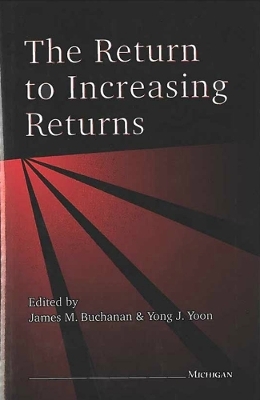
The Return to Increasing Returns
Seiten
1994
The University of Michigan Press (Verlag)
978-0-472-10432-1 (ISBN)
The University of Michigan Press (Verlag)
978-0-472-10432-1 (ISBN)
- Titel z.Zt. nicht lieferbar
- Versandkostenfrei
- Auch auf Rechnung
- Artikel merken
Makes available important articles on increasing returns as related to the size of the economy
The wealth of a nation depends on the division of labor, and the division of labor depends on the extent of the market. Adam Smith advanced this proposition in 1776, but neoclassical economists, in particular, have had difficulty incorporating it into conversational models. Increasing returns, as related to the size of the market nexus, have never found a secure place in economic theory, despite early efforts by Adam Smith, Alfred Marshall, and Allyn Young.
The neoclassical theory of distribution, developed in the last decades of the nineteenth century, relies on the postulate that in equilibrium there exist constant returns to scale, not only in particular firms and industries, but in the economy as a whole. As general equilibrium theory developed, emphasis was sifted to the properties of equilibrium, to the proofs of its existence, and to the attributes of welfare. The possibility of increasing returns represented an analytical “monkey wrench” thrown in the whole neoclassical structure. Thus, the neglect of increasing returns may have been methodologically understandable – if scientifically scandalous. Only in recent years has the increasing returns postulate returned to the mainstream through analyses of endogenous growth, international trade, unemployment, and the economics of ethics.
The wealth of a nation depends on the division of labor, and the division of labor depends on the extent of the market. Adam Smith advanced this proposition in 1776, but neoclassical economists, in particular, have had difficulty incorporating it into conversational models. Increasing returns, as related to the size of the market nexus, have never found a secure place in economic theory, despite early efforts by Adam Smith, Alfred Marshall, and Allyn Young.
The neoclassical theory of distribution, developed in the last decades of the nineteenth century, relies on the postulate that in equilibrium there exist constant returns to scale, not only in particular firms and industries, but in the economy as a whole. As general equilibrium theory developed, emphasis was sifted to the properties of equilibrium, to the proofs of its existence, and to the attributes of welfare. The possibility of increasing returns represented an analytical “monkey wrench” thrown in the whole neoclassical structure. Thus, the neglect of increasing returns may have been methodologically understandable – if scientifically scandalous. Only in recent years has the increasing returns postulate returned to the mainstream through analyses of endogenous growth, international trade, unemployment, and the economics of ethics.
| Erscheint lt. Verlag | 31.3.1994 |
|---|---|
| Zusatzinfo | figures, tables |
| Verlagsort | Ann Arbor |
| Sprache | englisch |
| Maße | 152 x 229 mm |
| Themenwelt | Wirtschaft ► Allgemeines / Lexika |
| Wirtschaft ► Volkswirtschaftslehre ► Mikroökonomie | |
| ISBN-10 | 0-472-10432-2 / 0472104322 |
| ISBN-13 | 978-0-472-10432-1 / 9780472104321 |
| Zustand | Neuware |
| Informationen gemäß Produktsicherheitsverordnung (GPSR) | |
| Haben Sie eine Frage zum Produkt? |
Mehr entdecken
aus dem Bereich


aus dem Bereich
Wirtschaftszusammenhänge verstehen und mitreden können
Buch | Softcover (2023)
Wiley-VCH (Verlag)
CHF 27,95
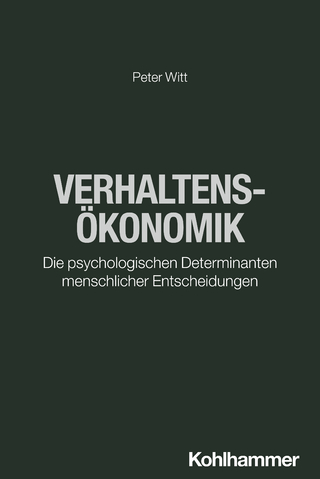
die psychologischen Determinanten menschlicher Entscheidungen
Buch | Softcover (2024)
Kohlhammer (Verlag)
CHF 54,60


