


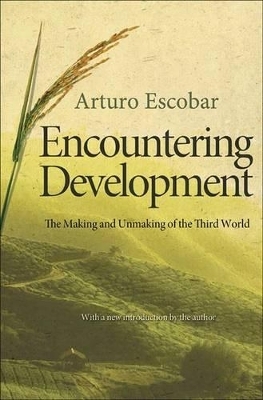
Encountering Development
The Making and Unmaking of the Third World
Seiten
2011
|
Revised edition
Princeton University Press (Verlag)
9780691150451 (ISBN)
Princeton University Press (Verlag)
9780691150451 (ISBN)
Answers questions such as: How did the industrialized nations of North America and Europe come to be seen as the appropriate models for post-World War II societies in Asia, Africa, and Latin America? How did the postwar discourse on development actually create the so-called Third World? And what will happen when development ideology collapses?
How did the industrialized nations of North America and Europe come to be seen as the appropriate models for post-World War II societies in Asia, Africa, and Latin America? How did the postwar discourse on development actually create the so-called Third World? And what will happen when development ideology collapses? To answer these questions, Arturo Escobar shows how development policies became mechanisms of control that were just as pervasive and effective as their colonial counterparts. The development apparatus generated categories powerful enough to shape the thinking even of its occasional critics while poverty and hunger became widespread. "Development" was not even partially "deconstructed" until the 1980s, when new tools for analyzing the representation of social reality were applied to specific "Third World" cases. Here Escobar deploys these new techniques in a provocative analysis of development discourse and practice in general, concluding with a discussion of alternative visions for a postdevelopment era.
Escobar emphasizes the role of economists in development discourse--his case study of Colombia demonstrates that the economization of food resulted in ambitious plans, and more hunger. To depict the production of knowledge and power in other development fields, the author shows how peasants, women, and nature became objects of knowledge and targets of power under the "gaze of experts." In a substantial new introduction, Escobar reviews debates on globalization and postdevelopment since the book's original publication in 1995 and argues that the concept of postdevelopment needs to be redefined to meet today's significantly new conditions. He then calls for the development of a field of "pluriversal studies," which he illustrates with examples from recent Latin American movements.
How did the industrialized nations of North America and Europe come to be seen as the appropriate models for post-World War II societies in Asia, Africa, and Latin America? How did the postwar discourse on development actually create the so-called Third World? And what will happen when development ideology collapses? To answer these questions, Arturo Escobar shows how development policies became mechanisms of control that were just as pervasive and effective as their colonial counterparts. The development apparatus generated categories powerful enough to shape the thinking even of its occasional critics while poverty and hunger became widespread. "Development" was not even partially "deconstructed" until the 1980s, when new tools for analyzing the representation of social reality were applied to specific "Third World" cases. Here Escobar deploys these new techniques in a provocative analysis of development discourse and practice in general, concluding with a discussion of alternative visions for a postdevelopment era.
Escobar emphasizes the role of economists in development discourse--his case study of Colombia demonstrates that the economization of food resulted in ambitious plans, and more hunger. To depict the production of knowledge and power in other development fields, the author shows how peasants, women, and nature became objects of knowledge and targets of power under the "gaze of experts." In a substantial new introduction, Escobar reviews debates on globalization and postdevelopment since the book's original publication in 1995 and argues that the concept of postdevelopment needs to be redefined to meet today's significantly new conditions. He then calls for the development of a field of "pluriversal studies," which he illustrates with examples from recent Latin American movements.
Arturo Escobar is the Kenan Distinguished Professor of Anthropology at the University of North Carolina, Chapel Hill. His most recent book is "Territories of Difference".
Preface to the 2012 Edition vii Preface xlv CHAPTER 1: Introduction: Development and the Anthropology of Modernity 3 CHAPTER 2: The Problematization of Poverty: The Tale of Three Worlds and Development 21 CHAPTER 3: Economics and the Space of Development: Tales of Growth and Capital 55 CHAPTER 4: The Dispersion of Power: Tales of Food and Hunger 102 CHAPTER 5: Power and Visibility: Tales of Peasants, Women, and the Environment 154 CHAPTER 6: Conclusion: Imagining a Postdevelopment Era 212 Notes 227 References 249 Index 275
| Erscheint lt. Verlag | 30.10.2011 |
|---|---|
| Verlagsort | New Jersey |
| Sprache | englisch |
| Maße | 152 x 235 mm |
| Gewicht | 454 g |
| Themenwelt | Sozialwissenschaften ► Soziologie ► Spezielle Soziologien |
| Wirtschaft ► Volkswirtschaftslehre ► Makroökonomie | |
| ISBN-13 | 9780691150451 / 9780691150451 |
| Zustand | Neuware |
| Informationen gemäß Produktsicherheitsverordnung (GPSR) | |
| Haben Sie eine Frage zum Produkt? |
Mehr entdecken
aus dem Bereich



aus dem Bereich
eine Einführung
Buch | Softcover (2024)
De Gruyter Oldenbourg (Verlag)
CHF 41,90
Antisemitismus und postkoloniale Debatte auf der documenta fifteen
Buch | Softcover (2025)
Campus (Verlag)
CHF 41,95
Bullshit als politische Strategie
Buch | Softcover (2025)
Kohlhammer (Verlag)
CHF 33,55


