


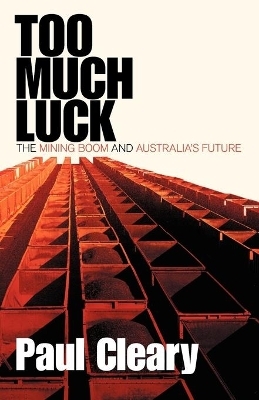
Too Much Luck: The Mining Boom and Australia's Future
Seiten
2011
Black Inc. (Verlag)
9781863955379 (ISBN)
Black Inc. (Verlag)
9781863955379 (ISBN)
- Keine Verlagsinformationen verfügbar
- Artikel merken
Shows that the resources boom, which seems like a blessing, has the potential to become a curse unless our governments take urgent action. This title maps out the pitfalls, considers what has worked overseas, and suggests a better way forward.
'We think we are the lucky country, but what we really have is dumb luck - a lot of luck without the planning or strategy to make sure our good fortune lasts.' - Paul Cleary In Too Much Luck, Paul Cleary shows that the resources boom, which seems like a blessing, has the potential to become a curse - unless our governments take urgent action. Today, under-taxed and under-regulated multinational companies make a tidy profit by selling off our non-renewable resources. As the mining boom accelerates, it will drive the dollar sky-high, forcing up the cost of doing business for everybody. Industries such as tourism and education - industries that, unlike mining, involve many jobs - will fade away. But what happens if commodity prices suddenly collapse, as they did with the GFC in 2008; or worse, when the resources run out? Many countries before us have been caught by the resources trap- a heady period of boom and growth, followed by a painful bust. Paul Cleary maps out the pitfalls, considers what has worked overseas, and suggests a better way forward.
'We think we are the lucky country, but what we really have is dumb luck - a lot of luck without the planning or strategy to make sure our good fortune lasts.' - Paul Cleary In Too Much Luck, Paul Cleary shows that the resources boom, which seems like a blessing, has the potential to become a curse - unless our governments take urgent action. Today, under-taxed and under-regulated multinational companies make a tidy profit by selling off our non-renewable resources. As the mining boom accelerates, it will drive the dollar sky-high, forcing up the cost of doing business for everybody. Industries such as tourism and education - industries that, unlike mining, involve many jobs - will fade away. But what happens if commodity prices suddenly collapse, as they did with the GFC in 2008; or worse, when the resources run out? Many countries before us have been caught by the resources trap- a heady period of boom and growth, followed by a painful bust. Paul Cleary maps out the pitfalls, considers what has worked overseas, and suggests a better way forward.
Authors Bio, not available
| Erscheint lt. Verlag | 2.8.2011 |
|---|---|
| Verlagsort | Melbourne |
| Sprache | englisch |
| Maße | 132 x 199 mm |
| Gewicht | 185 g |
| Themenwelt | Sozialwissenschaften |
| Technik ► Bergbau | |
| Wirtschaft ► Volkswirtschaftslehre ► Wirtschaftspolitik | |
| ISBN-13 | 9781863955379 / 9781863955379 |
| Zustand | Neuware |
| Informationen gemäß Produktsicherheitsverordnung (GPSR) | |
| Haben Sie eine Frage zum Produkt? |
Mehr entdecken
aus dem Bereich

aus dem Bereich
Wohlstand, Wachstum, Wettbewerb
Buch | Softcover (2025)
Kohlhammer (Verlag)
CHF 68,90
mit Marx, Menger und Marshall durch die Grundlagen der Ökonomie
Buch | Hardcover (2025)
De Gruyter Oldenbourg (Verlag)
CHF 62,90
Wurzeln und Perspektiven
Buch | Softcover (2025)
Kohlhammer (Verlag)
CHF 44,75


