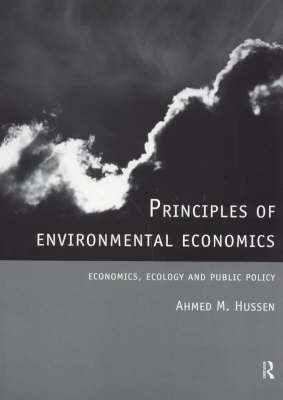
Principles of Environmental Economics
Routledge (Verlag)
978-0-415-19571-3 (ISBN)
- Titel erscheint in neuer Auflage
- Artikel merken
This text offers a systematic exposition of environmental and natural resource economics. It presents the economic and ecological principles essential for a clear understanding of contemporary environmental and natural resource issues and policy considerations. Environmental and natural resource issues are considered in a broad, interdisciplinary context that does not treat them as just another subset of applied economics. The main subject areas include:
* basic economic concepts specifically relevant to environmental economics
* the economics of natural resource scarcity
* ecology, economics and the biophysical constraints to economic growth
* ecological economics
* the economics of sustainable development
* the economics of pollution
* valuing the environment
* the economics of natural resources
* population, development and the environment.
The author develops specific tools to illuminate the central problems of environmental economics. Fundamental economic concepts specifically relevant to environmental and resource economics are introduced and then integrated with ecological principles and approaches. This text presents an integrated understanding of environmental and resource economics that acknowledges the disciplinary tie between economics and ecology. This student-friendly textbook includes a variety of study tools including case studies, revision questions and discussion questions.
Written in a clear and accessible style, Principles Of Environmental and Natural Resource Economics considers a variety of real world examples to illustrate the policy relevance and implications of key economic and ecological concepts.
Acknowledgment; List of Case Studies; List of Exhibits; List of Tables; Preface; Introduction Part I The "Preanalytic" Vision of Natural Resources: The Standard Economic Perspective Chapter 1 The Concept of Resources and Resource Scarcity: An Economic Perspective: Learning Objectives 1.1 Introduction; 1.2 The Concept of Resources; 1.3 Scarcity and Its Economic Implications; 1.4 A Schematic View of the Economic Process; 1.5 Applying the Concepts: Ecotourism, Cattle Ranching and the Economic of Costa Rica; 1.6Chapter Summary; Review and Discussion Questions Part II Markets, Efficiency, Technology, and Alternative Economic Indicators of Natural Resource Scarcity Chapter 2 Resource Scarcity, Economic Efficiency and Markets: How the Invisible Hand Works Learning Objectives; 2.1 Introduction; 2.2 Basic Assumptions; 2.3 An Interpretative Analysis of Demand, Supply and Market Equilibrium Price; 2.4 Evaluating the Performance of a Perfectly Competitive Market Economy; 2.4-1 Consumer Surplus; 2.4-2 Producer Surplus and Net Social Benefit; 2.4-3 Pareto Optimality and the Invisible Hand Theorem; 2.5 Product Price as a Measure of Resource Scarcity; 2.6 Chapter Summary; Review and Discussion Questions Chapter 3 Market Signals of Natural Resource Scarcity: Resource Price, Rent, and Extraction Cost Learning Objectives; 3.1 Introduction; 3.2 The Demand for a Factor of Production: The Case of Natural Resources; 3.3 Key Variables Affecting the Supply of a Factor of Production: The Case of Natural Resources; 3.4 Long-run Market Valuation of a Factor of Production; 3.5 Rent and Extraction Cost an Alternative Measures of Natural Resource Scarcity; 3.5-1 Differential Rent Extraction Cost; 3.6 Factor Substitution Possibilities, Technological Changes and Resource Scarcity; 3.7 Important Caveats 3.8 Chapter Summary; Review and Discussion Questions Part III Ecology: The Economics of Nature Chapter 4 The Concept of Natural Resources: An Ecological Perspective Learning Objectives; 4.1 Introduction; 4.2 Ecosystems Structure; 4.3 Ecosystem Function; 4.3-1 Material Recycling; 4.3-2 Succession, Equilibrium, Stability, Resilience and Complexity; 4.4 The Laws of Matter and Energy; 4.5 The Basic Lessons of Ecology; 4.6 Humanity as the Breaker of Climaxes; 4.7 Chapter Summary; Review and Discussion Questions Part IV Fundamentals of the Economics of Environmental ResourcesChapter 5 Markets, Externality, and the Optimal Trade-Offs between Environmental Quality and Environmental Goods Learning Objectives; 5.1 Introduction; 5.2 The Economic Process and the Assimilative Capacity of the Natural Environment; 5.3 Common Property Resources, External Costs and Market Failure; 5.3-1 Common Property Resources and the Economic Problem; 5.3-2 Environmental Externalities and Their Economic Consequences; 5.4 Internalizing Externality Using the Pigouvian Tax Approach; 5.5 The Macroeconomic Effects of Environmental Regulations: An overvi
| Erscheint lt. Verlag | 9.9.1999 |
|---|---|
| Verlagsort | London |
| Sprache | englisch |
| Maße | 174 x 246 mm |
| Gewicht | 794 g |
| Themenwelt | Wirtschaft ► Volkswirtschaftslehre |
| ISBN-10 | 0-415-19571-3 / 0415195713 |
| ISBN-13 | 978-0-415-19571-3 / 9780415195713 |
| Zustand | Neuware |
| Informationen gemäß Produktsicherheitsverordnung (GPSR) | |
| Haben Sie eine Frage zum Produkt? |
aus dem Bereich