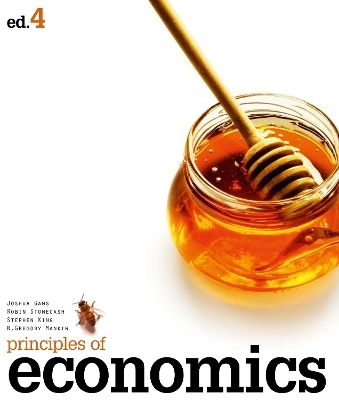
Bundle: Principles of Economics + Global Economic Crisis GEC Resource Center Printed Access Card
Nelson Australia
978-0-17-016011-7 (ISBN)
- Titel ist leider vergriffen;
keine Neuauflage - Artikel merken
Shortlisted for 2009 Australian Educational Publishing Awards.
Showing the power of economic tools and the importance of economic ideas, this forth edition of Principles of Economics continues to focus on what is truly important for students to learn in their first economics course.
With an engaging approach to the study of the economy, the text returns to applications and policy questions as often as possible, encouraging students to relate ecomonic theory to their own experiences. Designed for students in Australia and New Zealand, this new edition incorporates contemporary topics such as global warming, outsourcing, work quality, poverty and immigration, the effects of the US sub-prime market, increased trading with China and India, the RBA, interest rates and monetary policy.
Comprehensively revised and updated, the text enables students to understand the important foundations of economic analysis in a practical real-world context.
Joshua Gans holds the Skoll Chair in Innovation and Entrepreneurship at the Rotman School of Management, University of Toronto; he was previously Professor of Management (information Economics) at the Melbourne Business School. He studied economics at the University of Queensland and Stanford University. He currently teaches network and digital marketing strategy, but prior to his relocation to Canada he taught introductory economics and incentive theory to MBA students. Joshua Gans holds the Skoll Chair in Innovation and Entrepreneurship at the Rotman School of Management, University of Toronto; he was previously Professor of Management (information Economics) at the Melbourne Business School. He studied economics at the University of Queensland and Stanford University. He currently teaches network and digital marketing strategy, but prior to his relocation to Canada he taught introductory economics and incentive theory to MBA students. Stephen King is a Commissioner with Australia’s Productivity Commission and a Professor of Economics at Monash University. He has previously been Dean of Business and Economics at Monash University, a member of the Economic Regulation Authority of Western Australia, a member of the National Competition Council and a Commissioner at the Australian Competition and Consumer Commission. Stephen has taught a variety of courses, including introductory economics for 11 years at Harvard University, Monash University and the University of Melbourne. Professor King has researched and published in a wide range of areas, including law and economics, game theory, corporate finance, and industrial economics. Stephen regularly provides advice to government, private firms and the courts on a range of issues relating to regulation and competition policy. He is a Lay Member of the High Court of New Zealand and a Fellow of the Academy of Social Sciences in Australia. Stephen King is a Commissioner with Australia’s Productivity Commission and a Professor of Economics at Monash University. He has previously been Dean of Business and Economics at Monash University, a member of the Economic Regulation Authority of Western Australia, a member of the National Competition Council and a Commissioner at the Australian Competition and Consumer Commission. Stephen has taught a variety of courses, including introductory economics for 11 years at Harvard University, Monash University and the University of Melbourne. Professor King has researched and published in a wide range of areas, including law and economics, game theory, corporate finance, and industrial economics. Stephen regularly provides advice to government, private firms and the courts on a range of issues relating to regulation and competition policy. He is a Lay Member of the High Court of New Zealand and a Fellow of the Academy of Social Sciences in Australia. Robin Stonecash has recently retired from her position as Executive Dean of the Faculty of Business Law and Arts at Southern Cross University. She was previously Director of Executive Education and the Global EMBA at the University of Sydney’s Business School and Director of Executive Education at the Business School at the University of Technology, Sydney, as well as Director of Stonecash Associates, a boutique consulting firm. She studied economics at Swarthmore College, the University of Wisconsin and the University of New South Wales. She currently consults on strategy and negotiation as well as teaching economics, strategy and negotiation to business owners. Professor Stonecash’s research interests currently focus on agribusiness in Australia and New Zealand and the impact of sustainability in the agricultural sector. N. Gregory Mankiw is the Robert M. Beren Professor of Economics at Harvard University. For 14 years he taught EC10 Principles, the most popular course at Harvard. Dr. Mankiw studied economics at Princeton University and MIT. He is a prolific writer and a regular participant in academic and policy debates. His research includes work on price adjustment, consumer behavior, financial markets, monetary and fiscal policy and economic growth. Dr. Mankiw's articles have appeared in academic journals such as the American Economic Review, Journal of Political Economy and Quarterly Journal of Economics. His work has also appeared in more widely accessible forums, including The New York Times, The Washington Post, The Wall Street Journal and Fortune. Dr. Mankiw has been a research associate of the National Bureau of Economic Research, an adviser to the Federal Reserve Bank of Boston and the Congressional Budget Office and a member of the ETS® test development committee for the advanced placement exam in economics. From 2003 to 2005, Dr. Mankiw served as chairman of the President’s Council of Economic Advisers.
Part 1: Introduction
1. Ten lessons from economics
2. Thinking like an economist
3. Interdependence and the gains from trade
Part 2: Supply and demand I: How markets work
4. The market forces of supply and demand
5. Elasticity and its application
6. Supply, demand and government policies
Part 3: Supply and demand II: Markets and welfare
7. Consumers, producers and the efficiency of markets
8. Application: The costs of taxation
9. Application: International trade
Part 4: The economics of the public sector
10. Externalities
11. Public goods and common resources
12. The design of the tax system
Part 5: Firm behaviour and the organisation of industry
13. The costs of production
14. Firms in competitive markets
15. Monopoly
16. Business strategy
17. Competition policy
18. Monopolistic competition
Part 6: The economics of labour markets
19. The markets for the factors of production
20. Earnings, unions and discrimination
21. Income inequity and poverty
Part 7: Topics for further study
22. The theory of consumer choice
23. Frontiers of microeconomics
Part 8: The data of macroeconomics
24. Measuring a nation's income
25. Measuring the cost of living
Part 9: The real economy in the long run
26. Production and growth
27. Saving, investment and the financial system
28. The natural rate of unemployment
Part 10: Money and prices in the long run
29. The monetary system
30. Inflation: Its causes and costs
Part 11: The macroeconomics of open economies
31. Open-economy macroeconomics: Basic concepts
32. A macroeconomic theory of the open economy
Part 12: Short-run economic fluctuations
33. Aggregate demand and aggregate supply
34. The influence of monetary and fiscal policy on aggregate demand
35. The short-run trade-off between inflation and unemployment
Part 8: Final thoughts
36. Five debates over macroeconomic policy
| Erscheint lt. Verlag | 23.4.2010 |
|---|---|
| Sprache | englisch |
| Maße | 215 x 255 mm |
| Gewicht | 1703 g |
| Themenwelt | Wirtschaft ► Volkswirtschaftslehre |
| ISBN-10 | 0-17-016011-4 / 0170160114 |
| ISBN-13 | 978-0-17-016011-7 / 9780170160117 |
| Zustand | Neuware |
| Informationen gemäß Produktsicherheitsverordnung (GPSR) | |
| Haben Sie eine Frage zum Produkt? |
aus dem Bereich