


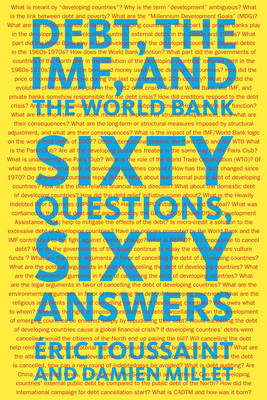
Debt, the IMF and the World Bank
Sixty Questions, Sixty Answers
Seiten
2010
Monthly Review Press,U.S. (Verlag)
978-1-58367-222-8 (ISBN)
Monthly Review Press,U.S. (Verlag)
978-1-58367-222-8 (ISBN)
Millet's name appears first in the French ed.
Mainstream economists tell us that developing countries will replicate the economic achievements of the rich countries if they implement the correct "free-market"policies. But scholars and activists Toussaint and Millet demonstrate that this is patently false. Drawing on a wealth of detailed evidence, they explain how developed economies have systematically and deliberately exploited the less-developed economies by forcing them into unequal trade and political relationships. Integral to this arrangement are the international economic institutions ostensibly created to safeguard the stability of the global economy--the International Monetary Fund (IMF) and the World Bank--and the imposition of massive foreign debt on poor countries. The authors explain in simple language, and ample use of graphics, the multiple contours of this exploitative system, its history, and how it continues to function in the present day.
Ultimately, Toussaint and Millet advocate cancellation of all foreign debt for developing countries and provide arguments from a number of perspectives--legal, economic, moral. Presented in an accessible and easily-referenced question and answer format, Debt, the IMF, and the World Bank is an essential tool for the global justice movement.
Mainstream economists tell us that developing countries will replicate the economic achievements of the rich countries if they implement the correct "free-market"policies. But scholars and activists Toussaint and Millet demonstrate that this is patently false. Drawing on a wealth of detailed evidence, they explain how developed economies have systematically and deliberately exploited the less-developed economies by forcing them into unequal trade and political relationships. Integral to this arrangement are the international economic institutions ostensibly created to safeguard the stability of the global economy--the International Monetary Fund (IMF) and the World Bank--and the imposition of massive foreign debt on poor countries. The authors explain in simple language, and ample use of graphics, the multiple contours of this exploitative system, its history, and how it continues to function in the present day.
Ultimately, Toussaint and Millet advocate cancellation of all foreign debt for developing countries and provide arguments from a number of perspectives--legal, economic, moral. Presented in an accessible and easily-referenced question and answer format, Debt, the IMF, and the World Bank is an essential tool for the global justice movement.
eric Toussaint, a doctor in political science, is president of the Committee for the Abolition of Third World Debt, CADTM Belgium. He is author of A Diagnosis of Emerging Global Crisis and Alternatives and The World Bank: A Critical Primer, among other books. Damien Millet teaches mathematics and is spokespersonfor CADTM France. He is the author of L'Afrique sans dette and co-author with Eric Toussaint of Tsunami Aid or Debt Cancellation.
| Erscheint lt. Verlag | 11.10.2010 |
|---|---|
| Verlagsort | New York |
| Sprache | englisch |
| Maße | 152 x 229 mm |
| Themenwelt | Wirtschaft ► Volkswirtschaftslehre ► Makroökonomie |
| ISBN-10 | 1-58367-222-2 / 1583672222 |
| ISBN-13 | 978-1-58367-222-8 / 9781583672228 |
| Zustand | Neuware |
| Informationen gemäß Produktsicherheitsverordnung (GPSR) | |
| Haben Sie eine Frage zum Produkt? |
Mehr entdecken
aus dem Bereich


aus dem Bereich
Buch | Softcover (2024)
Schäffer-Poeschel (Verlag)
CHF 48,95
Makroökonomie, Wirtschaftspolitik und nachhaltige Entwicklung
Buch | Hardcover (2022)
Vahlen (Verlag)
CHF 69,70
Kontroversen, Daten und Fakten zur Nachhaltigkeit
Buch | Softcover (2025)
Kohlhammer (Verlag)
CHF 54,60


