


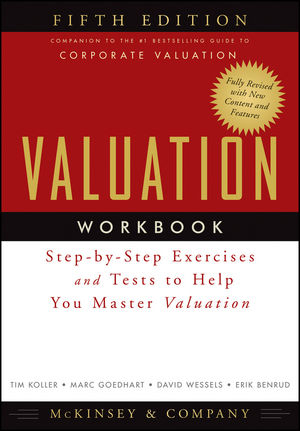
Valuation Workbook
John Wiley & Sons Ltd (Verlag)
978-0-470-42464-3 (ISBN)
- Titel ist leider vergriffen;
keine Neuauflage - Artikel merken
McKinsey & Company is a management consulting firm that helps leading corporations and organizations make distinctive, lasting, and substantial improvements in their performance. Over the past seven decades, the firm's primary objective has remained constant: to serve as an organization's most trusted external advisor on critical issues facing senior management. Tim Koller is a partner in McKinsey's New York office. Tim has served clients in North America and Europe on corporate strategy and issues concerning capital markets, M&A transactions, and value-based management. He leads the firm's research activities in valuation and capital markets issues. He received his MBA from the University of Chicago. Marc Goedhart is an associate principal in McKinsey's Amsterdam office. Marc has served clients across Europe on portfolio restructuring, issues concerning capital markets, and M&A transactions. He received a PhD in finance from Erasmus University Rotterdam. David Wessels is an adjunct professor of finance and director of executive education at the Wharton School of the University of Pennsylvania. Named by BusinessWeek as one of America's top business school instructors, he teaches corporate valuation at the MBA and Executive MBA levels. David received his PhD from the University of California at Los Angeles. Erik Benrud is a clinical full professor of finance and the CFA Review Coordinator and Advisor at Drexel University. His research has appeared in many peer-reviewed journals, and he has won teaching and research awards from Association to Advance Collegiate Schools of Business (AACSB)-accredited universities. He consults and has delivered seminars on finance around the world. Erik received his PhD from the University of Virginia where he also taught finance.
About the Authors ix Introduction xi Part One Questions 1 Why Value Value? 3 2 Fundamental Principles of Value Creation 6 3 The Expectations Treadmill 9 4 Return on Invested Capital 12 5 Growth 15 6 Frameworks for Valuation 18 7 Reorganizing the Financial Statements 22 8 Analyzing Performance and Competitive Position 26 9 Forecasting Performance 30 10 Estimating Continuing Value 35 11 Estimating the Cost of Capital 40 12 Moving from Enterprise Value to Value per Share 44 13 Calculating and Interpreting Results 48 14 Using Multiples to Triangulate Results 52 15 Market Value Tracks Return on Invested Capital and Growth 55 16 Markets Value Substance, Not Form 59 17 Emotions and Mispricing in the Market 63 18 Investors and Managers in Efficient Markets 66 19 Corporate Portfolio Strategy 70 20 Performance Management 73 21 Mergers and Acquisitions 77 22 Creating Value through Divestitures 82 23 Capital Structure 86 24 Investor Communications 90 25 Taxes 94 26 Nonoperating Expenses, One-Time Charges, Reserves, and Provisions 97 27 Leases, Pensions, and Other Obligations 101 28 Capitalized Expenses 105 29 Inflation 107 30 Foreign Currency 114 31 Case Study: Heineken 117 32 Valuing Flexibility 123 33 Valuation in Emerging Markets 126 34 Valuing High-Growth Companies 129 35 Valuing Cyclical Companies 132 36 Valuing Banks 142 Part Two Answers 1 Why Value Value? 149 2 Fundamental Principles of Value Creation 150 3 The Expectations Treadmill 152 4 Return on Invested Capital 154 5 Growth 156 6 Frameworks for Valuation 158 7 Reorganizing the Financial Statements 160 8 Analyzing Performance and Competitive Position 162 9 Forecasting Performance 164 10 Estimating Continuing Value 167 11 Estimating the Cost of Capital 170 12 Moving from Enterprise Value to Value per Share 172 13 Calculating and Interpreting Results 174 14 Using Multiples to Triangulate Results 176 15 Market Value Tracks Return on Invested Capital and Growth 178 16 Markets Value Substance, Not Form 180 17 Emotions and Mispricing in the Market 182 18 Investors and Managers in Efficient Markets 184 19 Corporate Portfolio Strategy 186 20 Performance Management 188 21 Mergers and Acquisitions 190 22 Creating Value through Divestitures 192 23 Capital Structure 194 24 Investor Communications 197 25 Taxes 199 26 Nonoperating Expenses, One-Time Charges, Reserves, and Provisions 201 27 Leases, Pensions, and Other Obligations 204 28 Capitalized Expenses 207 29 Inflation 209 30 Foreign Currency 216 31 Case Study: Heineken 219 32 Valuing Flexibility 224 33 Valuation in Emerging Markets 226 34 Valuing High-Growth Companies 228 35 Valuing Cyclical Companies 231 36 Valuing Banks 238
| Reihe/Serie | Wiley Finance Editions |
|---|---|
| Verlagsort | Chichester |
| Sprache | englisch |
| Maße | 178 x 254 mm |
| Gewicht | 428 g |
| Themenwelt | Wirtschaft ► Betriebswirtschaft / Management ► Finanzierung |
| ISBN-10 | 0-470-42464-8 / 0470424648 |
| ISBN-13 | 978-0-470-42464-3 / 9780470424643 |
| Zustand | Neuware |
| Informationen gemäß Produktsicherheitsverordnung (GPSR) | |
| Haben Sie eine Frage zum Produkt? |
aus dem Bereich


