


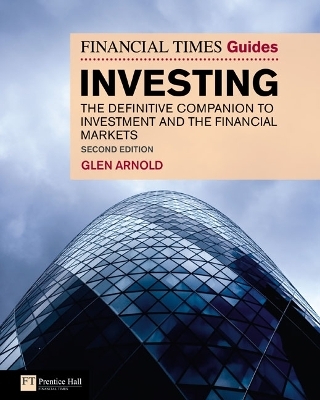
The Financial Times Guide to Investing
Pearson Education Limited (Verlag)
978-0-273-72374-5 (ISBN)
- Titel erscheint in neuer Auflage
- Artikel merken
The second edition of this bestselling introduction to investing explains how the financial markets operate, shows you what you need to know to be successful and encourages you to follow and act on your own judgements. Thoroughly updated to help you invest with skill and confidence, new sections include:
Online investing, website information and tools including screenshots and virtual portfolios as well as computerised counterparty trading
Detailed updating of tax rates and legislation, increases in ISA allowances and revisions to capital gains tax
A jargon-busting glossary to help you understand words, phrases and investing concepts
Recent Financial Times articles and tables which illustrate and expand on case studies and examples
Up-to-date statistics on the returns you can expect on shares and bonds
Investing can be profitable and fun and The Financial Times Guide to Investing 2nd edition, explains step-by-step both the essentials of investing as well as describing how the financial markets really work. It details the practicalities of investing, such as how to go about buying shares and describes the variety of financial securities you can buy, from bonds and unit trusts through to exchange traded funds.
Exploding the myths that only the wealthy can afford to buy and sell shares and showing you why you can be just as successful trading on your own as you would be by employing a fund manager, this authoritative guide book will help you build a profitable personal financial portfolio.
What is investment
The rewards of investment
Understanding stock markets
Using the financial media
Buying and selling shares
Pooled investments
Investing in bonds
Futures and options
Financial spreadbetting
Analysing companies and industries
Mastering company reports and accounts
Key investment ratios and measures
Ticks of the accounting trade
Managing your portfolio
Mergers and takeovers
Taxation and investors
Measuring performance
Investor protection
Investment clubs
Glen Arnold is a businessman, investor and a professor of finance at Salford University. Hes the author of numerous finance and investing books including Corporate Financial Management, The Handbook of Corporate Finance and The Financial Times Guide to Value Investing, all published by Financial Times-Prentice Hall.
Foreword
Whats new in the second edition
Introduction
PART I INVESTMENT BASICS
Chapter 1 What is investment?
Partnerships; Limited liability; Ordinary shares and extraordinary returns; Shareholder rights; A money-making machine; Dividends and retained earnings; What if I want to sell?; Primary and secondary markets; Bonds; Capital structure; Stocks and shares; Rights issues; Financial institutions; Be proud to be a capitalist!; A note of warning: investment and speculation
Chapter 2 The rewards of investment
Becoming a millionaire; Simple and compound interest; How well have investors fared in the past?; The importance of income; International comparison; Equities versus gilts; What about risk?; Closing comment; Further reading
Chapter 3 Stock markets
What is a stock market?; Brokers and market makers; Pricing good old supply and demand; A short history of the London Stock Exchange; Big Bang; The international scene; Variety of securities traded; The primary market; The secondary market; The Main Market(The Official List); The Alternative Investment Market; techMARK and the other MARKs; PLUS; Other trading facilities; Who owns UK shares?; The role of stock exchanges; Useful websites
Chapter 4 Buying and selling shares
Stockbroker services; Choosing a stockbroker; Finding prices; Getting the most out of websites; What happens when I buy or sell shares?; An alternative mechanism; A third trading system; What happens after dealing?; Ways of paying for your shares; Internet dealing; Transferring shares without brokers; Further reading
PART II THE INVESTMENT SPECTRUM
Chapter 5 Pooled investments
Unit trusts; Open-ended investment companies (OEICs); Exchange traded funds (ETFs); Investment trusts (investment companies); With-profits policies; Unit-linked policies; Insurance company bonds; Stock market-linked bonds; Money markets; Hedge funds; Fund supermarkets; Bringing home the significance of high fees
Chapter 6 Bonds
Gilts; Corporate bonds; Credit rating; High-yield (junk) bonds; Convertible bonds; Foreign bonds; Eurobonds
Chapter 7 Unusual share investment
Business angels; Venture capital and other private equity; Private equity categories; Overseas shares; Preference shares
Chapter 8 Options
What is a derivative?; What is an option?; Share options; Call option holders (call option buyers); Call option writers; An example of an option writing strategy; LIFFE share options; Put options; How to trade options; Using share options to reduce risk: hedging; Using options to reduce losses; Index options; Further reading; Websites
Chapter 9 Futures
Marking to market and margins; Settlement; Buying and selling futures; Universal stock futures (single stock futures)
Chapter 10 Spread betting, contracts for difference and warrants
Spread betting; Contracts for difference; Warrants; Covered warrants; Further reading; Websites
PART III COMPANY ANALYSIS
Chapter 11 Company accounts
Oh no! Not numbers again!; How to obtain reports; The report and accounts; Profit and loss account; Balance sheet; Cash flow statement; Chairmans statement; Chief executives review; Directors report and business review; Auditors report; Five-year summary; Trading statement; Further reading
Chapter 12 Key investment ratios and measures
From the financial pages; Performance ratios and measures; Financial health ratios and measures; Forward-looking measures; Further reading
Chapter 13 Some of the tricks of the accounting trade
Goodwill; Fair value; What was our revenue again?; Exceptional items; Stock (inventory) valuation; Depreciation; Capitalisation; Off-balance-sheet items; Share (stock) options; Other tricks; Concluding comment; Further reading
Chapter 14 Analysing industries
The competitive floor; The five competitive forces; Threat of entry; Intensity of rivalry of existing companies; The threat from substitutes ;Buyer (customer) power; Supplier power; Industry evolution; Concluding comments; Further reading
Chapter 15 The competitive position of the firm
The TRRACK system; What makes resources extraordinary?; Investment in resources; Leveraging resources and over-exploiting them; Concluding comments; Further reading
PART IV MANAGING YOUR PORTFOLIO
Chapter 16 Companies issuing shares.
New issues; Rights issues; Other equity issues; Scrip issues; Share buy-backs and special dividends
Chapter 17 Taxation and investors
Stamp duty; Tax on dividends; Capital gains tax; Interest-bearing instruments; Inheritance tax, Individual savings accounts; Personal pensions; Enterprise Investment Scheme; Venture capital trusts; Offshore investment
Chapter 18 Mergers and takeovers
Merger motives; Financing mergers; The rules of the takeover game; Who wins from mergers?; Final comment: Why do mergers fail?; Further reading
Chapter 19 Investor protection
Protecting investors from wayward financial service professionals; Regulation of markets; Regulating of companies; Self-protection
Chapter 20 Measuring performance: indices and risk
Indices; Risk; Diversifiable risk; Websites; Further reading
Chapter 21 Investment clubs
How to set up a club; The unit valuation system; Bank account; Brokers; Tax; Further reading
Glossary
List of useful Internet addresses
Index
| Erscheint lt. Verlag | 19.11.2009 |
|---|---|
| Reihe/Serie | The FT Guides |
| Verlagsort | Harlow |
| Sprache | englisch |
| Maße | 189 x 234 mm |
| Gewicht | 1120 g |
| Themenwelt | Wirtschaft ► Betriebswirtschaft / Management ► Finanzierung |
| ISBN-10 | 0-273-72374-X / 027372374X |
| ISBN-13 | 978-0-273-72374-5 / 9780273723745 |
| Zustand | Neuware |
| Informationen gemäß Produktsicherheitsverordnung (GPSR) | |
| Haben Sie eine Frage zum Produkt? |
aus dem Bereich


