


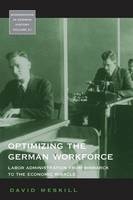
Optimizing the German Workforce
Labor Administration from Bismarck to the Economic Miracle
Seiten
2010
Berghahn Books (Verlag)
978-1-84545-631-3 (ISBN)
Berghahn Books (Verlag)
978-1-84545-631-3 (ISBN)
During the 20th century, German government and industry created a highly skilled workforce as part of an ambitious program to control and develop the country's human resources. Yet, these efforts to match as many workers as possible to skilled vocations and to establish a system of job training have received little scholarly attention, until now.
During the twentieth century, German government and industry created a highly skilled workforce as part of an ambitious program to control and develop the country’s human resources. Yet, these long-standing efforts to match as many workers as possible to skilled vocations and to establish a system of job training have received little scholarly attention, until now. The author’s account of the broad support for this program challenges the standard historical accounts that focus on disagreements over the German political-economic order and points instead to an important area of consensus. These advances are explained in terms of political policies of corporatist compromise and national security as well as industry’s evolving production strategies. By tracing the development of these policies over the course of a century, the author also suggests important continuities in Germany’s domestic politics, even across such different regimes as Imperial, Weimar, Nazi, and post-1945 West Germany.
During the twentieth century, German government and industry created a highly skilled workforce as part of an ambitious program to control and develop the country’s human resources. Yet, these long-standing efforts to match as many workers as possible to skilled vocations and to establish a system of job training have received little scholarly attention, until now. The author’s account of the broad support for this program challenges the standard historical accounts that focus on disagreements over the German political-economic order and points instead to an important area of consensus. These advances are explained in terms of political policies of corporatist compromise and national security as well as industry’s evolving production strategies. By tracing the development of these policies over the course of a century, the author also suggests important continuities in Germany’s domestic politics, even across such different regimes as Imperial, Weimar, Nazi, and post-1945 West Germany.
David Meskill received a Ph.D. in Modern European History from Harvard University. He has published articles on the Labor Administration, applied psychology, and Alexis de Tocqueville. He is currently an Assistant Professor of History at Dowling College.
List of Tables
Abbreviations
Acknowledgements
Introduction
Chapter 1. “Organizing” the Labor Market in the Dynamic Kaiserreich
Chapter 2. Promoting a Skilled Workforce
Chapter 3. Toward Totalerfassung: Creating the National Labor Administration
Chapter 4. Toward the German Skills Machine: Establishing Vocational Counseling and Training
Chapter 5. The Nazi Consolidation of the Human Economies
Chapter 6. The Labor Administration in the Economic Miracle
Conclusion: The Age of Organization
Bibliography
| Reihe/Serie | Monographs in German History |
|---|---|
| Zusatzinfo | Bibliography; Index |
| Verlagsort | Oxford |
| Sprache | englisch |
| Maße | 152 x 229 mm |
| Gewicht | 585 g |
| Themenwelt | Geschichte ► Allgemeine Geschichte ► Neuzeit (bis 1918) |
| Geschichte ► Teilgebiete der Geschichte ► Wirtschaftsgeschichte | |
| Wirtschaft ► Volkswirtschaftslehre ► Makroökonomie | |
| ISBN-10 | 1-84545-631-9 / 1845456319 |
| ISBN-13 | 978-1-84545-631-3 / 9781845456313 |
| Zustand | Neuware |
| Informationen gemäß Produktsicherheitsverordnung (GPSR) | |
| Haben Sie eine Frage zum Produkt? |
Mehr entdecken
aus dem Bereich


aus dem Bereich
Geschichte einer wilden Handlung
Buch | Hardcover (2024)
C.H.Beck (Verlag)
CHF 47,60


