


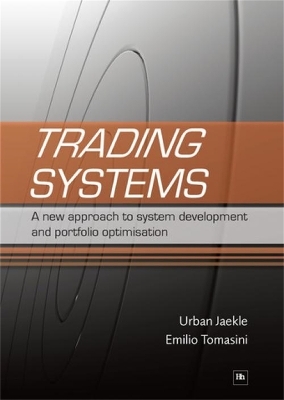
Trading Systems
Harriman House Publishing (Verlag)
978-1-905641-79-6 (ISBN)
- Titel ist leider vergriffen;
keine Neuauflage - Artikel merken
'The key is how to adapt existing codes to the current market conditions, how to build a portfolio and how to know when the moment has come to stop one system and start another one'. Every day there are traders who make a fortune. It may seem that it seldom happens, but it does - as William Eckhardt, Ed Seykota, Jim Simons, and many others remind us. You can join them by using systems to manage your trading. This book explains exactly how you can build a winning trading system. It is an insight into what a trader should know and do in order to achieve success in the markets, and it will show you why you don't need to be a rocket scientist to build a winning trading system. There are three main parts to "Trading Systems". Part One is a short, practical guide to trading systems' development and evaluation. It condenses the authors' years of experience into a number of practical tips. It also forms the theoretical basis for Part Two, in which readers will find a step-by-step development process for building a trading system, covering everything from initial code writing to walk forward analysis and money management.Part Three shows you how to combine a number of trading systems, for all the different markets, into an effective portfolio of systems.
A trader can never really say he was successful, but only that he survived to trade another day; the 'black swan' is always just around the corner. "Trading Systems" will help you find your way through the uncharted waters of systematic trading and show you what it takes to be among those that survive. This is a new approach to system development.
Emilio Tomasini is a proprietary trader for many European banks and hedge funds and Adjunct Professor of Corporate Finance at the University of Bologna, Italy. His website is www.EmilioTomasini.com. Urban Jaekle holds a diploma in physics. He is a regular speaker at the main European trading events and contributes to Traders' and Active Tradermagazine. His main business is to provide trading systems' advisory services for hedge funds and institutional investors - mainly with automated trading systems, portfolio optimisation and money management solutions.
Acknowledgments Preface Part I: A Practical Guide to Trading System Development and Evaluation 1. What is a trading system? 1.1 An easy example of a trading system 1.2 Why you need a trading system 1.3 The science of trading systems 2. Design, test, optimisation and evaluation of a trading system 2.1 Design 2.2 Test 2.3 The forecasting power of a trading system 2.4 Evaluation of a Trading System 2.5 Conclusion PART II: Trading System Development and Evaluation of a Real Case 3. How to develop a trading system step by step - using the example of the British Pound /US dollar pair 3.1 The birth of a trading system 3.2 First evaluation of the trading system 3.3 Variation of the input parameters: optimisation and stability diagrams 3.4 Inserting an intraday time filter 3.5 Determination of appropriate exits - risk management 3.6 Summary: Step-by-step development of a trading system 4. Two methods for evaluating the system's predictive power 4.1 Timescale analysis 4.2 Monte Carlo Analysis 5. The factors around your system 5.1 The market's long/short bias 5.2 Out-of-sample deterioration 5.3 The market data bias 5.4 Optimization and over-fitting 5.5 Rule complexity explained with polynomial curve fitting 6. Periodic re-optimisation and walk forward analysis 6.1 Short repetition: "normal", static optimisation 6.2 Anchored vs. rolling walk forward analysis (WFA) 6.3 Rolling WFA on the LUXOR system 6.4 The meaning of sample size and market structure 7. Position sizing on the example of the LUXOR system 7.1 Definitions: money management vs. risk management 7.2 Application of different MM schemes 7.3 Monte Carlo analysis of the position sized system 7.4 Conclusion Part III: Systematic Portfolio Trading 8. Dynamic Portfolio Construction 8.1 Introduction to Portfolio Construction 8.2 Correlation among equity lines 8.3 A dynamic approach: equity line crossover 8.4 Dynamic portfolio composition: the walk forward analysis activator 8.5 Largest losing trade/largest losing streak/largest drawdown Conclusion Appendices Appendix 1: Bollinger Band system Appendix 2: The Triangle system Appendix 3: Portfolios with the LUXOR trading system Bibliography Index
| Erscheint lt. Verlag | 4.9.2009 |
|---|---|
| Verlagsort | Petersfield |
| Sprache | englisch |
| Maße | 170 x 244 mm |
| Gewicht | 413 g |
| Themenwelt | Wirtschaft ► Betriebswirtschaft / Management ► Finanzierung |
| ISBN-10 | 1-905641-79-6 / 1905641796 |
| ISBN-13 | 978-1-905641-79-6 / 9781905641796 |
| Zustand | Neuware |
| Informationen gemäß Produktsicherheitsverordnung (GPSR) | |
| Haben Sie eine Frage zum Produkt? |
aus dem Bereich


