


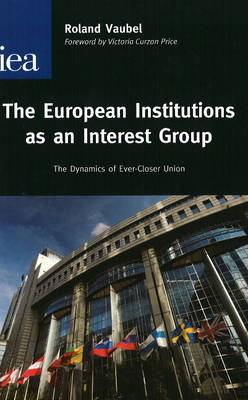
European Institutions as an Interest Group
The Dynamics of Ever-Closer Union
Seiten
2009
Institute of Economic Affairs (Verlag)
978-0-255-36634-2 (ISBN)
Institute of Economic Affairs (Verlag)
978-0-255-36634-2 (ISBN)
The institutions of the European Union are gaining more and more power at the expense of national and local governments, as well as individuals and private businesses. This book explains increasing centralization by analyzing the economic incentives at work.
The institutions of the European Union are gaining more and more power at the expense of national and local governments, as well as individuals and private businesses. There would appear to be no reverse gear in this process, while objections from the general public, as expressed in periodic referenda, tend to be brushed aside. This ground-breaking study explains increasing centralization by analyzing the economic incentives at work. The structure of European institutions means they have a vested interest in ever-closer union because this enhances their influence and prestige. Moreover, the bureaucrats themselves are self-selecting. Those that are pro-EU are more likely to seek positions in these organizations and therefore tend to favor policies which give the institutions more responsibilities. The author sets out a series of reforms designed to counteract the centralizing tendency and to ensure that the role of EU bodies is more closely aligned with the preferences of citizens.
The institutions of the European Union are gaining more and more power at the expense of national and local governments, as well as individuals and private businesses. There would appear to be no reverse gear in this process, while objections from the general public, as expressed in periodic referenda, tend to be brushed aside. This ground-breaking study explains increasing centralization by analyzing the economic incentives at work. The structure of European institutions means they have a vested interest in ever-closer union because this enhances their influence and prestige. Moreover, the bureaucrats themselves are self-selecting. Those that are pro-EU are more likely to seek positions in these organizations and therefore tend to favor policies which give the institutions more responsibilities. The author sets out a series of reforms designed to counteract the centralizing tendency and to ensure that the role of EU bodies is more closely aligned with the preferences of citizens.
Introduction: the driving forces of the centralising dynamic; The European Commission; The European Parliament; The Council -- the government of the member states; The European Court of Justice; Lisbon and the alternatives; The outlook.
| Erscheint lt. Verlag | 4.6.2009 |
|---|---|
| Zusatzinfo | tables |
| Verlagsort | London |
| Sprache | englisch |
| Maße | 200 x 130 mm |
| Gewicht | 128 g |
| Themenwelt | Sozialwissenschaften ► Politik / Verwaltung ► Vergleichende Politikwissenschaften |
| Wirtschaft ► Volkswirtschaftslehre ► Makroökonomie | |
| Schlagworte | Europäische Union (EU) |
| ISBN-10 | 0-255-36634-5 / 0255366345 |
| ISBN-13 | 978-0-255-36634-2 / 9780255366342 |
| Zustand | Neuware |
| Informationen gemäß Produktsicherheitsverordnung (GPSR) | |
| Haben Sie eine Frage zum Produkt? |
Mehr entdecken
aus dem Bereich



aus dem Bereich
Geschichte, Parteistruktur, Radikalisierung
Buch | Softcover (2024)
UTB (Verlag)
CHF 38,95


