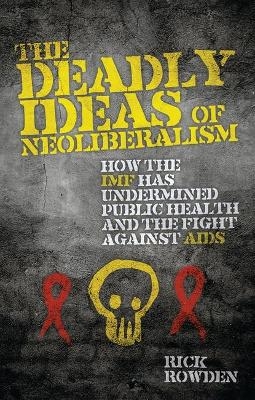
The Deadly Ideas of Neoliberalism
Zed Books Ltd (Verlag)
978-1-84813-285-6 (ISBN)
- Titel ist leider vergriffen;
keine Neuauflage - Artikel merken
'The Deadly Ideas of Neoliberalism' explores the history of and current collision between two of the major global phenomena that have characterized the last 30 years: the spread of HIV/AIDS and other diseases of poverty and the ascendancy of neoliberal economic ideas. The book explains not only how IMF policies of restrictive spending have exacerbated public health problems in developing countries, in particular the HIV/AIDS crisis, but also how such issues cannot be resolved under these economic policies. It also suggests how mounting global frustration about this inability to adequately address HIV/AIDS will ultimately lead to challenges to the dominant neoliberal ideas, as other more effective economic ideas for increasing public spending are sought.
In stark, powerful terms, Rowden offers a unique and in-depth critique of development economics, the political economy dynamics of global foreign aid and health institutions, and how these seemingly abstract factors play out in the real world - from the highest levels of global institutions to African finance and health ministries to rural health outposts in the countryside of developing nations, and back again.
Rick Rowden worked in Washington DC for 9 years with advocacy NGOs engaged on foreign aid and development issues, including as senior policy analyst for the US office of ActionAid. He has travelled extensively and worked with policy makers, economists and advocacy NGOs across Africa, Asia, Latin America and Europe to critically analyze the macroeconomic policies of the International Monetary Fund (IMF) and their impact on health spending in developing countries. With an MA and BA in International Relations from San Francisco State University, he is an expert in North-South relations and how the global foreign aid, trade and finance systems impact economic development. Previously, he taught Global Studies at California State University, Monterey Bay and Political Science at Golden Gate University in San Francisco. Most recently, he was an Inter-Regional Advisor with the Globalization and Development Strategies Division of the United Nations Conference on Trade and Development (UNCTAD) in Geneva, Switzerland. Currently he is pursuing doctoral studies in economics.
Introduction
Part I: Emergence of HIV/AIDS and the Global Response
1. The History of Global Funding to Fight HIV/AIDS
2. The Impact of the AIDS Response on Public Health Systems
3. The Shortage of Health Care Workers and the 'Brain Drain' Problem
4. The Debate Over 'Vertical' vs. 'Horizontal' Donor Aid
5. Different Types of Health Systems, Different Types of Financing
Part II: The Neoliberal Development Model
6. The Reagan Revolution, Structural Adjustment and The Washington Consensus
7. Neoliberal Theory and its Policies
8. The Consequences for Development
Part III: Consequences for Health
9. The Demise of Public Health & Rise of Neoliberalism
10. The Consequences for Health
11. 30 Years Later: Coming Full Circle - Rediscovering Public Health
12. The IMF: Blocking Progress on Public Health
Conclusion
| Erscheint lt. Verlag | 12.11.2009 |
|---|---|
| Sprache | englisch |
| Maße | 138 x 216 mm |
| Themenwelt | Studium ► Querschnittsbereiche ► Infektiologie / Immunologie |
| Studium ► Querschnittsbereiche ► Prävention / Gesundheitsförderung | |
| Sozialwissenschaften ► Politik / Verwaltung ► Politische Systeme | |
| Wirtschaft ► Volkswirtschaftslehre | |
| ISBN-10 | 1-84813-285-9 / 1848132859 |
| ISBN-13 | 978-1-84813-285-6 / 9781848132856 |
| Zustand | Neuware |
| Informationen gemäß Produktsicherheitsverordnung (GPSR) | |
| Haben Sie eine Frage zum Produkt? |
aus dem Bereich