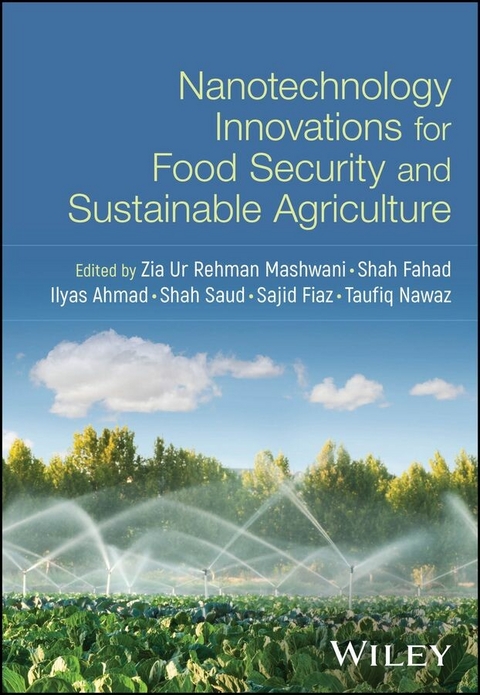
Nanotechnology Innovations for Food Security and Sustainable Agriculture (eBook)
676 Seiten
Wiley (Verlag)
978-1-394-34899-2 (ISBN)
Complete resource covering theory and practical applications to solve modern agricultural challenges and enhance productivity, sustainability, and food safety
Nanotechnology Innovations for Food Security and Sustainable Agriculture addresses the pressing challenges of modern agriculture and food security by demonstrating how nanotechnology can provide innovative solutions. It solves problems related to low crop yields, inefficient pest control, and inadequate food safety measures by introducing advanced nanoscale materials and techniques. By showcasing practical applications of nanotechnology in enhancing soil health, optimizing nutrient delivery, and improving pest management, the book offers strategies to increase agricultural productivity and sustainability.
It also tackles issues in food quality and safety through advanced nano-sensors and packaging solutions, ensuring that food production and distribution are both more efficient and secure. By bridging theoretical knowledge with practical applications, this comprehensive resource provides valuable insights into how nanotechnology can be influenced to achieve sustainable agricultural practices and enhance global food security.
In Nanotechnology Innovations for Food Security and Sustainable Agriculture, readers will find information on:
- Mechanisms, benefits, and future directions of nanofertilizers for soil health and fertility
- Nano-biofortification of cereal crops, addressing hidden hunger by enhancing nutritional content of staple foods
- Next generation agriculture with nanopesticides and nanofungicides, demonstrating how targeted, efficient solutions can minimize environmental impact
- The role of nanomaterials in modern plant disease management and potential health risks associated with nanoparticles
- Ethical, safety, and regulatory considerations in nanotechnology for agriculture
Nanotechnology Innovations for Food Security and Sustainable Agriculture serves as an essential resource on the subject for students and researchers, particularly those specializing in crop science, environmental science, and biotechnology, along with agricultural scientists and researchers, food safety and quality experts, farmers and agricultural practitioners, policy makers, and industry stakeholders.
Zia Ur Rehman Mashwani, Assistant Professor, Department of Botany, Pir Mehr Ali Shah Arid Agriculture University, Rawalpindi, Pakistan.
Shah Fahad, Assistant Professor, Department of Agronomy, Abdul Wali Khan University, Khyber Pakhtunkhwa, Pakistan.
Ilyas Ahmad, Department of Botany, Pir Mehr Ali Shah Arid Agriculture University, Rawalpindi, Pakistan.
Shah Saud, College of Life Science, Linyi University, Linyi, Shandong, China.
Sajid Fiaz, Assistant Professor, Department of Plant Breeding and Genetics, The University of Haripur, Pakistan.
Taufiq Nawaz, Department of Biology/Microbiology, South Dakota State University, Brookings, South Dakota, USA.
Complete resource covering theory and practical applications to solve modern agricultural challenges and enhance productivity, sustainability, and food safety Nanotechnology Innovations for Food Security and Sustainable Agriculture addresses the pressing challenges of modern agriculture and food security by demonstrating how nanotechnology can provide innovative solutions. It solves problems related to low crop yields, inefficient pest control, and inadequate food safety measures by introducing advanced nanoscale materials and techniques. By showcasing practical applications of nanotechnology in enhancing soil health, optimizing nutrient delivery, and improving pest management, the book offers strategies to increase agricultural productivity and sustainability. It also tackles issues in food quality and safety through advanced nano-sensors and packaging solutions, ensuring that food production and distribution are both more efficient and secure. By bridging theoretical knowledge with practical applications, this comprehensive resource provides valuable insights into how nanotechnology can be influenced to achieve sustainable agricultural practices and enhance global food security. In Nanotechnology Innovations for Food Security and Sustainable Agriculture, readers will find information on: Mechanisms, benefits, and future directions of nanofertilizers for soil health and fertilityNano-biofortification of cereal crops, addressing hidden hunger by enhancing nutritional content of staple foodsNext generation agriculture with nanopesticides and nanofungicides, demonstrating how targeted, efficient solutions can minimize environmental impactThe role of nanomaterials in modern plant disease management and potential health risks associated with nanoparticlesEthical, safety, and regulatory considerations in nanotechnology for agriculture Nanotechnology Innovations for Food Security and Sustainable Agriculture serves as an essential resource on the subject for students and researchers, particularly those specializing in crop science, environmental science, and biotechnology, along with agricultural scientists and researchers, food safety and quality experts, farmers and agricultural practitioners, policy makers, and industry stakeholders.
List of Contributors
Qamar Abbas
School of Business
Hengxing University
Qingdao, Shandong, China
Banzeer Ahsan Abbasi
Department of Botany
Rawalpindi Women University
Rawalpindi, Pakistan
Ilyas Ahmad
Department of Botany
Arid Agriculture University
Rawalpindi, Pakistan
Waqar Ahmad
Department of Botany
Government Degree College No 1
Dera Ismail Khan, Pakistan
Iftikhar Ali Ahmed
College of Resources and Environment/
Microelement Research Center/Key
Laboratory of Arable Land Conservation
(Middle and Lower Reaches of Yangtze River)
Ministry of Agriculture and Rural Affairs,
Huazhong Agricultural University
Wuhan, China
Rasheed Akbar
School of Environmental sciences and
Engineering
Jiangsu University
Zhenjiang, China
Md. Zubair Al Islam
Soil Science Division
Bangladesh Institute of Nuclear Agriculture
Mymensingh, Bangladesh
Amjad Ali
Department of Sustainable Crop Production
Università Cattolica Del Sacro Cuore
Piacenza, Italy
Ayaz Ali
College of Resources and Environment/
Microelement Research Center/Key
Laboratory of Arable Land Conservation
(Middle and Lower Reaches of Yangtze River)
Ministry of Agriculture and Rural Affairs,
Huazhong Agricultural University
Wuhan, China
Md. Yousuf Ali
Maize Breeding Division
Bangladesh Wheat and Maize Research
Institute
Nashipur, Dinajpur, Bangladesh
Nawab Ali
Biosystems and Agricultural Engineering
Michigan State University
East Lansing, USA
Rovaid Ali
Department of Horticulture
The University of Agriculture
Peshawar, Pakistan
Muhammad Anas
Department of Plant Sciences, Faculty of
Biological Sciences
Quaid‐I‐Azam University
Islamabad, Pakistan
and
Department of Soil Science & Plant Nutrition
Selçuk University Campus
Konya, Türkiye
Sadaf Anees
Department of Clinical Studies, Faculty of
Veterinary and Animal Sciences
Arid Agriculture University
Rawalpindi, Pakistan
Muhammad Mehran Anjum
AGROSCOPE, Climate Change and
Agriculture Research Division
Agroecology and Environment
Zurich, Switzerland
Muhammad Anwar‐ul‐Haq
Institute of Soil and Environmental
Sciences
University of Agriculture
Faisalabad, Pakistan
Annika Jahan Aonti
Soil Science Division
Bangladesh Wheat and Maize Research
Institute
Dinajpur, Bangladesh
Sanam Ashraf
Department of Plant Sciences, Faculty of
Biological Sciences
Quaid‐i‐Azam University
Islamabad, Pakistan
Nasir Assad
Institute of Chemistry
University of Sargodha
Sargodha, Pakistan
Asma Ayoob
Department of Clinical Studies, Faculty of
Veterinary and Animal Sciences
Arid Agriculture University
Rawalpindi, Pakistan
Jalal Bayar
Department of Agronomy
The University of Agriculture
Peshawar, Pakistan
Khadija Bibi
Department of Botany, Faculty of Sciences
Ghazi University
Dera Ghazi Khan, Pakistan
Nizakat Bibi
International joint research laboratory for
Global Change Ecology
School of Life Science, Henan University
Kaifeng, Henan, China
Younsuk Dong
Biosystems and Agricultural Engineering
Michigan State University
East Lansing, USA
Shah Fahad
Department of Agronomy
Abdul Wali Khan University
Mardan, Khyber Pakhtunkhwa, Pakistan
Aliza Falak
Department of Plant Sciences, Faculty of
Biological Sciences
Quaid‐i‐Azam University
Islamabad, Pakistan
Afshan Farid
Department of Botany
PMAS Arid Agricultural University
Rawalpindi, Punjab, Pakistan
Aimen Fatima
Department of Microbiology, Faculty of
biological sciences
Quaid‐i‐Azam University
Islamabad, Pakistan
Saba Fatima
Animal Quarantine Department
Ministry of National Food Security and
Research
Islamabad, Pakistan
Zuha Fatima
Department of Botany
Government Degree College No 1
Dera Ismail Khan, KPK, Pakistan
Sharjeel Haider
College of Resources and Environment/
Microelement Research Center/Key
Laboratory of Arable Land Conservation
(Middle and Lower Reaches of Yangtze River)
Ministry of Agriculture and Rural Affairs,
Huazhong Agricultural University
Wuhan, China
Abdul Haq
Pakistan Council of Scientific and
Industrial Research, Laboratories Complex
Peshawar, Pakistan
Sameel Hassan
Department of Agriculture & Forest
Science (DAFNE)
University of Tuscia
Viterbo, Italy
Akbar Hossain
Soil Science Division
Bangladesh Wheat and Maize Research
Institute
Dinajpur, Bangladesh
Chudary Sadam Hussain
Department of Botany
PMAS Arid Agriculture University
Rawalpindi, Pakistan
Muhammad Nasir Hussain
Department of Chemistry
Quaid‐i‐Azam University
Islamabad, Pakistan
Sajid Hussain
Department of Botany
PMAS Arid Agriculture University
Rawalpindi, Pakistan
Tahmina Iasmin
Adaptive Research and Extension
Division
Bangladesh Institute of Nuclear
Agriculture
Mymensingh, Bangladesh
Naila Ijaz
Nano composite lab, Department of Physics
University of Agriculture
Faisalabad, Pakistan
Shumaila Ijaz
Department of Burn and Plastic Surgery
Shenzhen Institute of Translational
Medicine, The First Affiliated Hospital
of Shenzhen University, School of
Biomedical Engineering, Shenzhen
University Medical School, Shenzhen
University
Shenzhen, China
Javed Iqbal
Department of Botany
Bacha Khan University
Charsadda, Khyber Pakhtunkhwa,
Pakistan
Majid Iqbal
Key Laboratory of Ecosystem Network
Observation and Modeling
Institute of Geographic Sciences and
Natural Resources
Research, Chinese Academy of Sciences
Beijing, China
and
University of Chinese Academy of Sciences
(UCAS)
Beijing, China
Parvez Kabir
Soil Science Division
Bangladesh Wheat and Maize Research
Institute
Dinajpur, Bangladesh
Alevcan Kaplan
Department of Crop and Animal
Production
Sason Vocational School, Batman University
Batman, Turkey
Amir Abdullah Khan
School of Environmental sciences and
Engineering
Jiangsu University
Zhenjiang, China
Amjid Khan
Department of Plant Sciences
Faculty of Biological Sciences
Quaid‐i‐Azam University
Islamabad, Pakistan
UNESCO UNISA Africa Chair in
Nanoscience and Nanotechnology
College of Graduate Studies
University of South Africa
Pretoria, South Africa
Asghar Khan
Department of Clinical Studies, Faculty of
Veterinary and Animal Sciences
Arid Agriculture University
Rawalpindi, Pakistan
Gul Roz Khan
Pakistan Council of Scientific and
Industrial Research, Laboratories Complex
Peshawar, Pakistan
Muhammad Nauman Khan
Department of Botany, Biology Laboratory
Islamia College Peshawar, University
Public School, University of Peshawar
Peshawar, Pakistan
Ramzan Khan
Department of Clinical Studies, Faculty of
Veterinary and Animal Sciences
Arid Agriculture University
Rawalpindi, Pakistan
Waseem Ahmed Khattak
Department of Plant Sciences, Faculty of
Biological Sciences
Quaid‐I‐Azam University
Islamabad, Pakistan
Marzia Batool Laila
Institute of Chemistry
University of Sargodha
Sargodha, Pakistan
Tariq Mahmood
Department of Plant Sciences, Faculty of
Biological Sciences
Quaid‐i‐Azam University
Islamabad, Pakistan
Muhammad Majeed
Department of Botany
University of Gujrat
Punjab, Pakistan
Zia ur Rehman Mashwani
Department of Botany
Arid Agriculture University
Rawalpindi, Pakistan
Nosheen Mirza
Department of Soil and Environmental
Sciences
Ghazi University
Dera Ghazi Khan, Pakistan
Nirma Mubeen
Department of Botany, Faculty of Plant
Science
University of Narowal
Punjab, Pakistan
Akhtar Munir
Department of Chemistry
Quaid‐i‐Azam University
Islamabad, Pakistan
Most Sirajum Munira
Entomology Division
Bangladesh Wheat and Maize Research
Institute
Nashipur, Dinajpur, Bangladesh
Venuste Munyaneza
College of Resources and Environment/
Microelement Research Center/Key
Laboratory of Arable Land Conservation
(Middle and Lower Reaches of Yangtze
River)
Ministry of...
| Erscheint lt. Verlag | 19.12.2025 |
|---|---|
| Sprache | englisch |
| Themenwelt | Naturwissenschaften ► Biologie |
| Weitere Fachgebiete ► Land- / Forstwirtschaft / Fischerei | |
| Schlagworte | Agricultural Productivity • Agricultural sustainability • Crop yields • Food Safety • food security • Modern agriculture • Nanoscale materials • nanotechnology • pest control • Pest management • Soil health • soil nutrient delivery |
| ISBN-10 | 1-394-34899-1 / 1394348991 |
| ISBN-13 | 978-1-394-34899-2 / 9781394348992 |
| Informationen gemäß Produktsicherheitsverordnung (GPSR) | |
| Haben Sie eine Frage zum Produkt? |
 EPUB (Adobe DRM)
Kopierschutz: Adobe-DRM
Adobe-DRM ist ein Kopierschutz, der das eBook vor Mißbrauch schützen soll. Dabei wird das eBook bereits beim Download auf Ihre persönliche Adobe-ID autorisiert. Lesen können Sie das eBook dann nur auf den Geräten, welche ebenfalls auf Ihre Adobe-ID registriert sind.
Details zum Adobe-DRM
Dateiformat: EPUB (Electronic Publication)
EPUB ist ein offener Standard für eBooks und eignet sich besonders zur Darstellung von Belletristik und Sachbüchern. Der Fließtext wird dynamisch an die Display- und Schriftgröße angepasst. Auch für mobile Lesegeräte ist EPUB daher gut geeignet.
Systemvoraussetzungen:
PC/Mac: Mit einem PC oder Mac können Sie dieses eBook lesen. Sie benötigen eine
eReader: Dieses eBook kann mit (fast) allen eBook-Readern gelesen werden. Mit dem amazon-Kindle ist es aber nicht kompatibel.
Smartphone/Tablet: Egal ob Apple oder Android, dieses eBook können Sie lesen. Sie benötigen eine
Geräteliste und zusätzliche Hinweise
Buying eBooks from abroad
For tax law reasons we can sell eBooks just within Germany and Switzerland. Regrettably we cannot fulfill eBook-orders from other countries.
aus dem Bereich