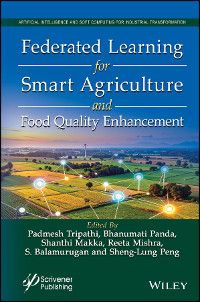
Federated Learning for Smart Agriculture and Food Quality Enhancement (eBook)
412 Seiten
Wiley-Scrivener (Verlag)
978-1-394-33870-2 (ISBN)
This essential book provides a comprehensive, expert-led guide on how federated learning can revolutionize crop yield, enhance resource management, and ensure a pathway to sustainable food quality and safety.
The convergence of artificial intelligence, machine learning, and data science with agriculture and food, provides remarkable opportunities to improve quality, sustainability, and productivity in the agricultural sector. Federated Learning is a promising technology that has emerged at this intersection. In the context of smart agriculture, federated learning holds promise for improving crop yield, resource management, and decision-making. Additionally, federated learning provides greater clarity and understanding in the world of agriculture, encouraging stakeholders to explore and adopt this technology for improved farm management.
Readers will find the book:
- Explores the integration of federated learning, a novel machine learning technique, into the realm of agriculture and food quality enhancement, showcasing the latest advancements;
- Introduces real-world applications of federated learning in agriculture, and demonstrates the way this technology can transform farming practices, crop monitoring, pest control, and food quality assurance;
- By bridging the fields of agriculture, machine learning, and food science, it offers a holistic perspective on leveraging technology to address challenges in food production and quality management;
- Emphasizes the importance of sustainability in agriculture, exploring how federated learning can contribute to more efficient resource utilization, reduced environmental impact, and the overall sustainability of food production systems;
- Discusses the future directions of smart agriculture and food quality enhancement, envisioning how federated learning and other emerging technologies can continue to shape the industry and address evolving challenges.
Audience
Agriculture specialists, agricultural engineers, professionals associated with food safety, crop managers, quality assurance professionals, IT professionals, data scientists, and academics working towards improved quality and sustainability in agriculture.
Padmesh Tripathi, PhD is a Professor of Mathematics in the Department of AI and Data Science at the Delhi Technical Campus, Greater Noida, India with more than 24 years of teaching experience. He has published several articles in reputed journals, book chapters as well as several patents.
Bhanumati Panda, PhD is an Associate Professor in the Academy of Business and Engineering Science's Engineering College, Ghaziabad, UP, India with more than two decades of teaching experience. Her teaching and research expertise spans a wide range of subjects, including engineering mathematics, operations research, numerical analysis, complex analysis, discrete mathematics, real analysis, and statistics.
Shanthi Makka, PhD is a Professor in the Department of Computer Science and Engineering and the Head of the Teaching Learning Center at the Vardhaman College of Engineering, Hyderabad, India with more than 19 years of academic experience. She has published one book, more than 28 papers in reputed international journals and conferences, and several patents.
Reeta Mishra is an Assistant Professor in the School of Computer Science and Engineering at IILM University, Greater Noida, India. She has contributed to many research papers in reputed national and international journals and published five patents.
S. Balamurugan, PhD is the Director of Intelligent Research Consultancy Services in Coimbatore India. He has published more than 70 books, 300 articles in international journals and conferences, and 300 patents, and serves as a research consultant to many companies and startups.
Sheng-Lung Peng, PhD is a Professor and the Director of the Department of Creative Technologies and Product Design at the National Taipei University of Business,Taiwan. He has published over 100 articles in international journals and conferences.
This essential book provides a comprehensive, expert-led guide on how federated learning can revolutionize crop yield, enhance resource management, and ensure a pathway to sustainable food quality and safety. The convergence of artificial intelligence, machine learning, and data science with agriculture and food, provides remarkable opportunities to improve quality, sustainability, and productivity in the agricultural sector. Federated Learning is a promising technology that has emerged at this intersection. In the context of smart agriculture, federated learning holds promise for improving crop yield, resource management, and decision-making. Additionally, federated learning provides greater clarity and understanding in the world of agriculture, encouraging stakeholders to explore and adopt this technology for improved farm management. Readers will find the book: Explores the integration of federated learning, a novel machine learning technique, into the realm of agriculture and food quality enhancement, showcasing the latest advancements;Introduces real-world applications of federated learning in agriculture, and demonstrates the way this technology can transform farming practices, crop monitoring, pest control, and food quality assurance;By bridging the fields of agriculture, machine learning, and food science, it offers a holistic perspective on leveraging technology to address challenges in food production and quality management;Emphasizes the importance of sustainability in agriculture, exploring how federated learning can contribute to more efficient resource utilization, reduced environmental impact, and the overall sustainability of food production systems;Discusses the future directions of smart agriculture and food quality enhancement, envisioning how federated learning and other emerging technologies can continue to shape the industry and address evolving challenges. Audience Agriculture specialists, agricultural engineers, professionals associated with food safety, crop managers, quality assurance professionals, IT professionals, data scientists, and academics working towards improved quality and sustainability in agriculture.
1
Harnessing the Power of Federated Learning for Agricultural Innovation
Abhishek1*, Mritunjay Rai1, Anand Prakash Singh2 and Vishwanath Jha3
1Department of Electrical and Electronics Engineering, Shri Ramswaroop Memorial University Barabanki, (U.P.), India
2IIMT College of Engineering, Greater Noida, UP, India
3Department of Computer Science Engineering (DS), Indrerprastha Engineering College, Ghaziabad, UP, India
Abstract
Federated learning (FL) represents a paradigm shift in agricultural technology, offering novel solutions to pressing challenges in food production and quality management. This chapter provides an in-depth examination of FL’s transformative application in agriculture, underscoring its pivotal role in advancing data driven decision-making processes while safeguarding data privacy. By enabling decentralized model training across a diverse array of stakeholders including farmers, agronomists, and agricultural researchers, FL facilitates the seamless integration of heterogeneous data sources without necessitating centralization. This decentralized approach not only enhances data security but also addresses privacy concerns associated with traditional data sharing methods. The chapter delves into several key applications of FL within the agricultural domain. In precision agriculture, FL is instrumental in optimizing crop management practices, improving yield forecasting accuracy, and enhancing soil health monitoring. Additionally, FL plays a crucial role in pest detection systems, where it enables the aggregation of data from multiple sensors and sources to improve detection capabilities and response strategies. The chapter also thoroughly addresses the operational and technical challenges associated with deploying FL in diverse agricultural settings. The discussion highlights how these challenges can be mitigated through tailored FL strategies and innovative solutions. The chapter presents a comprehensive analysis of current FL implementations and explores its potential future applications within agriculture. By incorporating decentralized, privacy-preserving data-processing techniques, FL offers a novel approach to optimizing agricultural practices. This includes improving resource management, increasing efficiency, and facilitating better decision-making in food production processes. This chapter underscores the transformative impact of FL on the agricultural sector. It illustrates how FL can be harnessed to achieve substantial improvements in agricultural practices, address critical challenges, and contribute to the development of robust food management systems. By bridging the gap between advanced data analytics and practical agricultural applications, FL paves the way for a more innovative and secure approach to managing global food resources. This chapter offers a comprehensive analysis of FL’s application in agriculture, emphasizing its role in enhancing data driven decision-making while preserving data privacy. FL allows diverse stakeholders including farmers, agronomists, and researchers to collaboratively develop machine learning models using localized data, thereby avoiding central data aggregation and enhancing data security. The chapter meticulously explores FL’s application in precision agriculture, where it significantly improves crop management and yield forecasting by integrating diverse data sources. FL’s collaborative learning approach enhances predictive accuracy and supports advanced soil health monitoring. Additionally, in pest detection, FL aggregates data from various sensors to refine detection algorithms, thereby improving pest identification and management strategies. Operational and technical challenges of deploying FL in heterogeneous agricultural environments are also critically examined. These challenges include managing data diversity, addressing infrastructure constraints, and integrating FL with existing agricultural systems. The chapter discusses strategies to overcome these issues and optimize FL implementation. Furthermore, the chapter provides a detailed review of current FL applications and investigates potential future directions.
Keywords: Deep learning, FL, precision agriculture, yield forecasting, pest detection, CNN, ANN
1.1 Introduction
The agricultural sector is facing new challenges in 21st century, as the global population predicted to exceed 9.6 billion, as it faces the challenge associated with feeding a global population that is predicted to become 10 billion by the year 2050, which is a huge increase from the 7.7 billion in 2019. To meet this demand, global food production must increase by approximately 60% from 2007 levels, a daunting task considering the simultaneous pressures of climate change, land degradation, and resource scarcity. Climate change, in particular, poses severe threats to agricultural productivity, with altered weather patterns, increased frequency of extreme events, and shifting pest populations, all contributing to reduced yields and greater uncertainty in food production. In this context, the role of digital technologies in transforming agricultural practices cannot be overstated. Among these technologies, precision agriculture has emerged as a crucial approach to optimizing resource use, increasing crop yields, and minimizing environmental impact. Precision agriculture uses advanced technologies like remote sensing, Global Positioning System (GPS)-mounted machinery, and Internet of Things (IoT) sensors to collect and use data on soil condition, crop health, and weather patterns. This data enables farmers to make more precise decisions, applying water, fertilizers, and pesticides exactly where they are needed, in that way improve efficiency and sustainability [1]. Figure 1.1 shows the application of FL in precision farming.
Traditional centralized data-processing models, where data is collected from various sources and analyzed in a central location, face significant barriers, including concerns about data privacy, security, and interoperability. In agriculture, data is often sensitive and proprietary, with farmers and agricultural businesses reluctant to share information due to fears of data breaches, misuse, or loss of competitive advantage. Additionally, the heterogeneous nature of agricultural data, which can vary widely in terms of format, quality, and source, complicates the development of comprehensive models that can be applied across different regions and farming systems [2]. The FL offers a transformative solution to these challenges, enabling decentralized data processing while preserving privacy and security. FL is a machine learning (ML) technique that is used to train models across multiple decentralized devices without privacy concerns. In FL, only the model updates and gradients are shared, which ensures that the data will remain on the local device. This approach not only addresses privacy issues but also mitigates the risks associated with data-related breaches and enhances the scalability of data driven solutions across diverse agricultural landscapes.
Figure 1.1 FL and agriculture.
The application of FL in agriculture represents a paradigm shift in how data is leveraged to drive innovation and improve food production systems. By enabling the use of data from a wide range of sources like sensors, satellite imagery, and historical farm records without compromising privacy, FL helps in the development of more robust and accurate predictive models. For instance, in precision agriculture, FL can enhance crop management practices by providing tailored recommendations based on localized data, improving both yield forecasts and resource efficiency. A study found that FL-based models could improve the accuracy of crop yield predictions by up to 15% compared to traditional centralized models, underscoring the potential of FL to revolutionize decision-making in agriculture. Another critical application of FL in agriculture is in pest and disease management. Effective pest control is essential for maintaining crop health and ensuring food security, but it requires timely and accurate detection of pest outbreaks [3]. Traditional pest detection methods, which rely on manual scouting or centralized data analysis, are often slow and prone to errors. By aggregating data from multiple farms and regions, FL can enable the development of more precise and timely pest detection models, which are crucial for early intervention and minimizing crop losses. For example, a case study on wheat crops in Australia demonstrated that FL-based models improved pest detection accuracy by 12% compared to conventional methods, highlighting the potential for FL to enhance pest management practices in agriculture.
The successful use of FL in agriculture has come with its challenges. The primary challenge is the heterogeneity in agricultural data, which varies significantly in terms of format, quality, and origin. Agricultural data can be highly unstructured, ranging from satellite images and sensor readings to handwritten farm records and observational notes. This diversity makes it difficult to develop standardized models that can be applied universally across different farming systems and regions. Additionally, the quality of agricultural data can be inconsistent, with missing or inaccurate information further complicating the model training process. Infrastructure limitations also pose a significant challenge to the widespread adoption of FL in agriculture [4]. Many rural and remote agricultural regions, particularly in developing countries, lack reliable internet connectivity and the...
| Erscheint lt. Verlag | 16.12.2025 |
|---|---|
| Sprache | englisch |
| Themenwelt | Naturwissenschaften ► Biologie |
| Weitere Fachgebiete ► Land- / Forstwirtschaft / Fischerei | |
| ISBN-10 | 1-394-33870-8 / 1394338708 |
| ISBN-13 | 978-1-394-33870-2 / 9781394338702 |
| Informationen gemäß Produktsicherheitsverordnung (GPSR) | |
| Haben Sie eine Frage zum Produkt? |
 EPUB (Adobe DRM)
Kopierschutz: Adobe-DRM
Adobe-DRM ist ein Kopierschutz, der das eBook vor Mißbrauch schützen soll. Dabei wird das eBook bereits beim Download auf Ihre persönliche Adobe-ID autorisiert. Lesen können Sie das eBook dann nur auf den Geräten, welche ebenfalls auf Ihre Adobe-ID registriert sind.
Details zum Adobe-DRM
Dateiformat: EPUB (Electronic Publication)
EPUB ist ein offener Standard für eBooks und eignet sich besonders zur Darstellung von Belletristik und Sachbüchern. Der Fließtext wird dynamisch an die Display- und Schriftgröße angepasst. Auch für mobile Lesegeräte ist EPUB daher gut geeignet.
Systemvoraussetzungen:
PC/Mac: Mit einem PC oder Mac können Sie dieses eBook lesen. Sie benötigen eine
eReader: Dieses eBook kann mit (fast) allen eBook-Readern gelesen werden. Mit dem amazon-Kindle ist es aber nicht kompatibel.
Smartphone/Tablet: Egal ob Apple oder Android, dieses eBook können Sie lesen. Sie benötigen eine
Geräteliste und zusätzliche Hinweise
Buying eBooks from abroad
For tax law reasons we can sell eBooks just within Germany and Switzerland. Regrettably we cannot fulfill eBook-orders from other countries.
aus dem Bereich