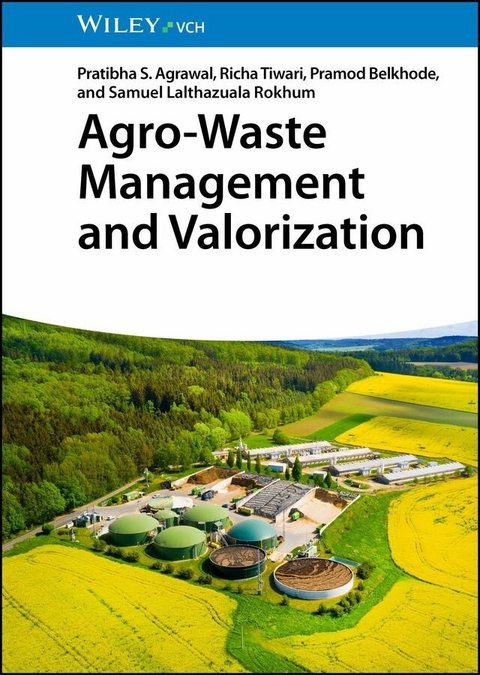
Agro-Waste Management and Valorization (eBook)
555 Seiten
Wiley-VCH (Verlag)
978-3-527-85420-2 (ISBN)
Presents cutting-edge insights on transforming agricultural waste into renewable energy, sustainable materials, and economic opportunities
The urgent need to transition toward sustainable development has propelled agro-waste management to the forefront of global research and policy initiatives. Agricultural residues, once treated as environmental burdens, now offer vast potential as renewable feedstocks for biofuels, compost, and biochar, as well as for driving innovations in the circular economy.
Agro-Waste Management and Valorization provides an authoritative and comprehensive overview of the scientific, technological, and economic frameworks required to turn agricultural waste into valuable resources. Through a multidisciplinary lens, the authors examine the chemistry, engineering, and environmental principles that shape modern waste-to-value pathways, while situating these approaches within relevant legislative and policy contexts.
The book integrates fundamental concepts, applied research, and real-world case studies to demonstrate how biological and thermochemical conversion processes, waste biorefineries, and digital innovations can advance sustainability goals. Detailed analyses of bio-additives, composting strategies, and algae-based biorefineries highlight the practical applications of waste valorization across diverse agricultural systems. In-depth chapters incorporate techno-economic analyses and life cycle assessments to equip readers with the tools needed to evaluate feasibility and long-term impact.
Both synthesizing current knowledge and charting a pathway for future inquiry and technology transfer in the field, Agro-Waste Management and Valorization:
- Explores advanced bioconversion and thermochemical techniques with detailed process parameters and optimization strategies
- Highlights studies of waste-to-energy technologies and their integration into sustainable agricultural systems
- Analyzes international and national policy frameworks shaping agro-waste management and valorization
- Examines waste biorefinery and algal biorefinery models with real-world scalability considerations
- Includes techno-economic analysis (TEA) and life cycle assessment (LCA) of key technologies
- Investigates innovative uses of glycerol and biochar, as well as emerging digital tools such as IoT for efficient waste monitoring and processing
Agro-Waste Management and Valorization is an essential reference for graduate and postgraduate students in environmental chemistry, chemical engineering, agricultural sciences, and biotechnology, particularly in courses such as Environmental Sustainability, Waste Management, and Renewable Energy Systems. It is equally valuable for researchers, policymakers, and professionals in biotechnological and agricultural industries who are seeking practical and research-based approaches to agro-waste valorization.
Pratibha S. Agrawal is a PhD Supervisor at Laxminarayan Innovation Technological University, Nagpur, India. With 16 years of teaching and research experience, she is a recognized authority in applied chemistry and sustainable resource management.
Richa Tiwari is pursuing her PhD. at Laxminarayan Innovation Technological University, Nagpur, India. Her research interests include biofuels, environmental impact assessment, waste oils, recycling technologies, and sustainable development practices.
Pramod Belkhode is an Associate Professor of Mechanical Engineering in the Department of General Engineering at Laxminarayan Innovation Technological University, Nagpur, India. His research areas include automation, ergonomics, man-machine systems, and agricultural mechanization.
Samuel Lalthazuala Rokhum is an Associate Professor of Chemistry at the National Institute of Technology Silchar, Assam, India. His research spans organic chemistry, renewable energy, material science, and heterogeneous catalysis. He has authored over 140 research papers and 21 book chapters.
Chapter 1
Waste-to-value Opportunity and Challenges
1.1 Introduction
Rapid economic growth and urbanization worldwide have resulted in a substantial increase in resource consumption and waste generation. Disposing of this growing volume of solid waste, particularly in landfills, is often neither economically feasible nor sustainable in urban environments. Energy recovery from waste, resource recovery, and waste volume reduction represent attractive and viable alternatives for waste management. Extracting energy from waste minimizes the need for energy produced from finite resources. Therefore, there is an urgent need to develop sustainable strategies for waste management. This study explores the latest advancements in sustainable waste-to-energy (WtE) technologies, resource recovery methods, and low-carbon biotechnologies and bioenergy options. Recent research highlights the growing importance of the circular economy as a sustainable waste management approach [1, 2]. WtE alternatives are crucial in the waste management sector. This chapter presents an innovative approach focused on addressing the challenges of managing organic waste by integrating WtE technologies. Globally, there is increasing emphasis on sustainable waste management practices, as utilizing organic waste for WtE purposes is a viable option. Identifying and prioritizing WtE alternatives is key, given the large quantities of waste in the management system. The goal is to reduce the environmental and logistical impacts of organic waste disposal, contributing to a more efficient and sustainable waste management system aimed at minimizing environmental effects and producing renewable energy. Ludlow et al. [3] emphasize that achieving net-zero greenhouse gas (GHG) emissions by 2050 fundamentally requires a shift in waste management practices. Organic waste disposal frequently presents significant challenges, including insufficient collection infrastructure, limited public awareness, and operating difficulties, particularly in urban areas. Daily per capita waste generation varies considerably globally, ranging from 0.11 to 4.54 kg [4].
Managing waste involves complexity and costs, which differ depending on local resource allocation and population density. However, as waste volume and disposal costs rise, developing countries face significant challenges in managing waste effectively [5]. Despite these challenges, alternative waste management options, such as anaerobic digestion (AD), pyrolysis, and gasification, are gaining traction. Implementing effective waste management practices and technologies is critical for mitigating negative environmental and health impacts [6]. Developing nations urgently need to adopt sustainable waste management practices.
1.1.1 Waste-to-energy
WtE technologies are commonly employed for sustainable waste management, facilitating simultaneous energy generation and effective disposal [7]. Among WtE methods, thermal conversion is the most widely adopted approach for large-scale waste-processing. Incineration, a thermal technology, is still under development; while pyrolysis remains experimental, it is not yet commercially viable for managing municipal solid waste (MSW) globally. Biological conversion methods like AD are also used, particularly for bio-methanization. AD is frequently utilized for processing organic-rich biodegradable waste like manure and sewage sludge [8]. Using landfills for waste disposal is less favored due to drawbacks such as unpleasant odors, GHG emissions from methane (CH4), leachate production, and associated health risks. Evidence suggests that WtE technologies implemented in Latin American and Caribbean (LAC) countries offer long-term advantages, including economic development, environmental benefits, and improved human well-being [9]. Existing literature provides a detailed look at the scale of waste challenges in developing nations and explores potential methods to promote sustainable waste management practices in the future.
This chapter helps fill knowledge gaps by analyzing treatment methods used in developing countries and their potential to support continuous sustainability by aligning with renewable energy sources such as hydroelectricity, which are environmentally friendly and non-emission-generating. For example, South Africa’s electricity mix in 2021 heavily relied on coal-fired plants (84%), resulting in substantial CO2 emissions of 396 g CO2/kWh. Energy consumption also surged sharply in New Zealand (66 kg CO2/kWh, primarily powered by geothermics [57%], hydro [17%], and thermal sources ([9%]) [10, 11]. The rapid urbanization in many developing countries intensifies waste management challenges.
Nonetheless, these challenges also present significant opportunities. Treating waste as a valuable resource rather than a problem allows different nations to adopt sustainable waste management techniques and achieve future development goals. Studies conducted in Korea demonstrate how WtE operations reduced GHG emissions by 16,061 tCO2eq annually; this reduction is projected to increase further to 26,477 tCO2eq per year by 2021 [12]. The environmental advantages of WtE technologies (like incineration, pyrolysis, gasification, and incineration) vary depending on the specific method used [13]. The purpose of this chapter is to provide a systematic evaluation and highlight the benefits and challenges of WtE technology, especially in developing countries. This includes assessing the characteristics and volume of waste produced, current treatment methods, the opportunities and obstacles within the waste management sector, and the feasibility of implementing or expanding WtE solutions domestically.
1.1.2 Environmental Benefits
Figure 1.1 illustrates that incineration notably influences the global warming potential (GWP), contributing between 975,554 and 830,750 tCO2-eq/year due to the large quantity of processed waste. In thermal technologies, emissions are a primary contributor to the GWP [14]. The environmental impact of incineration is largely dictated by its energy conversion efficiency; higher efficiency leads to lower emission rates. For instance, an incineration plant operating at 25% efficiency emits roughly 1,007 kg CO2-eq per MWh of combustion, while increasing efficiency by just 5% (to 30%) reduces emissions by approximately 17% due to lower GHG emissions [15]. The significant emission reductions from incineration can be attributed to the characteristics of the burned materials. Plastic waste, comprising over 20% of facility input, has the most notable impact on GWP due to its chemical properties and low moisture content, resulting in greater emission contributions [16]. Moreover, the common practice of disposing of MSW without source separation leads to high moisture levels [17]. Achieving greater environmental and economic benefits from WtE technologies requires continuous improvements.
Figure 1.1 GHG emissions and emission saving from WtE technologies (tCO2-eq/year). Adapted from [16].
1.1.3 Energy Generation Potential
Uncollected CH4 (25%) from landfill gas (LFG) is a major factor contributing to GWP, amounting to 417,533 tCO2-eq/year of GHG emissions [18]. In contrast, AD methods produce the lowest emissions, achieving 99% efficiency in capturing CH4, leaving only 5% to be released into the atmosphere. The environmental performance of WtE technologies compared to coal-based electricity generation was also examined [19]. Research indicates that LFG recovery results in the highest net GWP, estimated between 137,439 and 323,604 tCO2-eq annually. Incineration shows a lower GWP, ranging from 219,121 to 84,803 tCO2-eq/year. Incineration with energy recovery surpasses simple incineration in reducing emissions. Energy generation from WtE can offset some of the benefits gained from electricity production but significantly counteracts global warming effects. AD technology has substantially reduced impact on GWP, resulting in an avoidance of 95,321–195,395 tCO2-eq/year of GHGs. From an environmental standpoint, AD technology is arguably the most suitable option due to its lower emissions.
1.1.4 Economic Potential
The global waste recycling services market is projected to reach US$99.2 billion by 2032, with an average annual growth rate of 5.1% from 2023 to 2032 [20]. In 2022, the Asia-Pacific region’s waste recycling services market constituted over 80% of the total market share. The US Environmental Protection Agency (EPA) reports that the recycling industry employs 534,000 people and contributes US$13.2 billion in wages and benefits [15]. An analysis indicates that in 2020, only 9% of electronic waste (e-waste)was properly collected and recycled [21]. According to the EPA, the United States generated 292.4 million tons of MSW in 2018, of which 69 million tons were recycled [22]. The increasing adoption of advanced WtE technology offers substantial potential for adding value to waste and generating energy [23]. The precise potential varies based on factors such as the type and volume of available waste, technological readiness, environmental considerations, and government policies. Figure 1.2 illustrates potential applications of waste recycling and processing technologies that significantly influence the waste recycling services market value.
Figure 1.2 Potential of waste-to-energy (WtE) technology. Adapted from [24].
WtE presents considerable potential, but its viability is dependent on various...
| Erscheint lt. Verlag | 11.12.2025 |
|---|---|
| Sprache | englisch |
| Themenwelt | Naturwissenschaften ► Biologie |
| Weitere Fachgebiete ► Land- / Forstwirtschaft / Fischerei | |
| Schlagworte | agro-waste alternative fuels • agro-waste biofuels • agro-waste chemistry • agro-waste conversion • agro-waste engineering • agro-waste environmental sustainability • agro-waste policy • agro-waste refinery • agro-waste renewable energy • agro-waste to energy |
| ISBN-10 | 3-527-85420-7 / 3527854207 |
| ISBN-13 | 978-3-527-85420-2 / 9783527854202 |
| Informationen gemäß Produktsicherheitsverordnung (GPSR) | |
| Haben Sie eine Frage zum Produkt? |
 EPUB (Adobe DRM)
Kopierschutz: Adobe-DRM
Adobe-DRM ist ein Kopierschutz, der das eBook vor Mißbrauch schützen soll. Dabei wird das eBook bereits beim Download auf Ihre persönliche Adobe-ID autorisiert. Lesen können Sie das eBook dann nur auf den Geräten, welche ebenfalls auf Ihre Adobe-ID registriert sind.
Details zum Adobe-DRM
Dateiformat: EPUB (Electronic Publication)
EPUB ist ein offener Standard für eBooks und eignet sich besonders zur Darstellung von Belletristik und Sachbüchern. Der Fließtext wird dynamisch an die Display- und Schriftgröße angepasst. Auch für mobile Lesegeräte ist EPUB daher gut geeignet.
Systemvoraussetzungen:
PC/Mac: Mit einem PC oder Mac können Sie dieses eBook lesen. Sie benötigen eine
eReader: Dieses eBook kann mit (fast) allen eBook-Readern gelesen werden. Mit dem amazon-Kindle ist es aber nicht kompatibel.
Smartphone/Tablet: Egal ob Apple oder Android, dieses eBook können Sie lesen. Sie benötigen eine
Geräteliste und zusätzliche Hinweise
Buying eBooks from abroad
For tax law reasons we can sell eBooks just within Germany and Switzerland. Regrettably we cannot fulfill eBook-orders from other countries.
aus dem Bereich