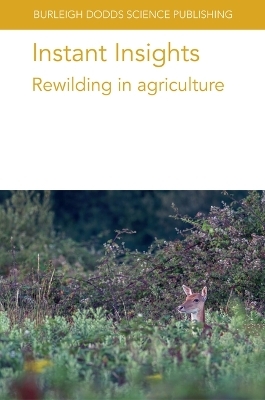
Instant Insights: Rewilding in Agriculture
Burleigh Dodds Science Publishing Limited (Verlag)
9781835455654 (ISBN)
- Titel nicht im Sortiment
- Artikel merken
This book features three peer-reviewed reviews on rewilding in agriculture.
The first chapter highlights the diversity of best practices used to rewild grasslands and rangelands, including those used to restore biological soil crusts, apply prescribed fire, increase stand establishment and persistence, overcome soil limitations, rectify nutrient pollution, and sequester soil carbon. The chapter also provides a case study on the restoration of sagebrush-steppe rangelands in the state of Utah, USA.
The second chapter provides an overview of the trade-offs related to animal rewilding in agroecosystems (e.g. ecosystem services versus disservices). The chapter also discusses three key management trends the authors foresee will facilitate net positive outcomes in animal rewilding: capturing wild provisioning services, coordinating broad spatial heterogeneity in land use and employing coexistence conservation tactics.
The final chapter outlines the benefits and challenges of rewilding in Australia and New Zealand and references four case studies to study this. The first two describe rewildings on formerly degraded agricultural land (Tiritiri Matangi Island, Scotia Sanctuary), while the third posits a conceptual rewilding program using a continental top predator, the dingo. The fourth case study describes a digitally-enabled survey and monitoring system on a mixed-agriculture farm that provides a step towards rewilding such landscapes in future.
Dr Chris Dickman is an Emeritus Professor in Ecology at the University of Sydney and a Fellow of the Australian Academy of Science. He is the recipient of several national and international awards, including New South Wales Plant and Animal Scientist of the Year in 2010. His work focuses mostly on mammals and other vertebrates, and encompasses wide-ranging projects in applied conservation and management, in particular seeking to understand and manage the impacts of introduced predators on native fauna.
Chapter 1 - Rewilding grasslands and rangelands: Thomas A. Jones, Forage and Range Research Laboratory – U.S. Department of Agriculture – Agricultural Research Service, USA;
1 Introduction
2 Past and current threats to grasslands and rangelands
3 Application of ecological models to restoration management
4 Approaches to grassland and rangeland rewilding: passive restoration
5 Approaches to grassland and rangeland rewilding: active restoration
6 Approaches to grassland and rangeland rewilding: prescribed burning
7 Species establishment and persistence
8 The native seed industry
9 Weed management in restoration projects
10 Dealing with the legacy of degraded soils
11 Atmospheric nitrogen deposition
12 Soil-carbon sequestration
13 Case study: Utahs Watershed Restoration Initiative and the restoration of sagebrush-steppe rangelands
14 Conclusion
15 Future research needs
16 Where to look for further information
17 Acknowledgments
18 References
Chapter taken from: Reid, N. and Smith, R. (eds.), Managing biodiversity in agricultural landscapes: Conservation, restoration and rewilding, Burleigh Dodds Science Publishing, Cambridge, UK, 2024, (ISBN 978 1 80146 454 3)
Chapter 2 - The future of animal rewilding in agricultural landscapes: Kiarrah J. Smith, Iain. J. Gordon, Belinda A. Wilson and Adrian D. Manning, The Australian National University, Australia;
1 Introduction
2 Benefits of wild animals in agricultural landscapes
3 Disservices of wild animals to agricultural landscapes
4 Future trends: capturing wild provisioning services
5 Future trends: coordinating broad spatial heterogeneity in land use
6 Future trends: employing coexistence conservation tactics
7 Conceptual case study: kangaroos and dingoes
8 Conclusion
9 Where to look for further information
10 References
Chapter taken from: Reid, N. and Smith, R. (eds.), Managing biodiversity in agricultural landscapes: Conservation, restoration and rewilding, Burleigh Dodds Science Publishing, Cambridge, UK, 2024, (ISBN 978 1 80146 454 3)
Chapter 3 - Animal rewilding in theory and practice: Australia and New Zealand: Christopher R. Dickman, Aaron C. Greenville and Glenda M. Wardle, The University of Sydney, Australia;
Cover
1 Introduction
2 The benefits of rewilding
3 The challenges of rewilding
4 Case studies
5 Conclusion
6 Future trends in research
7 Where to look for further information
8 Acknowledgements
9 References
Chapter taken from: Reid, N. and Smith, R. (eds.), Managing biodiversity in agricultural landscapes: Conservation, restoration and rewilding, Burleigh Dodds Science Publishing, Cambridge, UK, 2024, (ISBN 978 1 80146 454 3)
| Erscheint lt. Verlag | 26.5.2026 |
|---|---|
| Reihe/Serie | Burleigh Dodds Science: Instant Insights |
| Zusatzinfo | Color tables, photos and figures |
| Verlagsort | Cambridge |
| Sprache | englisch |
| Maße | 152 x 229 mm |
| Themenwelt | Naturwissenschaften ► Biologie ► Ökologie / Naturschutz |
| Weitere Fachgebiete ► Land- / Forstwirtschaft / Fischerei | |
| ISBN-13 | 9781835455654 / 9781835455654 |
| Zustand | Neuware |
| Informationen gemäß Produktsicherheitsverordnung (GPSR) | |
| Haben Sie eine Frage zum Produkt? |
aus dem Bereich