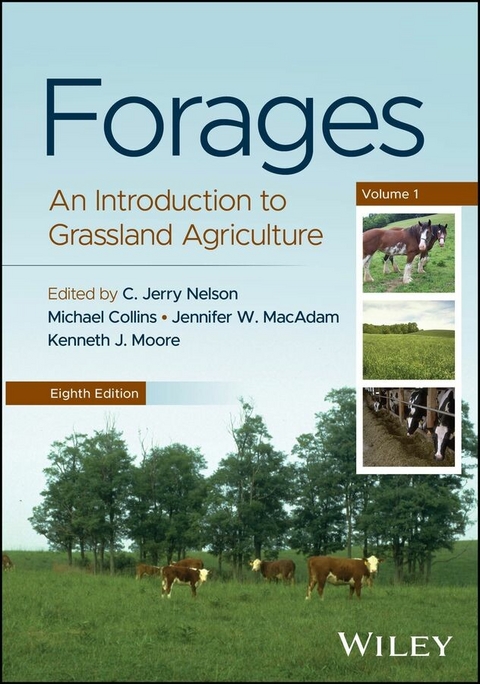
Forages, Volume 1 (eBook)
1252 Seiten
Wiley (Verlag)
978-1-394-25860-4 (ISBN)
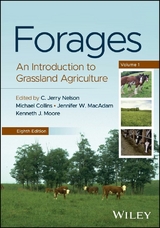
Comprehensive introduction to forages enabling readers to understand the complexity of grassland ecosystems and their relationships to the wider environment
Forages delivers a balance of scientific principles to aid in reader integration of the concepts as well as practical information on forage identification, plant characteristics, management, and utilization. The coverage of the science behind the plant characteristics and responses make this book applicable to many parts of the world.
This edition has been updated to reflect recent changes in precision planting, fertilization, pest management technologies, new control chemicals, and increasing use of biologicals. The editors have also added a new chapter on forages for conservation and ecological services to discuss the many ways in which forages can be used to mitigate environmental impacts and increase the resilience of agricultural systems. This aspect of forage use has also been highlighted in other chapters throughout the book.
Part I covers the characteristics of forage species. Part II covers establishment, fertilization, and pest management of forages. Part III covers all aspects of forage utilization, grazing systems, and animal management, including the use of GPS collars and drones to control movement of animals.
Sample topics discussed in Forages include:
- Forages' ability to reduce soil erosion, filter nutrients from water, and increase the water- and nutrient-holding capacity of the soil while also providing tons of feed per acre
- The state of forages and grasslands in a changing world and the structure and morphology of grasses, legumes, and other forbs
- Forage crops for bioenergy and industrial products
- Forage-related animal disorders, grazing management services guidelines, and management of grassland ecosystems
Forages is an essential textbook for undergraduates studying forages and an excellent reference for all individuals working in industry, government, and organizations involved with the use of forages.
C. Jerry Nelson, Emeritus Curators' Professor of Plant Sciences at the University of Missouri, USA. His research focuses on growth of grasses and persistence of legumes and he is active in agriculture-related international programs.
Michael Collins, Emeritus Professor and former Director of the Division of Plant Sciences at the University of Missouri, USA.
Kenneth J. Moore, Charles F. Curtiss Distinguished Professor in Agricultural and Life Sciences and Professor of Agronomy at Iowa State University, USA.
List of Contributors
DAVID J. BARKER is a Professor of Horticulture and Crop Science at The Ohio State University. He received his BS and MS from Massey University, New Zealand, and his PhD from the University of Nebraska. He teaches graduate and undergraduate forage classes. His research interests are pasture ecology and biodiversity, plant water relations, grazing management, and the interaction of these with soil fertility.
VERN S. BARON is a Research Scientist for Agriculture and Agri‐Food Canada at Lacombe, AB. He received his BSc from the University of Manitoba and his MSc and PhD from the University of Guelph. He has carried out research in extending the grazing season and winter grazing, reducing environmental impacts of beef cattle on the environment, and increasing the productivity of old grass pastures.
LISA L. BAXTER is an Associate Professor and State Forage Extension Specialist at the University of Georgia Tifton Campus. She earned her BS in Agriculture and Natural Resources from Berea College, MS in Crop and Soil Sciences from the University of Georgia, and PhD in Plant and Soil Science from Texas Tech University. Her forage research and extension program was designed to address contemporary issues in forage management and hay production by integrating novel weed and insect management strategies and relevant precision agriculture techniques with foundational agronomic practices. She is best known for her research on the bermudagrass stem maggot and forage weed control.
MARILIA B. CHIAVEGATO is an Assistant Professor of Agroecosystems Management in the Departments of Horticulture and Crop Science and Animal Sciences at The Ohio State University. She received her BS in Agronomy and her MS in Applied Chemistry from the University of São Paulo, and her PhD in Animal Science from Michigan State University. Her research focuses on understanding the function of forage and grazing agroecosystems and their responses to various changes. She emphasizes the manipulation of management practices as a strategy to increase sustainability, with a particular focus on nutrient cycling and reducing environmental impacts.
MICHAEL COLLINS is an Emeritus Professor and Director of the Division of Plant Sciences at the University of Missouri, Columbia. He received his BS from Berea College, his MS from West Virginia University, and his PhD from the University of Kentucky. During a 36‐year career in forage research and teaching at the University of Kentucky, Lexington, and the University of Wisconsin, Madison, he taught an undergraduate/graduate forages course and advised graduate students. His research emphasized forage management and postharvest physiology of hay and silage, with an emphasis on forage quality.
S. CAROLINA CÓRDOVA is an Assistant Professor and Statewide Soil Health Specialist at the University of Nebraska‐Lincoln (UNL). She received her BEng in Agroindustry from Técnica del Norte University (Ecuador), and her PhD from Iowa State University. Her research focuses on carbon sequestration, nitrogen fixation, and long‐term resilience in diverse cropping systems. Dr. Córdova co‐leads the UNL Soil Health Team and is a member of the Long‐Term Agroecosystems Research Network (ARS‐USDA) and the Nebraska Strategic Agriculture Coalition. With experience in both the USA and Latin America, Dr. Córdova's work contributes significantly to advancing regenerative agricultural practices and soil health on regional and global scales.
NIKOLAY M. FILIPOV is a Distinguished Professor and Director of the Interdisciplinary Toxicology Program in the College of Veterinary Medicine at the University of Georgia. His research focuses on communication between the nervous and immune systems in health and disease, as well as on the role of the environment in the modulation of this communication. He has taught courses in veterinary toxicology, organ systems toxicology, neurophysiology, and mammalian cell physiology.
E. SCOTT FLYNN is a Global Biology Leader for Corteva Agriscience™. He received his BS from Eastern Kentucky University, his MS from the University of Kentucky, and his PhD from Iowa State University. Scott’s research has focused on developing herbicides and digital tools for controlling invasive plants in forage production systems.
SHELBY M. GRUSS is an Assistant Professor and Forage Extension Specialist in the Department of Agronomy at Iowa State University. She has an active statewide extension program on forage production that addresses issues related to forage management, pests, and diseases. She teaches an undergraduate course on forage crop management. Her research focuses on agricultural production systems, aiming to understand different resiliency factors and how forages may help increase resiliency in agricultural production systems.
JOHN A. GURETZKY is an Associate Professor and grassland systems ecologist in the Department of Agronomy and Horticulture at the University of Nebraska‐Lincoln. He received his BS from the University of Nebraska‐Lincoln and PhD from Iowa State University. His research focuses on the impacts of interseeding legumes and summer annuals in pasture plant communities. He teaches an undergraduate course in forage crop and pasture management and graduate courses in forage quality and forage evaluation.
JACOB M. JUNGERS is an Associate Professor in the Department of Agronomy and Plant Genetics at the University of Minnesota. He received his BS from the University of Wisconsin–Oshkosh and PhD from the University of Minnesota. His research focuses on sustainable cropping systems and emphasizes the integration of perennial crops into diverse crop rotations. He teaches graduate and undergraduate courses related to agriculture.
ROBERT L. KALLENBACH is a Professor in the Division of Plant Sciences and Technology and Associate Dean of Extension in the College of Agriculture, Food, and Natural Resources at the University of Missouri, Columbia. He received his BS from Southwest Missouri State University, his MS from the University of Missouri, and his PhD from Texas Tech University. His program focuses on optimizing forage‐livestock systems, with an emphasis on digital technologies.
ROCKY W. LEMUS is an Extension/Research Professor and Extension Forage Specialist in the Department of Plant and Soil Sciences at Mississippi State University with 25 years of forage production experience. He also serves as the leader of the Center for Forage Management and Environmental Stewardship. His research and extension activities are related to forage production, nutrient management, grazing systems, livestock production, cover crops, and forage quality and utilization.
JENNIFER W. MacADAM is a Professor at Utah State University, where she teaches courses in forage production and pasture ecology, and plant structure and function. She received her BS from Missouri State University, and her MS and PhD from the University of Missouri, Columbia. She studies legume‐ and grass‐based ruminant production systems and their environmental impacts.
ALI M. MISSAOUI is an Assistant Professor of Forage and Biomass Breeding and Genetics at the University of Georgia. He received his BS from Oregon State University, his MS from Texas Tech University, and his PhD from the University of Georgia. He teaches an upper‐level undergraduate/graduate course in forage management and utilization, and an advanced course in plant breeding. He conducts research on the genetic improvement of cool‐season forage legumes and grasses adapted to the southeast USA, with a focus on stress tolerance and reduced anti‐quality factors.
ROBERT B. MITCHELL is a Research Agronomist with the USDA Agricultural Research Service in Lincoln, Nebraska. He received his BS, MS, and PhD from the University of Nebraska. He has taught undergraduate and graduate courses in all aspects of grassland ecology and management. His research focuses on the establishment and management of perennial grasses for forage and biomass energy, sustainability of perennial forage and biomass energy systems, and evaluation and development of biomass energy systems.
KENNETH J. MOORE is a Distinguished Professor of Agronomy at Iowa State University. He received his BS from Arizona State University and his MS and PhD from Purdue University. He has taught graduate‐level courses in field plot technique and design, pasture and grazing management, and forage quality and utilization. He advises graduate students and conducts research on crop management and ecology.
C. JERRY NELSON is an Emeritus Curators' Professor of Plant Sciences at the University of Missouri. He received his BS and MS from the University of Minnesota, and his PhD from the University of Wisconsin. His research has focused on the growth of grasses and persistence of legumes, and he is now active in agriculture‐related international programs, especially in Asia.
YOANA C. NEWMAN is an Assistant Professor of Crop Science and Forage Extension Specialist in the Department of Plant and Earth Science at the University of Wisconsin, River Falls. She received her BA from the University of Rafael Urdaneta, Venezuela, and her MS and PhD from the University of Florida, Gainesville. She teaches an introduction to plant science course and forage crop production courses.
DAREN D. REDFEARN is a Professor of Agronomy and Forage Systems Specialist at the University of Nebraska–Lincoln. He received his BS from Texas Tech University...
| Erscheint lt. Verlag | 2.12.2025 |
|---|---|
| Sprache | englisch |
| Themenwelt | Naturwissenschaften ► Biologie |
| Weitere Fachgebiete ► Land- / Forstwirtschaft / Fischerei | |
| Schlagworte | forage animal management • forage chemicals • forage establishment • forage fertilization • forage grazing systems • forage identification • forage pest management • Forage Planting • forage textbook • Forage Utilization • Plant characteristics |
| ISBN-10 | 1-394-25860-7 / 1394258607 |
| ISBN-13 | 978-1-394-25860-4 / 9781394258604 |
| Informationen gemäß Produktsicherheitsverordnung (GPSR) | |
| Haben Sie eine Frage zum Produkt? |
 EPUB (Adobe DRM)
Kopierschutz: Adobe-DRM
Adobe-DRM ist ein Kopierschutz, der das eBook vor Mißbrauch schützen soll. Dabei wird das eBook bereits beim Download auf Ihre persönliche Adobe-ID autorisiert. Lesen können Sie das eBook dann nur auf den Geräten, welche ebenfalls auf Ihre Adobe-ID registriert sind.
Details zum Adobe-DRM
Dateiformat: EPUB (Electronic Publication)
EPUB ist ein offener Standard für eBooks und eignet sich besonders zur Darstellung von Belletristik und Sachbüchern. Der Fließtext wird dynamisch an die Display- und Schriftgröße angepasst. Auch für mobile Lesegeräte ist EPUB daher gut geeignet.
Systemvoraussetzungen:
PC/Mac: Mit einem PC oder Mac können Sie dieses eBook lesen. Sie benötigen eine
eReader: Dieses eBook kann mit (fast) allen eBook-Readern gelesen werden. Mit dem amazon-Kindle ist es aber nicht kompatibel.
Smartphone/Tablet: Egal ob Apple oder Android, dieses eBook können Sie lesen. Sie benötigen eine
Geräteliste und zusätzliche Hinweise
Buying eBooks from abroad
For tax law reasons we can sell eBooks just within Germany and Switzerland. Regrettably we cannot fulfill eBook-orders from other countries.
aus dem Bereich