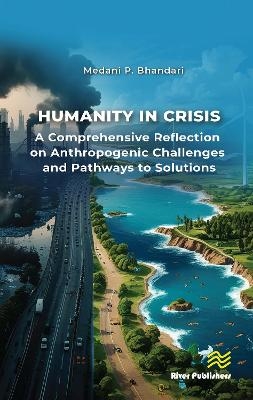
Humanity in Crisis—A Comprehensive Reflection on Anthropogenic Challenges and Pathways to Solutions
River Publishers (Verlag)
9788743808770 (ISBN)
- Titel nicht im Sortiment
- Artikel merken
This is a groundbreaking exploration of humanity's multifaceted crises in the Anthropocene era. This book offers an in-depth examination of human-induced challenges—ranging from climate change, biodiversity loss, and environmental degradation to social inequality, political instability, and ethical dilemmas posed by technological advancements. It brings diverse perspectives, integrating insights from environmental science, sociology, philosophy, and global governance, to provide a holistic understanding of these interconnected issues.
What makes this book unique is its interdisciplinary approach and its focus on actionable solutions. It bridges the knowledge gap by connecting theoretical frameworks with practical applications, offering innovative pathways to address these challenges. The book emphasizes the importance of systemic thinking, collaborative governance, and ethical leadership while highlighting the role of individuals, communities, and global institutions in fostering resilience and sustainability.
The book is intended for a broad audience, including academics, policymakers, activists, and anyone concerned about the future of humanity and the planet. Synthesizing cutting-edge research with real-world case studies provides readers with the tools to understand the complexity of the crises we face and inspires them to become agents of change.
Humanity in Crisis is a beacon of hope and a call to action in a world increasingly defined by uncertainty and polarization. It diagnoses the root causes of our challenges and envisions a transformative path forward rooted in equity, ethics, and collective responsibility. This book is vital for building a more just, sustainable, and harmonious future for all.
Dr. Medani P. Bhandari is a widely recognized humanitarian, professor, author, and editor who has significantly contributed to social and environmental sciences. With expertise in social equity, inequality, inclusion, innovation, feminism, sustainability, climate change, and social and environmental policies and management, Dr. Bhandari has dedicated his career to these important areas. In addition to his extensive scholarly work, Dr. Bhandari is a poet, essayist, and advocate for the environment and social causes. His expertise expands to global and international environmental politics and justice, climate change, sustainable development, public/social policy, the non-profit sector, renewable energy, nature, culture, and power. He has gained field experience across diverse regions, including Asia, Africa, North America, Western Europe, Australia, Japan, and the Middle East. Dr. Bhandari has authored and co-edited several books, including Green Web-II: Standards and Perspectives from the IUCN, 2nd Edition; Reducing Inequalities Towards Sustainable Development Goals: Multilevel Approach, Educational Transformation; The Nexus of Climate Change and Land-use – Global Scenario with Reference to Nepal, Women and Society, etc. Furthermore, Dr. Bhandari's creative writing encompasses a vast collection of poems and essays. Dr. Bhandari's multifaceted contributions to academia, humanitarianism, and creative writing have solidified his reputation as an esteemed figure in social and environmental sciences, profoundly impacting social equity, sustainability, climate change, and beyond. Professor Bhandari holds five master's degrees in social and environmental sciences and a Ph.D. in sociology. For 45 years, he has been actively involved in environmental conservation and humanitarian efforts through nonprofit and academic platforms. Guided by the philosophy that all living and non-living beings are interconnected ("Vasudhaiva Kutumbakam") and the principle of "Live and Let Others Live," his work reflects a deep commitment to the well-being of our planet and its inhabitants. He serves as an International Program Director at the New York-based NGO Atlantic State Legal Foundation in Syracuse, NY; a professor at Akamai University, USA, and Sumy State University, Ukraine; and is an advisor to Gandaki University, Nepal. He is also the UNEP Civil Society Regional Facilitator for North America and the Lead Author of UNEP GEO 7. He is also the editor-in-chief of Strategic Planning for Energy and the Environment, the books series editor at the River Publisher, and the books series editor at Nova Publishers.
Chapter 1. Introduction: Humanity in Crisis—A Comprehensive Reflection on Anthropogenic Challenges and Pathways to Solutions Part I: Understanding the Crisis Chapter 2: Understanding the Crisis: Theories and Epistemology Chapter 3: The Anthropocene and Its Consequences Chapter 4: Systemic Crises in a Globalized World Part II: Environmental Crises Chapter 5: Environmental Crises: Causes, Consequences, and Responses Chapter 6: Biodiversity and Ecosystem Collapse Chapter 7: The Global Water Crisis Chapter 8: Pollution and Waste Management Part III: Social and Humanitarian Crises Chapter 9: Social and Humanitarian Crises Chapter 10: Public Health in Peril Chapter 11: Conflict, War, and Displacement Chapter 12: Gender Inequality and Social Justice Chapter 13: Education in Crisis Part IV: Political and Economic Crises Chapter 14: Political and Economic Crises Chapter 15: Political Instability and Governance Chapter 16: The Crisis of Knowledge and Misinformation Part V: Cultural and Ethical Crises Chapter 17: Identity, Belonging, and Social Fragmentation Chapter 18: Technology and Ethical Dilemmas Chapter 19: Global Wars and Conflict Crisis Chapter 20: The Crisis of Meaning and Purpose Part VI: Pathways to Solutions Chapter 21: Sustainability and Resilience Chapter 22: Global Cooperation and Solidarity Chapter 23: Innovations for a Better Future Chapter 24: Education for Transformation Chapter 25: Ethical Leadership and Governance Part VII: Hope and Vision for Humanity Chapter 26: Hope and Vision for Humanity Chapter 27: A Vision for Humanity’s Future Chapter 28. The Path Forward: Challenges and Opportunities Chapter 29. Case Studies and Success Stories: Resolving Humanity in Crisis
| Erscheint lt. Verlag | 26.2.2026 |
|---|---|
| Reihe/Serie | River Publishers Series in Social, Urban, Economic and Environmental Sustainability |
| Zusatzinfo | 1 Halftones, color; 1 Illustrations, color |
| Verlagsort | Gistrup |
| Sprache | englisch |
| Maße | 156 x 234 mm |
| Themenwelt | Technik ► Umwelttechnik / Biotechnologie |
| Weitere Fachgebiete ► Land- / Forstwirtschaft / Fischerei | |
| ISBN-13 | 9788743808770 / 9788743808770 |
| Zustand | Neuware |
| Informationen gemäß Produktsicherheitsverordnung (GPSR) | |
| Haben Sie eine Frage zum Produkt? |
aus dem Bereich