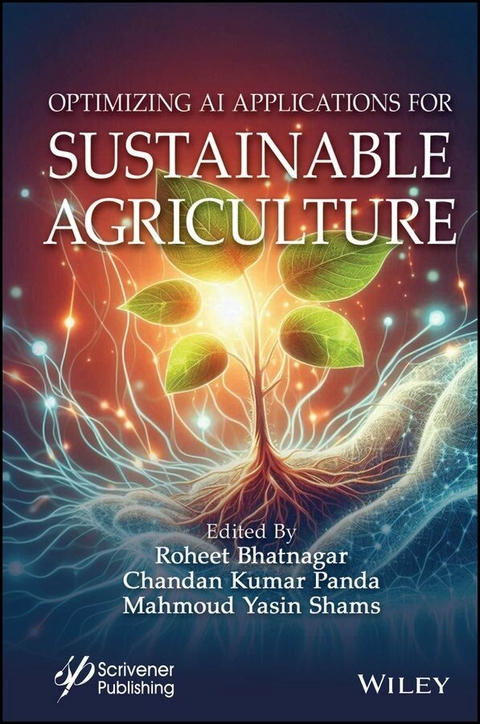
Optimizing AI Applications for Sustainable Agriculture (eBook)
786 Seiten
Wiley-Scrivener (Verlag)
978-1-394-28724-6 (ISBN)
Embrace the future of sustainable food production with this comprehensive guide that explores how artificial intelligence and emerging technologies are revolutionizing agriculture.
In an era marked by climate change, resource depletion, and population growth, innovation is not a luxury-it is a necessity. Integrating AI into agricultural practices offers a promising solution. From precision farming and crop monitoring to predictive analytics and decision support systems, AI has the potential to revolutionize how we grow, manage, and distribute food. This book is a comprehensive guide that delves into the transformative potential of artificial intelligence and emerging technologies in the field of agriculture. An in-depth exploration of various AI technologies, such as machine learning, deep learning, natural language processing, and computer vision, will demonstrate the wide applications these tools have for agricultural practices. It covers emerging technologies like the Internet of Things, drones, precision farming, and agro-technology. The primary focus is on how these technologies can enhance sustainability in agriculture by improving crop yields, reducing water consumption, minimizing chemical use, and promoting eco-friendly farming practices. This essential guide will give readers a deep understanding of how cutting-edge technology can be harnessed to create a more sustainable future for agriculture.
Readers will find the volume:
- Dives into the latest research and innovations in AI and emerging technologies that are transforming agricultural practices;
- Provides real-world examples and case studies that show how these technologies can be implemented in farming;
- Explores how these modern technologies align with global sustainability goals and how they can be integrated into national strategies;
- Introduces the role of AI and emerging technologies in promoting sustainable agricultural practices that protect the environment.
Audience
Researchers, computer and agricultural scientists, farmers, and policymakers looking to leverage the potential of artificial intelligence and machine learning for the benefit of farmers.
Roheet Bhatnagar, PhD is a Professor in the Department of Computer Science and Engineering at Manipal University, Jaipur, Rajasthan, India with over 22 years of experience. He has published more than 100 research papers in reputed conferences and journals and edited five books. His research focuses on soft computing, data structure, and software engineering.
Chandan Kumar Panda, PhD is an Assistant Professor at Bihar Agricultural University, Sabour, Bihar, India with over eight years of research and teaching experience. He has published three books, 16 book chapters, and more than 50 research papers in international journals and conferences. He is an acclaimed researcher in ICT in the agriculture sector. His research interests include agricultural extension, rural development, and information and communication technology in agriculture.
Mahmoud Yasin Shams, PhD is an Associate Professor of Machine Learning and Information Retrieval in the School of Artificial Intelligence, Kafrelsheikh University, Kafr el-Sheikh, Egypt. With over 70 papers and conference presentations published in top-tier journals he has made significant contributions to the field. He specializes in artificial intelligence, machine learning, pattern recognition, and classification.
1
AI and Emerging Technologies for Precision Agriculture: A Survey
Brajesh Kumar Khare
Department of Computer Science and Engineering, Harcourt Butler Technical University, Kanpur, Uttar Pradesh, India
Abstract
The urgent need for sustainable agriculture practices is increasingly recognized in light of escalating global food demands and environmental pressures. This paper examines the role of artificial intelligence (AI) and other emerging technologies including Internet of Things, blockchain, robotics and automated machinery, and vertical farming in optimizing agricultural processes to achieve sustainability goals. These technologies promise enhanced efficiency, reduced resource consumption, improved crop yields, and minimized environmental impacts. Robotics and automated machinery represent transformative tools in reducing labor costs and increasing precision, whereas vertical farming offers a sustainable solution to urban food production challenges by minimizing land use and optimizing water and nutrient cycles. Additionally, this paper discusses the significant barriers to technology adoption, such as data privacy concerns, lack of infrastructure, and the need for farmer training and technological literacy. This paper also explores future research directions in the field of agriculture. Key areas include AI-driven precision irrigation and nutrient management to optimize resource use, climate resilience modeling to mitigate climate change impacts, and data integration platforms utilizing big data and blockchain for transparency and efficiency. Enhanced remote sensing techniques will provide detailed insights into crop and soil health, whereas user-friendly AI interfaces and farmer training programs will ensure widespread adoption.
Keywords: Agriculture, Internet of Things (IoT), blockchain, machine learning (ML), sensor
1.1 Introduction
Farming, essential for human survival since ancient times, now faces significant hurdles due to environmental shifts, rising populations, and growing food needs. To address these challenges, a new approach called precision agriculture has emerged, blending AI with advanced technologies. This innovative field aims to revolutionize traditional farming methods through research and technological progress. Precision agriculture strives to maximize crop yields by harnessing sophisticated technologies to collect and analyze data on diverse elements, including soil characteristics, meteorological conditions, crop vigor, and pest infestations. By combining this data with AI algorithms, precision agriculture can provide farmers with actionable insights and recommendations tailored to their specific fields and crops. The need to address the many issues confronting the global agricultural sector—such as the need for sustainable practices, resource constraints, climate change, and increased food production to feed a growing population—is the foundation of emerging technologies in agriculture. The United Nations projects that the global population will hit 9.7 billion by 2050. This figure represents a significant increase from the current world population and highlights the pressing need to address challenges related to food security, resource management, and sustainable development to support the growing number of people inhabiting our planet over the next few decades [1]. This population growth places tremendous pressure on agriculture to produce more food, often referred to as the “food security challenge.” Farming activities require vast quantities of land, water, and energy resources. As the availability of these vital resources diminishes over time, it is becoming increasingly crucial to adopt more efficient and environmentally friendly agricultural methods that promote sustainability and conservation [2]. The phenomena of climate change are having a profound impact on agricultural practices around the world. Rising global temperatures, shifts in rainfall and precipitation patterns, as well as an escalation in the occurrence of severe weather events are all factors contributing to disruptions in the agricultural sector. These climate-related challenges pose significant threats to crop yields, food production, and the overall sustainability of farming activities on a global scale [3]. This necessitates adaptation strategies and mitigation efforts within the agricultural sector [4]. Modern information technologies are being leveraged in the concept of “smart farming” to enhance and optimize the intricate systems involved in agricultural operations. Information and communication technologies are being integrated into agricultural production systems with the goal of improving overall efficiency and yields. Agriculture is one of the key industries in the field of production, given its critical role in sustaining human populations.
AI techniques, play a pivotal role in precision agriculture. These techniques enable the analysis of vast amounts of data including remote sensing devices and soil sensors. AI algorithms analyze agricultural data to identify patterns, enabling predictions and recommendations for crop yields, irrigation, fertilizer use, and pest control. This data-driven approach helps potentially improving agricultural productivity and sustainability.
Emerging technologies, such as Internet of Things (IoT) devices, drones, and robotics, are also revolutionizing precision agriculture. IoT sensors embedded in fields can continuously monitor Environmental conditions, providing real-time data for AI algorithms to process. Unmanned aerial vehicles, commonly known as drones, outfitted with advanced multispectral imaging cameras, possess the capability to capture exceptionally high-resolution visual data of crop fields. This technological application allows for the timely identification of early warning signs that crops may be experiencing stress or deficiencies in essential nutrients. Moreover, robotic systems designed specifically for agricultural applications can automate and take over labor-intensive tasks such as planting seeds, removing unwanted vegetation, and harvesting mature crops. The integration of these robotic solutions into farming operations has the potential to significantly reduce labor costs while concurrently boosting overall operational efficiency.
As AI and emerging technologies continue to evolve, their potential applications in precision agriculture will expand, paving the way for a more efficient, sustainable, and productive agricultural sector globally.
1.2 Precision Agriculture
Precision agriculture represents an innovative and technologically advanced approach to farming that aims to optimize multiple facets of agricultural productivity. This methodology employs data-driven strategies and cutting-edge technologies to precisely manage and allocate critical resources like pesticides and seeds according to the specific conditions present within different areas of a cultivated field. The overarching objectives of precision agriculture are to boost crop yields, minimize the costs associated with agricultural inputs and resources, and reduce the environmental impacts of farming activities, all while promoting the long-term sustainability of agricultural practices. By precisely tailoring resource allocation to the unique needs of localized sections within a field, precision agriculture techniques strive to maximize efficiency, profitability, and environmental stewardship across the entire farming operation [5]. Data collected from diverse sources, including Global Positioning System (GPS), soil sensors, and drones. These data are meticulously analyzed to comprehend field variability, assess crop conditions, and inform decision-making [6]. Variable rate technology (VRT) facilitates the pesticides and irrigation based on specific field conditions. This tailored approach ensures efficient resource utilization and minimizes wastage [7]. GPS technology is integral for precise field mapping, navigation, and the georeferencing of data. It enables the accurate tracking of field operations and the creation of detailed field maps [8]. At the core of precision agriculture lies the collection and analysis of data from remote sensing devices, weather stations, soil sensors, and yield monitors. This data is then processed and interpreted using specialized software and algorithms, often incorporating machine learning (ML) and AI techniques. Precision agriculture relies heavily on zone-based field management, a technique that segments farmland into distinct areas according to various agricultural parameters including soil composition, landscape features, and past production records. This approach recognizes that even within a single field, there can be significant variations in soil fertility, moisture levels, and other factors that affect crop growth and productivity. By accurately mapping and analyzing these variations, precision agriculture allows for the precise application of inputs such as fertilizers, pesticides, and water. VRT enables tailored input application based on each field zone’s unique requirements. VRT systems are often integrated with GPS-guided machinery and automated control systems, ensuring accurate and efficient application of inputs.
Another critical aspect of precision agriculture is cropping monitoring and yield mapping. Advanced sensing technologies, such as multispectral and hyperspectral imaging systems mounted on drones or satellites, can provide detailed information about crop health, nutrient status, and potential yield. Precision data collection identifies field areas needing specific treatments. Yield mapping...
| Erscheint lt. Verlag | 31.10.2025 |
|---|---|
| Sprache | englisch |
| Themenwelt | Naturwissenschaften ► Biologie |
| Weitere Fachgebiete ► Land- / Forstwirtschaft / Fischerei | |
| Schlagworte | Agricultural Innovation • Agricultural Researchers • Agricultural Technology • Agritech • crop management • Crop Surveillance • Crop yield optimization • Digital Agriculture • Drones in Agriculture • Emerging Technologies in Agriculture • Precision Farming • Smart Agriculture • Soil Monitoring • sustainable agriculture • water consumption |
| ISBN-10 | 1-394-28724-0 / 1394287240 |
| ISBN-13 | 978-1-394-28724-6 / 9781394287246 |
| Informationen gemäß Produktsicherheitsverordnung (GPSR) | |
| Haben Sie eine Frage zum Produkt? |
 EPUB (Adobe DRM)
Kopierschutz: Adobe-DRM
Adobe-DRM ist ein Kopierschutz, der das eBook vor Mißbrauch schützen soll. Dabei wird das eBook bereits beim Download auf Ihre persönliche Adobe-ID autorisiert. Lesen können Sie das eBook dann nur auf den Geräten, welche ebenfalls auf Ihre Adobe-ID registriert sind.
Details zum Adobe-DRM
Dateiformat: EPUB (Electronic Publication)
EPUB ist ein offener Standard für eBooks und eignet sich besonders zur Darstellung von Belletristik und Sachbüchern. Der Fließtext wird dynamisch an die Display- und Schriftgröße angepasst. Auch für mobile Lesegeräte ist EPUB daher gut geeignet.
Systemvoraussetzungen:
PC/Mac: Mit einem PC oder Mac können Sie dieses eBook lesen. Sie benötigen eine
eReader: Dieses eBook kann mit (fast) allen eBook-Readern gelesen werden. Mit dem amazon-Kindle ist es aber nicht kompatibel.
Smartphone/Tablet: Egal ob Apple oder Android, dieses eBook können Sie lesen. Sie benötigen eine
Geräteliste und zusätzliche Hinweise
Buying eBooks from abroad
For tax law reasons we can sell eBooks just within Germany and Switzerland. Regrettably we cannot fulfill eBook-orders from other countries.
aus dem Bereich