SAFFRON
CRC Press (Verlag)
978-1-032-51744-5 (ISBN)
- Noch nicht erschienen (ca. Mai 2026)
- Versandkostenfrei
- Auch auf Rechnung
- Artikel merken
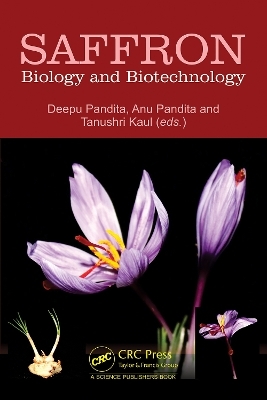
Crocus sativus L. (family-Iridaceae) or Saffron is often called “Red Gold or Gold Condiment” as it is flavourful, aromatic and it is very expensive. This volume offers a comprehensive overview of Saffron Cultivation and Ecology, Genetics and Cytogenetics, Role of Saffron Bioactive compounds in Nutrition and Medicine, Economic Importance, Beneficial Effects, Applications, Safety Evaluation and Limitations of Saffron. Further, Transcriptomics, Post transcriptomics, Metabolomics, Computational Biology, Molecular Markers, Genome Editing, Microbiome and Endophytic interactions, Micropropagation and Phytochemistry and uses of Saffron as a Medicinal and Aromatic plant are discussed. Genomics and Transcriptomics provide deeper insights into the genes responsible for the production of saffron metabolites. Further, the integra tome omics frameworks give an insight into the systemic and comprehensive saffron biology and future genetic progress by tools of genome editing, epigenetics, breeding and micro-propagation.
The area of saffron biology is an important research area and, this volume will provide readers with comprehensive and updated. It will be most recent updated compilation on saffron biology and biotechnology. It will appeal to saffron farmers, the food and pharmaceutical industries, researchers, scholars, and anyone interested in the science of saffron.
Deepu Pandita is a Senior Lecturer in the Government Department of School Education, Jammu, India, with over 22 years of teaching experience. She holds an MSc in Botany from the University of Kashmir and an MPhil in Biotechnology from the University of Jammu. Deepu has earned several prestigious fellowships, including the Junior Research Fellowship (JRF), Senior Research Fellowship (SRF), and National Eligibility Test (NET) for Assistant Professorship, awarded by the Council of Scientific & Industrial Research and University Grants Commission, New Delhi. In addition, she has been recognized with a Biotechnology Fellowship from the Government Department of Science and Technology, Jammu & Kashmir, and the IASc-INSA-NASI Summer Research Teacher Fellowship, by three National Science Academies of India. Deepu has presented her research at major conferences, winning accolades like the Best Oral Presentation Award at the International Conference on Biotechnology for Better Tomorrow, as well as the Women Researcher Award and Research Excellence Award from professional associations. As a dedicated academic, she serves as a reviewer and editor for several reputed journals. Her publications include numerous editorials, 60 book chapters, and 23 review and research articles. She has also edited nine books as the principal editor and one as a co-editor, with several more under publication, establishing herself as a prolific contributor to her field. Anu Pandita is a Senior Dietician at Vatsalya Clinic, New Delhi, India. With a rich background in dietetics and academia, she previously served as a lecturer at Bee Enn College of Nursing, Jammu, India, and has worked as a dietician at Ahinsa Dham Bhagwan Mahavir Charitable Health Centre, New Delhi. Anu holds an MSc in Dietetics and has completed her internship at the prestigious Postgraduate Institute of Medical Education and Research (PGI), Chandigarh, where she conducted a detailed case study on a patient with chronic liver disease in the Paediatric Gastroenterology Ward at Nehru Hospital, PGI, Chandigarh. In addition to her MSc, she has a certificate in food and nutrition and has participated in numerous training programs, workshops, and refresher courses to stay at the forefront of her field. Anu Pandita is a lifetime member of the Indian Dietetic Association and the Indian Science Congress Association, Kolkata. She has contributed significantly to academia, co-editing ten books, authoring 20 book chapters, and publishing 19 research and review articles in reputed journals. Her work has been well-received, and she has shared her insights at various major conferences. Dr. Tanushri Kaul is an internationally renowned and eminent scientist, serving as Group Leader at the International Centre for Genetic Engineering and Biotechnology (ICGEB), New Delhi, India. She is a visionary and a leading authority, catapulting to the forefront of crop improvement, genome-editing, plant nutrition, and plant stress biology, earning recognition as a pioneering scientist and a trailblazer in her field. She has a Ph.D. in Botany from Delhi University (2002), DIM from IGNOU, School of Management Studies (2000), M.Phil. in Botany from Delhi University (1996), B.Ed. from Delhi University's Central Institute of Education (1995), and Master’s in Botany from Delhi University (1994). Dr. Kaul harnesses state-of-the-art genome-editing technology for crop improvement, leveraging her expertise to orchestrate ground-breaking research. Her expertise spans genome editing, plant molecular biology, biofortification, nutrient-use efficiency, and plant stress responses. Dr. Kaul's cutting-edge research and leadership have significantly advanced crop biotechnology and sustainable agricultural solutions. Dr. Kaul has had an illustrious career, serving as Group Leader, Nutritional Improvement of Crops at ICGEB since 2016. Prior to this, she was a Research Scientist in the Plant Molecular Biology Group at ICGEB (2012-2016). Notably, Dr. Kaul works at the confluence of crop improvement and human health, developing innovative solutions to address micronutrient deficiencies. She has received several prestigious awards and fellowships, including the BioCare Award and Fellowship (2012), Rapid Grant for Young Investigator Award (RGYI, 2011), Research Associateship in Indo-German 2+2 DST Project (2011), Research Scientist positions in the Centre for Excellence Project (2008-2010) and Indo-Belarus DST Project (2003-2004). She was selected for the prestigious Indo-Israel Postdoctoral Fellowship in 2006-2007, wherein she focused on developing heat-resilient tomatoes at the Agricultural Research Organization, Volcani Centre, Bet Dagan in Israel, and IISC-DBT Post Doctoral Fellowship (2004-2006) at ICGEB. In recognition of her outstanding contributions to crop improvement, Dr. Kaul has been nominated for the prestigious VIWA Award for Distinguished Woman Scientist-2025 in Crop Improvement. Dr. Kaul's pioneering work in crop improvement and genome editing has paved the way for innovative solutions to global food security challenges, inspiring future generations of scientists and researchers. Her research focuses on biofortification and genome editing of crops to combat global micronutrient malnutrition, as well as understanding responses and nutritional-use efficacy in crops under plant stress and developing stress-tolerant crops, thereby spearheading innovative solutions.
Preface. 1. Saffron (Crocus sativus L.): The Red Gold. 2. Cultivation and Ecology of Saffron. 3. Genetics and Cytogenetics of Saffron. 4. Saffron: Nature’s Golden Elixir - The Emerging Role of Saffron Bioactives in Nutrition and Medicine. 5. Economic Importance of Saffron. 6. Beneficial Effects, Applications, Safety Evaluation and Limitations of the Medicinal Plant Crocus sativus (Saffron). 7. Saffron Transcriptomics. 8. Saffron Post-Transcriptome. 9. Metabolomic Analysis of Saffron: An Overview of the Current Status. 10. Computational Biology of Saffron: An Expensive Spice. 11. Molecular Markers of Saffron. 12. Genome Editing in Saffron. 13. Microbiome and Endophytic Interactions of Saffron. 14. Micropropagation as an Aid to Saffron Conservation. 15. Saffron: Phytochemistry and uses in Human Health and Diseases.
| Erscheinungsdatum | 04.11.2025 |
|---|---|
| Zusatzinfo | 17 Tables, black and white; 6 Line drawings, color; 1 Line drawings, black and white; 14 Halftones, color; 11 Halftones, black and white; 20 Illustrations, color; 12 Illustrations, black and white |
| Verlagsort | London |
| Sprache | englisch |
| Maße | 156 x 234 mm |
| Themenwelt | Naturwissenschaften ► Biologie ► Botanik |
| Technik ► Lebensmitteltechnologie | |
| Weitere Fachgebiete ► Land- / Forstwirtschaft / Fischerei | |
| ISBN-10 | 1-032-51744-1 / 1032517441 |
| ISBN-13 | 978-1-032-51744-5 / 9781032517445 |
| Zustand | Neuware |
| Informationen gemäß Produktsicherheitsverordnung (GPSR) | |
| Haben Sie eine Frage zum Produkt? |
aus dem Bereich