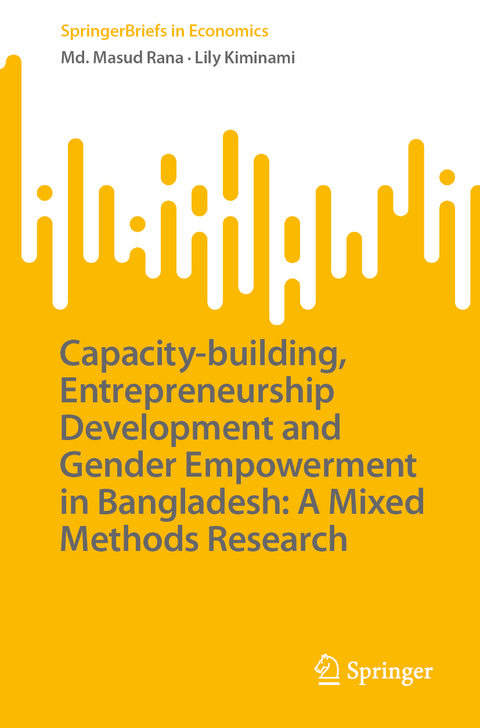
Capacity-building, Entrepreneurship Development and Gender Empowerment in Bangladesh: A Mixed Methods Research
Springer Verlag, Singapore
978-981-95-5040-1 (ISBN)
- Titel nicht im Sortiment
- Artikel merken
Qualitative analysis such as the Trajectory Equifinality Model (TEM) was employed in the case studies of six local entrepreneurs, three men and three women, to evaluate the effectiveness of a common interest group (CIG) approach to overcome poverty and gender inequality. The analytical results revealed that a mixed-gender CIG consisting of male and female farmers was effective for capacity building along with group leadership, crop diversification, access to seed, and mechanized farming compared with those in a single-gender CIG or among non-CIG farmers. In addition, it was demonstrated that a CIG approach was effective for entrepreneurial development through the formation and mobilization of social capital.
Access to finance, workplace culture, and institutional support were the most crucial factors for entrepreneurship development to ensure gender equality and economic empowerment. Research showed that in order to enhance the capacity of resource-poor farmers, the government should pay attention to gender diversity management to minimize existing gaps and to achieve income-generating agriculture through public–private partnerships. In other words, a gender-inclusive entrepreneurial environment is essential to facilitate socio-cultural transformation for sustainable socio-economic development in Bangladesh.
Md. Masud Rana receives Bachelor of Science (BSc) from the Faculty of Agriculture in Bangladesh Agricultural University, Bangladesh. Subsequently, he obtains Master of Science (MSc) from the Department of Agricultural Extension Education at Bangladesh Agricultural University, Bangladesh. For pursuing Doctor of Philosophy (PhD), he was awarded the Japanese Government Scholarship (MONBUKAGAKUSHO: MEXT). Currently, he is a PhD candidate at the Graduate School of Science and Technology in Niigata University, Japan. Besides, he also serves as an Assistant Professor at the Department of Agricultural Extension Education in Bangladesh Agricultural University, Bangladesh. His research interest includes agricultural and rural development, sustainable food system, resource economics, regional science, livelihood strategies and farmers’ capacity-building, social entrepreneurship and gender empowerment. Lily Kiminami received Bachelor of Economics (BEc) from the Faculty of Industrial Economy in Shanghai University of Finance and Economics, China. She earned a master's degree in agricultural science from Mie University (Japan) in 1989 and Ph.D. from The University of Tokyo (Japan) in agricultural science in 1992. Her research interests include international specialization, labor migration, agricultural and rural development, sustainable food system, and regional science. Currently, she is the president of the Japan Section of Regional Science Association International.
Chapter 1. Introduction.- Chapter 2. Literature review.- Chapter 3. Research target, conceptual framework, hypotheses and methodology.-Chapter 4. Capacity-building of farming households in resource-poor area for agricultural and rural development.- Chapter 5. Entrepreneurship and gender empowerment for socio-cultural changes.- Chapter 6. Conclusions and policy recommendations.
| Erscheint lt. Verlag | 24.1.2026 |
|---|---|
| Reihe/Serie | SpringerBriefs in Economics |
| Zusatzinfo | 12 Illustrations, color; 7 Illustrations, black and white |
| Verlagsort | Singapore |
| Sprache | englisch |
| Maße | 155 x 235 mm |
| Themenwelt | Technik ► Elektrotechnik / Energietechnik |
| Wirtschaft ► Volkswirtschaftslehre | |
| Weitere Fachgebiete ► Land- / Forstwirtschaft / Fischerei | |
| Schlagworte | capacity building • Common Interest Group (CIG) • Entrepreneurship Development • Gender equality • Resource-poor Area • Social capital • Socio-cultural changes |
| ISBN-10 | 981-95-5040-8 / 9819550408 |
| ISBN-13 | 978-981-95-5040-1 / 9789819550401 |
| Zustand | Neuware |
| Informationen gemäß Produktsicherheitsverordnung (GPSR) | |
| Haben Sie eine Frage zum Produkt? |
aus dem Bereich