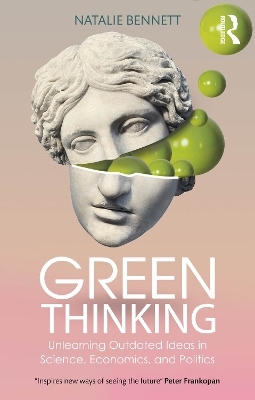
Green Thinking
Routledge (Verlag)
978-1-032-64027-3 (ISBN)
- Noch nicht erschienen (ca. April 2026)
- Versandkostenfrei
- Auch auf Rechnung
- Artikel merken
Green Thinking seeks to “compost” the views of dead white men (René Descartes, Thomas Hobbes, Adam Smith, Norman Borlaugh) and of some not white or dead (Francis Fukuyama, Richard Dawkins, Richard Thaler). It explores the flowering of probiotic Green thinking in the 21st century.
This book understands the foundation of life is cooperation, not competition; that diversity is essential to resilience and health of systems; that humans are just one more species of animal, or rather, holobiont; that reductionism has to be replaced by relational thinking; that financialising society has destroyed – as it was meant to do – relationships essential to wellbeing; and, perhaps most crucially at all, that we have to draw on the knowledge and wisdom of indigenous societies that have maintained themselves and their environments in healthy balance for thousands or tens of thousands of years. That means acknowledging the time, energy and talents of all life must contribute to a new way for humans to live in balance with the more-than-human world.
This book will appeal to fans of David Graeber, Kate Raworth, Tyson Yunkaporta, Jason Hickel, Anna Tsing, Robin Wall Kimmerer, Ursula Le Guin, Bruno Latour, Wangarii Maathai, Merlin Sheldrake, Vandana Shiva, Lynn Margulis, Kim Stanley Robinson, as well as listeners to the New Books Network, Past Present Future, and HPS podcasts.
Natalie Bennett has been the editor of the Guardian Weekly newspaper, a volunteer with the Thai National Commission on Women’s Affairs and is currently a Member of the UK House of Lords, which she entered in 2019.
Introduction: The old paths lead only to disaster
Chapter 1: Unlearning “this biological machine can be reduced to its components”
Chapter 2: Unlearning “humans are innately selfish, aggressive, acquisitive beasts”
Chapter 3: Unlearning “humans are at the peak of the great chain of being”
Chapter 4: Unlearning “humans have ascended to this peak moment of triumph”
Chapter 5: Unlearning “we can have a healthy and sustainable life in the Plantationocene”
Chapter 6: Unlearning “IQ is a measurement of value and Maslow’s hierarchy can guide priorities”
Chapter 7: Unlearning “money makes the world go round”
Chapter 8: Unlearning “a ‘great leader’ will fix our problems”
Conclusion: A probiotic ecosystem of knowledge making?
| Erscheint lt. Verlag | 10.4.2026 |
|---|---|
| Verlagsort | London |
| Sprache | englisch |
| Maße | 138 x 216 mm |
| Gewicht | 453 g |
| Themenwelt | Naturwissenschaften ► Biologie ► Ökologie / Naturschutz |
| Sozialwissenschaften ► Soziologie ► Spezielle Soziologien | |
| Weitere Fachgebiete ► Land- / Forstwirtschaft / Fischerei | |
| ISBN-10 | 1-032-64027-8 / 1032640278 |
| ISBN-13 | 978-1-032-64027-3 / 9781032640273 |
| Zustand | Neuware |
| Informationen gemäß Produktsicherheitsverordnung (GPSR) | |
| Haben Sie eine Frage zum Produkt? |
aus dem Bereich