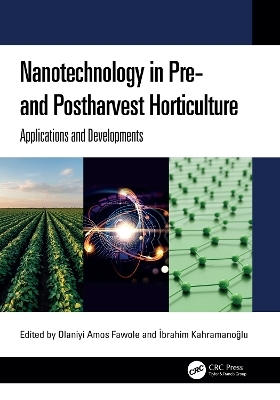
Nanotechnology in Pre- and Postharvest Horticulture
CRC Press (Verlag)
978-1-032-85302-4 (ISBN)
- Lieferbar (Termin unbekannt)
- Versandkostenfrei
- Auch auf Rechnung
- Artikel merken
Nanotechnology in Pre- and Postharvest Horticulture: Applications and Developments provides a comprehensive exploration of the dynamic intersection between nanotechnology and horticulture, showcasing cutting-edge research and practical applications. Across its four sections and sixteen chapters, readers will discover how engineered nanomaterials, nanosensors, smart delivery systems, and nano-enabled packaging are revolutionizing horticultural practices—from pre-harvest strategies to postharvest preservation. Topics include precision horticulture, crop stress management, pest and disease control, nutrient efficiency, and innovative packaging solutions, with a focus on sustainable synthesis methods and addressing environmental and health concerns.
Featuring contributions from leading researchers worldwide, this book bridges fundamental science with real-world applications, offering valuable insights for scientists, farmers, industry professionals, and students alike. Whether you are seeking to understand the latest advancements or looking to inspire future innovations, this book is an essential resource for anyone invested in the future of agriculture.
Prof. Dr. Olaniyi Amos Fawole Prof. Fawole earned his PhD in Horticultural Sciences, specialising in Postharvest Technology, Agroprocessing, and Food Circular Bioeconomy from Stellenbosch University. Over the years, he has focused his research and impact on preserving and adding value to nutritious food crops to improve health outcomes and promote food security. Recognizing the critical link between quality education and food security, he has dedicated his efforts to equipping future generations with the knowledge and skills necessary to drive sustainable food systems. As the Founding Director of the Postharvest and Agroprocessing Research Centre (PARC) and the SARChI Chair in Sustainable Preservation & Agroprocessing Research (SPAR) at the University of Johannesburg (UJ), Prof. Fawole has been an important figure in fostering innovation that bridges education and food security. His work supports small-scale farmers and commercial stakeholders with knowledge and practical solutions to reduce food loss and waste through agroprocessing and sustainable postharvest practices. He is also a strong advocate for the role of education in enhancing agricultural productivity and improving food security outcomes. He has published over 240 indexed articles and has successfully graduated 40 postgraduate students, with 28 currently under his supervision. His contributions have earned him a B2 rating, a rating category reserved for internationally acclaimed researchers by the National Research Foundation of South Africa. Prof. Fawole is an active leader in his field, collaborating with various organizations such as the Food and Agriculture Organization of the United Nations (FAO), the African Union Commission (AUC), and the World Academy of Sciences. His expertise and leadership abilities have earned him positions on several boards, including being a Technical Board Member of the global organization CIGR Section VI and an Advisory Committee Member of the Food Loss and Waste Initiative of the Consumer Goods Council of South Africa. Assoc. Prof. Dr. İbrahim Kahramanoğlu İbrahim Kahramanoğlu was born in 1984 in Northern Cyprus. He is an Associate Professor at Department of Horticulture, Faculty of Agricultural Sciences and Technologies in the European University of Lefke (Northern Cyprus), specializing in horticulture and postharvest biology and technology. Before his academic career, he served as the Managing Director of Alnar Pomegranates Ltd. from 2010 to 2018, where he controlled the production, packaging, and export of fresh pomegranate fruits, as well as the manufacture of 100% natural, freshly squeezed pomegranate juice. During this period, he also worked on the USAID-funded Alternative Crops Project in Northern Cyprus and managed over 100 projects supported by national and international bodies, including the European Commission. His academic research focuses on the physiology, quality management, and innovative preservation techniques of fresh horticultural produce. With a strong publication record in Web of Science and Scopus, Dr. Kahramanoğlu actively contributes to international collaborations and scientific projects.
List of Figures. List of Tables. Preface. Acknowledgments. About the Editors. List of Contributors. List of Abbreviations. SECTION I Introduction to Nanotechnology. Chapter 1 Fundamentals of Nanotechnology: Definition, Advantages, Disadvantages, and Limitations. Chapter 2 Synthesis and Preparation of Nanoparticles by Using Abiotic Materials. Chapter 3 Synthesis and Preparation of Nanoparticles by Biotic Materials (Including Plants and Microorganisms). SECTION II Nanotechnology in Crop Production. Chapter 4 Nanoparticles in Soil Management and Enhanced Plant Nutrition. Chapter 5 Nanotechnology for Soil Remediation and Nutrient Delivery: Innovations in Sustainable Agriculture. Chapter 6 Nanomaterials for Enhanced Crop Performance and Stress Resilience. Chapter 7 Nano-Based Solutions for Integrated Pest, Disease, and Weed Management. Chapter 8 Enhancing Seed Treatment and Germination through Nanotechnology. Chapter 9 Nanotechnology in the Detoxification of Agrochemical Residues. Chapter 10 Nanosensors for Advanced Precision Horticulture. SECTION III Nanotechnology in Postharvest. Chapter 11 Nanotechnology in Managing Fruits and Vegetables Postharvest Diseases. Chapter 12 Enhancing Postharvest Quality with Nanomaterials. Chapter 13 Nanopackaging for Storage of Horticultural Crops. SECTION IV Pros, Cons, and Future of Nanotechnology. Chapter 14 Regulatory and Safety Aspects of Nanotechnology in Horticulture. Chapter 15 Environmental Impacts of Nanotechnology in Horticulture. Chapter 16 Future Trajectories and Challenges in Nanotechnology for Horticulture. Index.
| Erscheinungsdatum | 16.12.2025 |
|---|---|
| Zusatzinfo | 42 Tables, black and white; 7 Line drawings, black and white; 25 Halftones, black and white; 32 Illustrations, black and white |
| Verlagsort | London |
| Sprache | englisch |
| Maße | 178 x 254 mm |
| Themenwelt | Weitere Fachgebiete ► Land- / Forstwirtschaft / Fischerei |
| ISBN-10 | 1-032-85302-6 / 1032853026 |
| ISBN-13 | 978-1-032-85302-4 / 9781032853024 |
| Zustand | Neuware |
| Informationen gemäß Produktsicherheitsverordnung (GPSR) | |
| Haben Sie eine Frage zum Produkt? |
aus dem Bereich