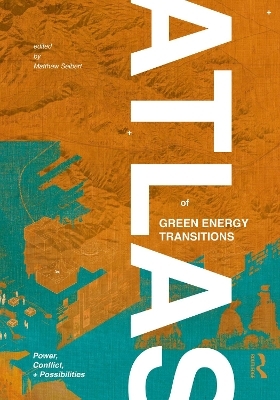
Atlas of Green Energy Transitions
Routledge (Verlag)
978-1-032-77167-0 (ISBN)
- Noch nicht erschienen (ca. Februar 2026)
- Versandkostenfrei
- Auch auf Rechnung
- Artikel merken
This edited collection of scholars and activists employs immersive first-person narrative descriptions and rich imagery to tell the oft-revealing stories of contestation, exploitation, and complication within the landscapes upon which the world’s green energy transition depends: the unsanctioned cobalt mines of the Congo, the solar farms clearing vast tracts of the Mojave Desert, the scattered e-waste operations of Zimbabwe, among others.
Utilizing the global supply chain as an organizing structure—working backwards from consumption to extraction, and back again—each chapter is framed around an abiotic protagonist crucial for the widespread adoption of renewable energy technologies. Cast as our saviors in the face of climate change, cobalt, aluminum, and the many critical minerals needed for solar panels, wind turbines, and electric vehicles are explored through the biophysical environments and cultural contexts in which they are extracted, refined, or deployed. In challenge to these descriptive chapters are counternarratives that offer alternatives beyond silver bullet ecomodernism toward complicated futures built on just practices and reciprocity. In grounding all chapters amid host landscapes, the collection cultivates a heightened awareness of land relations and global interconnection. The project thus not only engages the green energy transition, a topic of accelerating importance and topical prevalence, but uniquely exhibits the skills of landscape architectural practice to communicate environmental challenges of global proportions, identify points of interdisciplinary intervention, and craft compelling futures to catalyze change.
The book targets an audience of students and practitioners of the built environment while seeking to inspire the inner designer in all readers.
Matthew Seibert’s work aspires to encourage one to rethink their position and relation to the world as the first, fundamental step in a theory of change toward a just, more promising future. As an Associate Professor of Landscape Architecture at the University of Virginia, his research and teaching challenge dominant modes of knowledge production with specific attention to land relations. This practice and pedagogy in support of a world where many worlds and worldviews are not only welcome, but desired, is built first by creatively interrogating conventional ways of knowing through strategic disorientation. In the design of novel tools and methods, presuppositions can be disassembled, cultural constructions confronted, and power structures dismanteld, enabling a radical rebuilding of self, community, and environment in new and powerful ways. One must look backward and inward to orient the march forward.
Introduction: The Dark Side of Green 1. Sun: Solar Farms and a Mojave Desert Under Threat 2. Wind: Wind Power and Deepening Conflicts in Biobío, Chile 3. Aluminum: Smelting with Iceland's Melting Glaciers 4. Photovoltaics: Unpacking the Waste Chalenges of a Global Industry 5. E-Waste: Reclaiming the Digital Detritus, Forging a Sustainable Dawn in Zimbabwe 6. Hydrogen: Landscape and Literacy along Canada's Peace River 7. Rare Earths: Extractive Frontiers of Green Capitalism in South Greenland 8. Lithium: White Gold and Black Geographies of Resistance in Brazil 9. Cobalt: Eating Congo Caviar at the End of the World Conclusion: Where Histories are Held and Futures Rehearsed Center the Periphery: or, How to Invert a Mine Circularize the Economy: Designing for Disassembly Overlap Systems: Searching for Symbiosis Reduce Energy, Build Community: The Cultural Project of a True Transition
| Erscheint lt. Verlag | 28.2.2026 |
|---|---|
| Zusatzinfo | 100 Halftones, color; 100 Illustrations, color |
| Verlagsort | London |
| Sprache | englisch |
| Maße | 178 x 254 mm |
| Themenwelt | Technik ► Architektur |
| Technik ► Elektrotechnik / Energietechnik | |
| Weitere Fachgebiete ► Land- / Forstwirtschaft / Fischerei | |
| ISBN-10 | 1-032-77167-4 / 1032771674 |
| ISBN-13 | 978-1-032-77167-0 / 9781032771670 |
| Zustand | Neuware |
| Informationen gemäß Produktsicherheitsverordnung (GPSR) | |
| Haben Sie eine Frage zum Produkt? |
aus dem Bereich