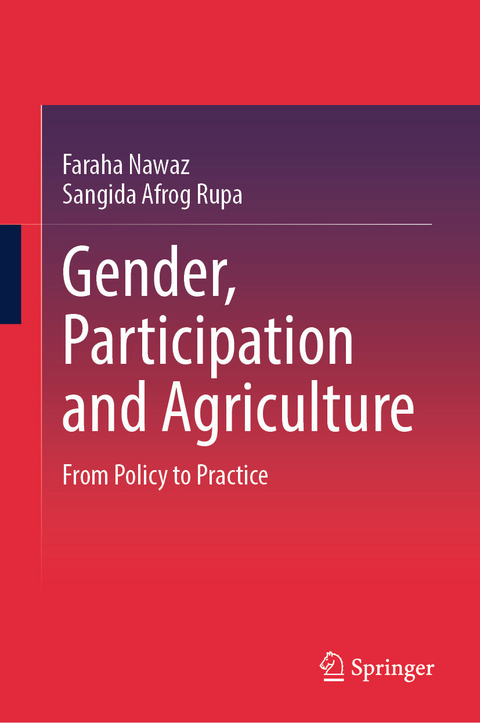
Gender, Participation and Agriculture (eBook)
109 Seiten
Springer Nature Singapore (Verlag)
978-981-96-8460-1 (ISBN)
This book presents an extensive study of women's involvement in agricultural activities at the family level in rural Bangladesh, with a particular emphasis on their participation in decision-making. The authors examine the extent to which women are involved in decision-making regarding agricultural practices at family level. In addition to examining women's contributions to various agricultural tasks, the research expands its scope to include discussions on gender inequality and empowerment, integrating these concepts into the decision-making framework. The authors argue that true participation should not only address the involvement of women in agriculture but also consider their influence on decision-making processes. They stress the importance of factors such as autonomy, control over resources, and self-confidence, which play a crucial role in shaping women's decision-making ability within the family. Moreover, the research identifies several key barriers to participation, including entrenched patriarchal norms, societal cultural expectations, and institutional challenges, which hinder women's active involvement in decision-making. The authors advocate for policy reforms and institutional changes to address these challenges, urging government bodies to align policies with their recommendations. The book provides valuable insights for policymakers, government officials, and NGOs working to promote gender-based approach and improve women's empowerment in rural communities.
This book presents an extensive study of women's involvement in agricultural activities at the family level in rural Bangladesh, with a particular emphasis on their participation in decision-making. The authors examine the extent to which women are involved in decision-making regarding agricultural practices at family level. In addition to examining women's contributions to various agricultural tasks, the research expands its scope to include discussions on gender inequality and empowerment, integrating these concepts into the decision-making framework. The authors argue that true participation should not only address the involvement of women in agriculture but also consider their influence on decision-making processes. They stress the importance of factors such as autonomy, control over resources, and self-confidence, which play a crucial role in shaping women's decision-making ability within the family. Moreover, the research identifies several key barriers to participation, including entrenched patriarchal norms, societal cultural expectations, and institutional challenges, which hinder women's active involvement in decision-making. The authors advocate for policy reforms and institutional changes to address these challenges, urging government bodies to align policies with their recommendations. The book provides valuable insights for policymakers, government officials, and NGOs working to promote gender-based approach and improve women's empowerment in rural communities.
| Erscheint lt. Verlag | 30.6.2025 |
|---|---|
| Zusatzinfo | XIII, 109 p. 22 illus., 17 illus. in color. |
| Sprache | englisch |
| Themenwelt | Geschichte ► Teilgebiete der Geschichte ► Kulturgeschichte |
| Sozialwissenschaften ► Soziologie ► Gender Studies | |
| Weitere Fachgebiete ► Land- / Forstwirtschaft / Fischerei | |
| Schlagworte | Challenges of Participation in Agriculture • Decision Making • Empowerment • Existing Agriculture Policy • Family Level Agriculture • Policy Gaps • power relations • Rural Women’s Participation in Agriculture • Rural Women’s Participation in Decision Making • women in agriculture |
| ISBN-10 | 981-96-8460-9 / 9819684609 |
| ISBN-13 | 978-981-96-8460-1 / 9789819684601 |
| Informationen gemäß Produktsicherheitsverordnung (GPSR) | |
| Haben Sie eine Frage zum Produkt? |
 PDF (Wasserzeichen)
DRM: Digitales Wasserzeichen
Dieses eBook enthält ein digitales Wasserzeichen und ist damit für Sie personalisiert. Bei einer missbräuchlichen Weitergabe des eBooks an Dritte ist eine Rückverfolgung an die Quelle möglich.
Dateiformat: PDF (Portable Document Format)
Mit einem festen Seitenlayout eignet sich die PDF besonders für Fachbücher mit Spalten, Tabellen und Abbildungen. Eine PDF kann auf fast allen Geräten angezeigt werden, ist aber für kleine Displays (Smartphone, eReader) nur eingeschränkt geeignet.
Systemvoraussetzungen:
PC/Mac: Mit einem PC oder Mac können Sie dieses eBook lesen. Sie benötigen dafür einen PDF-Viewer - z.B. den Adobe Reader oder Adobe Digital Editions.
eReader: Dieses eBook kann mit (fast) allen eBook-Readern gelesen werden. Mit dem amazon-Kindle ist es aber nicht kompatibel.
Smartphone/Tablet: Egal ob Apple oder Android, dieses eBook können Sie lesen. Sie benötigen dafür einen PDF-Viewer - z.B. die kostenlose Adobe Digital Editions-App.
Buying eBooks from abroad
For tax law reasons we can sell eBooks just within Germany and Switzerland. Regrettably we cannot fulfill eBook-orders from other countries.
aus dem Bereich