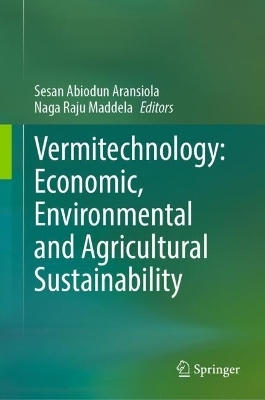
Vermitechnology: Economic, Environmental and Agricultural Sustainability
Springer International Publishing (Verlag)
978-3-031-96211-0 (ISBN)
This book is about vermitechnology and focuses on its current status and future directions in the economic, environmental and sustainable agricultural development. The book exposes new idea on how cost-effective waste management, increase in crop yields and reduction in chemical fertilizer is possible through vermitechnology.
The book ultimately captures the environmental benefits of vermitechnology in how organic solid wastes are managed to reduce the emissions of greenhouse gases; soil is conserved to improve its structure and reduces erosion. The book offers a baseline application of vermitechnology in agricultural sustainability to curb food insecurity by improving soil health, increase crop resilience and provide organic farming acceptability.
This book is a must-read for researchers, farmers, environmentalists, professionals, students and anyone interested in creating jobs and community development. The book covers cutting edge topics such as earthworms role in global warming/climate change, strengths of vermitechnology in the conversion of waste to wealth, the mutualistic relationship between soil microorganisms and the vermitechnology by-products, vermifiltration in wastewater treatment, vermiremediation of polluted soil for sustainable agriculture, vermitechnology in organic farming, vermicast and vermiwash as sustainable fertilizers, and case studies in vermitechnology.
Sesan Abiodun Aransiola is a notable Ph.D holder in Environmental Microbiology in the Department of Microbiology, Federal University of Technology, Minna, Nigeria. He obtained his first degree (B.Tech) and Master Degree (M.Tech) from the same Department in 2009 and 2014 respectively. He has demonstrated his research expert in the production of vermicasts from vermicoposting (Vermitechnology) of organic wastes to assist plants in the remediation of polluted soil with heavy metals. Currently, he is a Lecturer at the Department of Microbiology, University of Abuja, Nigeria. his expertise spans environmental health, phytoremediation, vermicomposting, marine resources and bioremediation of pollutants soil including plastics. Aransiola s research is deeply rooted in innovative solutions for soil and water remediation, with significant contributions to microbial biotechnology and waste management. He is an award-winning researcher and has over 90 publications including book chapters, research and review articles of good international repute with high impact factor. He has co-edited scientific books of global interest which include microbial biotechnology for bioenergy (Elsevier). Ecological interplays in microbial enzymology, prospects for soil regeneration and its impact on environmental protection, Soil microbiome in green technology sustainability, marine bioprospecting for sustainable blue-bioeconomy (Springer). Microbial biofilms applications and control, marine greens: environmental, agricultural, industrial and biomedical applications, Emerging Contaminants in Food and Food Products, Phytoremediation in Food Safety: Risks and Prospects (CRC Press) with many more in the process. Also, has worked to the rank of an assistant chief scientific officer at Bioresources Development Centre, National Biotechnology Research and Development Agency, Nigeria where he was involved in the uses of vinasse (a by-product of ethanol) as bio-fertilizer to reclaim polluted soil for agricultural purposes. Dr. Aransiola s academic journey is complemented by a robust teaching career and active involvement in community services, where he leverages his knowledge to foster sustainability. His contributions continue to impact both academia and the broader environmental sciences community. Abiodun is a member of Nigerian Society for Microbiology and American Society for Microbiology among others.
Naga Raju Maddela received his M.Sc. (1996 1998) and Ph.D. (2012) in Microbiology from Sri Krishnadevaraya University, Anantapuramu, India. During his doctoral program in the area of Environmental Microbiology, he investigated the effects of industrial effluents/insecticides on soil microorganisms and their biological activities and he is working as Faculty in Microbiology since 1998, teaching undergraduate and postgraduate students. He worked on Prometeo Investigator (fellowship received from SENESCYT) at Universidad Estatal Amazónica, Ecuador during 2013-15, received "Postdoctoral Fellowship" (2016 2018) from Sun Yat-sen University, China. He also received external funding from "China Po
Part I. Vermitechnology - Preparation, Distribution and Economical Impacts.- Chapter 1. General Perspectives of Vermitechnology - An Overview.- Chapter 2. Global warming: how earthworms helps.- Chapter 3. Vermitechnology and influencing factors.- Chapter 4. Vermicompost, soil fertility and the global perspectives.- Chapter 5. Waste to wealth- strength of vermitechnology and economic impact.- Chapter 6. Bio-particles of vermifilter biofilm.- Chapter 7. Economic implication of vermitechnology.- Part II. Vermitechnology - Application in Environmental Sustainability.- Chapter 8. Vermiconversion and vermifiltration in Waste water treatment.- Chapter 9. Vermistabilization of earthworms.- Chapter 10. Vermiremediation of polluted soil.- Chapter 11. Agro-industrial sludge and vermitechnology.- Chapter 12. Biorestoration of contataminated soil by PAHs and heavy metals: the role of vermitechnology.- Chapter 13. Plastics remediation and earthworms- solution or problem?.- Part III. Vermitechnology - Application in Agricultural Sustainability.- Chapter 14. Phytoremediation and vermicomposting.- Chapter 15. Symbiotic relationship of Microbial Communities and vermicompost.- Chapter 16. Vermicast, vermiwash: a substitute to chemical fertilizer.- Chapter 17. Role of vermitechnology in plant growth and nutrient.- Chapter 18. Organic farming- the role of vermitechnology.- Chapter 19. Case studies in vermitechnology.- Chapter 20. Future directions of research in vermitechnology.
| Erscheinungsdatum | 13.06.2025 |
|---|---|
| Zusatzinfo | XVI, 427 p. 70 illus., 65 illus. in color. |
| Verlagsort | Cham |
| Sprache | englisch |
| Maße | 155 x 235 mm |
| Themenwelt | Naturwissenschaften ► Geowissenschaften ► Geologie |
| Weitere Fachgebiete ► Land- / Forstwirtschaft / Fischerei | |
| Schlagworte | Agricultural sustainability • Environmental Pollution • Solid Wastes • Vermicompost • Vermitechnology |
| ISBN-10 | 3-031-96211-7 / 3031962117 |
| ISBN-13 | 978-3-031-96211-0 / 9783031962110 |
| Zustand | Neuware |
| Informationen gemäß Produktsicherheitsverordnung (GPSR) | |
| Haben Sie eine Frage zum Produkt? |
aus dem Bereich