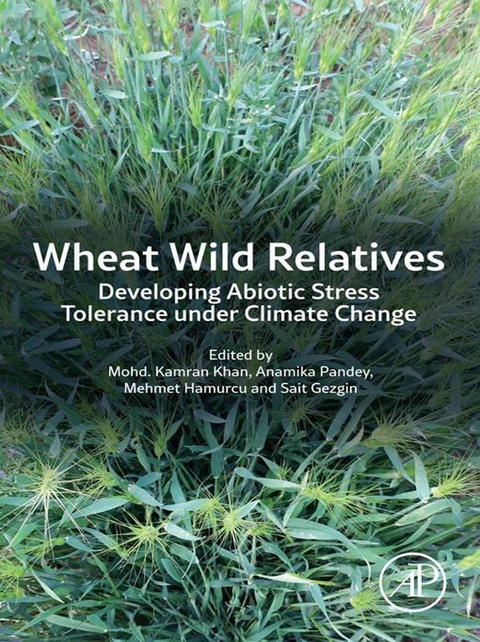
Wheat Wild Relatives (eBook)
475 Seiten
Elsevier Science (Verlag)
978-0-443-22089-0 (ISBN)
Wheat Wild Relatives: Developing Abiotic Stress Tolerance under Climate Change presents a state-of-the-art outline of the problem, including issues, opportunities, and modern developments in the utilization of Wild Wheat Relatives (WWR) and related neglected species for wheat crop improvement, specifically focusing on environmental constraints. The book comprehensively discusses different wheat wild relatives, including major genus Triticum and Aegilops and their utilization in mitigating different environmental constraints using agronomic, physiological, and molecular approaches. Chapters provide insights into the advancement in the deployment of wheat genetic resources, including wild relatives and neglected species for crop improvement towards environmental issues.Wheat is a major staple food crop that has largely been focused for fulfilling the food requirements of world population during the Green revolution. Since then, it has come to cover more agricultural land than any other commercial crop. Continuously changing climatic conditions have drastically affected wheat production, with yields largely limited by environmental constraints. Theses production losses caused by crop vulnerability to climate change may be resolved by using wheat wild relatives that are closely related to cultivated genotypes and known for their beneficial traits. - Covers a variety of wheat genetic resources, including wheat wild relatives (WWR) and neglected wheat species- Describes advances in agronomic, biochemical, physiological, and molecular approaches to counter the effect of individual environmental issues of drought, heat, salt, cold, nutrients, and heavy metals constraints- Explores the benefits of contemporary biotechnological tools, including whole genome sequencing and genome editing
| Erscheint lt. Verlag | 28.3.2025 |
|---|---|
| Sprache | englisch |
| Themenwelt | Naturwissenschaften ► Biologie |
| Technik ► Lebensmitteltechnologie | |
| Weitere Fachgebiete ► Land- / Forstwirtschaft / Fischerei | |
| ISBN-10 | 0-443-22089-1 / 0443220891 |
| ISBN-13 | 978-0-443-22089-0 / 9780443220890 |
| Informationen gemäß Produktsicherheitsverordnung (GPSR) | |
| Haben Sie eine Frage zum Produkt? |
 EPUB (Adobe DRM)
Kopierschutz: Adobe-DRM
Adobe-DRM ist ein Kopierschutz, der das eBook vor Mißbrauch schützen soll. Dabei wird das eBook bereits beim Download auf Ihre persönliche Adobe-ID autorisiert. Lesen können Sie das eBook dann nur auf den Geräten, welche ebenfalls auf Ihre Adobe-ID registriert sind.
Details zum Adobe-DRM
Dateiformat: EPUB (Electronic Publication)
EPUB ist ein offener Standard für eBooks und eignet sich besonders zur Darstellung von Belletristik und Sachbüchern. Der Fließtext wird dynamisch an die Display- und Schriftgröße angepasst. Auch für mobile Lesegeräte ist EPUB daher gut geeignet.
Systemvoraussetzungen:
PC/Mac: Mit einem PC oder Mac können Sie dieses eBook lesen. Sie benötigen eine
eReader: Dieses eBook kann mit (fast) allen eBook-Readern gelesen werden. Mit dem amazon-Kindle ist es aber nicht kompatibel.
Smartphone/Tablet: Egal ob Apple oder Android, dieses eBook können Sie lesen. Sie benötigen eine
Geräteliste und zusätzliche Hinweise
Buying eBooks from abroad
For tax law reasons we can sell eBooks just within Germany and Switzerland. Regrettably we cannot fulfill eBook-orders from other countries.
aus dem Bereich