


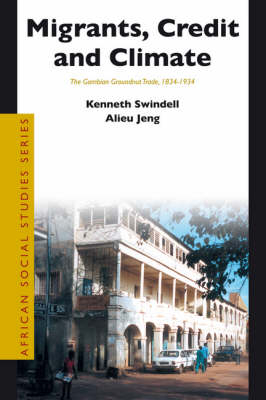
Migrants, Credit and Climate
The Gambian Groundnut Trade, 1834-1934
Seiten
2006
Brill (Verlag)
978-90-04-14059-2 (ISBN)
Brill (Verlag)
978-90-04-14059-2 (ISBN)
This text provides an overview of the Gambian groundnut trade, assessing the various political, economic, social and environmental forces, which shaped the trade locally and internationally, and their contemporary relevance to theperception and transformation of West African agriculture.
After the ending of the Atlantic slave trade West Africa experienced a period of transition to legitimate trade, which provided agricultural staples for the burgeoning European market. One early example was the groundnut trade, which developed along the River Gambia where myriad households grew the crop, which was purchased and transported by the merchant interest. Of crucial importance were pioneer migrant farmers, whose numbers were later swelled by other labour migrants drawn from a wide area. The trade pre-dated colonial partition, and producers were integrated into the international market by extended chains of merchant credit and indebtedness. By the latter part of the 19th century the vagaries of the world market were becoming apparent, as well as the climate, which together affected output and incomes. Colonial rule created conditions for the expansion of the trade, but food supply in the face of groundnut specialization became a fundamental issue and led to experiments with irrigation and mixed farming. In the 20th century the trade was marked by drought, the First World War, credit crises, de-monetization and trade depression, while throughout it remained a migrant driven economy.
The book provides an account of the Gambian groundnut trade and the associated environmental, social and economic conditions, as well as commenting on liberal and radical analyses on the shift from the Atlantic slave trade through legitimate trade to colonial rule.
After the ending of the Atlantic slave trade West Africa experienced a period of transition to legitimate trade, which provided agricultural staples for the burgeoning European market. One early example was the groundnut trade, which developed along the River Gambia where myriad households grew the crop, which was purchased and transported by the merchant interest. Of crucial importance were pioneer migrant farmers, whose numbers were later swelled by other labour migrants drawn from a wide area. The trade pre-dated colonial partition, and producers were integrated into the international market by extended chains of merchant credit and indebtedness. By the latter part of the 19th century the vagaries of the world market were becoming apparent, as well as the climate, which together affected output and incomes. Colonial rule created conditions for the expansion of the trade, but food supply in the face of groundnut specialization became a fundamental issue and led to experiments with irrigation and mixed farming. In the 20th century the trade was marked by drought, the First World War, credit crises, de-monetization and trade depression, while throughout it remained a migrant driven economy.
The book provides an account of the Gambian groundnut trade and the associated environmental, social and economic conditions, as well as commenting on liberal and radical analyses on the shift from the Atlantic slave trade through legitimate trade to colonial rule.
Alieu Jeng, Ph.D. University of Birmingham worked as a deputy chief executive at the Gambia National Investment board for several years. Currently, he holds a position as a Country Development manager for the English speaking West African countries at the African Development Bank. Kenneth Swindell, Ph.D. (1974) in Economic Geography, London School of Economics and Political Science, is Honorary Senior Research Fellow at The Centre of West African Studies, University of Birmimngham. He has published extensively on migrant labour, farm labour and agrarian change in The Gambia and Nigeria.
| Erscheint lt. Verlag | 29.8.2006 |
|---|---|
| Reihe/Serie | African Social Studies Series ; 12 |
| Verlagsort | Leiden |
| Sprache | englisch |
| Maße | 160 x 240 mm |
| Gewicht | 509 g |
| Themenwelt | Geschichte ► Teilgebiete der Geschichte ► Kulturgeschichte |
| Geschichte ► Teilgebiete der Geschichte ► Wirtschaftsgeschichte | |
| Sozialwissenschaften ► Ethnologie | |
| Sozialwissenschaften ► Soziologie | |
| Weitere Fachgebiete ► Land- / Forstwirtschaft / Fischerei | |
| ISBN-10 | 90-04-14059-X / 900414059X |
| ISBN-13 | 978-90-04-14059-2 / 9789004140592 |
| Zustand | Neuware |
| Informationen gemäß Produktsicherheitsverordnung (GPSR) | |
| Haben Sie eine Frage zum Produkt? |
Mehr entdecken
aus dem Bereich



aus dem Bereich
Die Revolution des Gemeinen Mannes
Buch | Softcover (2024)
C.H.Beck (Verlag)
CHF 16,80
vom Mittelalter bis zur Gegenwart
Buch | Softcover (2024)
C.H.Beck (Verlag)
CHF 16,80


