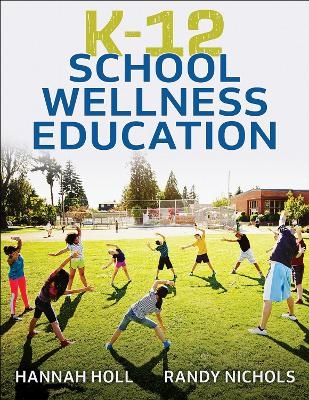
K-12 School Wellness Education
Human Kinetics (Verlag)
978-1-7182-1840-6 (ISBN)
Health education and physical education teachers are the champions of wellness in schools, but often health and physical activity are taught separately in the K-12 environment. The School Wellness Education (SWE) model is a unique approach that teaches students why physical activity benefits their well-being to holistically influence students toward healthy lifestyles. K-12 School Wellness Education prepares future physical education teachers with strategies to use a whole school approach to promote health, wellness, and fitness.
Authors Hannah Holl and Randy Nichols, the educators who developed the SWE model, have based K-12 School Wellness Education on the Whole School, Whole Community, Whole Child (WSCC) model and aligned the content with SHAPE America’s most recent National Physical Education Standards.
The text incorporates traditional areas of games, sports, and fitness performance and, more importantly, focuses on why physical activity matters. Units are not based on games or fitness activities but are instead focused on the National Physical Education Standards and the five components of Living Well: nutrition, social and emotional wellness, the human body and responses to physical activity, health-related fitness, and injury prevention and safety.
The Living Well focus helps elementary, middle school, and high school students progress along their physical literacy journey and health literacy journey. It demonstrates for students how a physically active lifestyle is associated with wellness, disease prevention, and an overall improved quality of life.
K-12 School Wellness Education offers physical education teacher education (PETE) students and in-service teachers the following:
Information on how SWE (and its related evidence-based research) differs from other models
Curriculum development tools such as templates for unit plans, unit storyboards, and lesson plans
K-12 grade-level benchmarks to measure student progress on their physical and health literacy journeys
Over 30 success stories and leadership examples to guide strategies for collaboration, garner administrative support, and create a culture of wellness in schools
Special features such as learning objectives, key term lists, sidebars, and chapter wrap-up sections to support reader comprehension
K-12 School Wellness Education prepares future educators and current physical education teachers to take a school wellness approach by integrating physical activity and well-being into their program at every instructional level.
Hannah Holl, EdD, is a professor at Slippery Rock University and the coordinator of the school wellness education program. An advocate for improving well-being in K-12 schools through the School Wellness Education (SWE) model, she has presented on this topic several times at the national level. She serves as the director of a project-funded by a grant from the Pennsylvania Department of Health-that provides training on the School Wellness Education model to in-service public school health and physical education teachers. In 2017, Holl was the lead author of an article published in the Journal of Physical Education, Recreation and Dance (JOPERD) titled “Preparing Physical and Health Education Teacher Candidates to Create a Culture of Wellness in Schools: New Curriculum, New Message.” She also coauthored a chapter in the book Physical Best and was asked to serve as an expert writer in a position statement released by SHAPE America–Society of Health and Physical Educators on the Whole School, Whole Community, Whole Child (WSCC) model. Randy Nichols, EdD, is a professor in the physical and health education department at Slippery Rock University. Nichols earned his doctorate in physical education teacher education from West Virginia University and has more than 30 years of teaching experience. He has presented and published on numerous topics in the field of health, wellness, and physical education. Contributing Author (Chapter 8) Patricia Kardambikis, PhD, is an assistant professor at Robert Morris University, where she is the coordinator of the principal certification program. She has worked in public education for 30 years, with her last position as an assistant superintendent at Slippery Rock Area School District. Kardambikis holds a doctorate in curriculum and instruction from Kent State University, a master’s degree in health education from Penn State University, and a bachelor of science degree in nursing from Carlow University. While pursuing her master’s degree, Kardambikis obtained the Certified Health Education Specialist (CHES) credential. In addition, she received her principal certification and superintendent letter of eligibility from Westminster College. She has presented at national, regional, and local conferences on wellness, social and emotional learning, leadership, curriculum development, and poverty.
Chapter 1. Well-Being Through Physical Education
Lead With Why
Acknowledge the Current State of Well-Being in Society
Shift to Individualized Education and Learning
Provide Something Needed by Society
Become an Effective School Wellness Educator
Chapter 2. School Wellness Education Model
Whole School
Living Well
Self-Empowerment
Chapter 3. Unit Planning
Create a Program Goal Statement
Utilize a Backward Design Approach
Plan the Unit Storyboard
Chapter 4. Lesson Planning
Part 1: Establish the Lesson Goal Statement and Scope
Part 2: Plan the Resources, Steps and Sequences, and Assessment
Part 3: Design the Living Well Moment
Part 4: Plan the Physical Activity Education Delivery
Part 5: Set the Closure and Assessment Components
Chapter 5. School Wellness Education at the Elementary Level
Whole School Connections
Living Well Focus
Self-Empowerment Strategies
Lesson Planning
Chapter 6. School Wellness Education at the Middle School Level
Whole School Connections
Living Well Focus
Self-Empowerment Strategies
Lesson Planning
Chapter 7. School Wellness Education at the High School Level
Whole School Connections
Living Well Focus
Self-Empowerment Strategies
Lesson Planning
Chapter 8. Creating a Well Future
Patricia Kardambikis, PhD
The Administrator’s Role in School Wellness Education
Strategies for Creating School Wellness Policies and Programs
School Wellness Committee
Leadership and Controversy
Case Studies
Chapter 9. School Wellness Education Success Stories
Chapter 10. School Wellness Education Leadership and Partnerships
Appendix A. The Five Components of Living Well by Grade Level
Appendix B. Unit Storyboards
| Erscheinungsdatum | 02.09.2025 |
|---|---|
| Verlagsort | Champaign, IL |
| Sprache | englisch |
| Maße | 216 x 279 mm |
| Themenwelt | Kinder- / Jugendbuch ► Sachbücher ► Körper / Sexualität |
| Sozialwissenschaften ► Pädagogik | |
| Weitere Fachgebiete ► Sportwissenschaft | |
| ISBN-10 | 1-7182-1840-0 / 1718218400 |
| ISBN-13 | 978-1-7182-1840-6 / 9781718218406 |
| Zustand | Neuware |
| Informationen gemäß Produktsicherheitsverordnung (GPSR) | |
| Haben Sie eine Frage zum Produkt? |
aus dem Bereich