


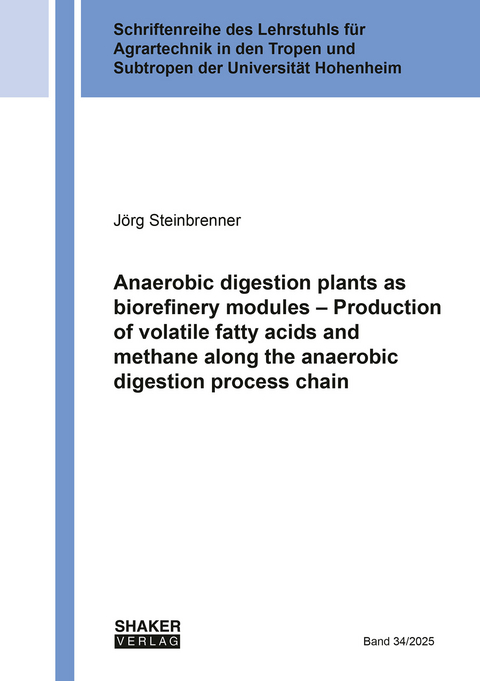
Anaerobic digestion plants as biorefinery modules – Production of volatile fatty acids and methane along the anaerobic digestion process chain
Seiten
Anaerobic digestion is a versatile process. Different biomasses, from biowastes, residual biomass, to renewable resources can be used to produce methane. This can be used energetically in a combined heat and power unit to provide renewable electricity and heat. However, biomass, especially cultivated biomass, is a limited and valuable resource and therefore material use should have priority over energy use. In most of the biorefinery concepts, anaerobic digestion is used as a sink for the biological waste streams to produce energy and providing heat and electricity for the preceding and downstream process steps.
In this study, the focus was on the anaerobic digestion process itself and its capability of producing volatile fatty acids as resource for chemical industry. Two process steps are particularly relevant here. The ensiling and the anaerobic degradation process itself- Especially with regard to two-stage fermentation.
Regarding ensiling, the focus was placed on the production of butyric acid. In the case of two-stage fermentation, the focus was on increasing the yield of volatile fatty acids from the acidification stage. For this purpose, a leachbed reactor was used and equipped with pH-dependent extraction of leachate to achieve stable process conditions.
Both experimental designs, were carried out on a laboratory scale. The possible yields of volatile fatty acids were determined for the ensiling as well as the two-stage process. Additionally potential losses due to the separation and extraction of the produced volatile fatty acids were measured.
In this study, the focus was on the anaerobic digestion process itself and its capability of producing volatile fatty acids as resource for chemical industry. Two process steps are particularly relevant here. The ensiling and the anaerobic degradation process itself- Especially with regard to two-stage fermentation.
Regarding ensiling, the focus was placed on the production of butyric acid. In the case of two-stage fermentation, the focus was on increasing the yield of volatile fatty acids from the acidification stage. For this purpose, a leachbed reactor was used and equipped with pH-dependent extraction of leachate to achieve stable process conditions.
Both experimental designs, were carried out on a laboratory scale. The possible yields of volatile fatty acids were determined for the ensiling as well as the two-stage process. Additionally potential losses due to the separation and extraction of the produced volatile fatty acids were measured.
| Erscheinungsdatum | 19.03.2025 |
|---|---|
| Reihe/Serie | Schriftenreihe des Lehrstuhls für Agrartechnik in den Tropen und Subtropen der Universität Hohenheim ; 34,2025 |
| Verlagsort | Düren |
| Sprache | englisch |
| Maße | 148 x 210 mm |
| Gewicht | 168 g |
| Themenwelt | Technik ► Maschinenbau |
| Weitere Fachgebiete ► Land- / Forstwirtschaft / Fischerei | |
| Schlagworte | Anaerobic digestion • Bioeconomy • GRASS • leachbed • Maize • Silage • volatile fatty acids |
| ISBN-10 | 3-8440-9785-6 / 3844097856 |
| ISBN-13 | 978-3-8440-9785-6 / 9783844097856 |
| Zustand | Neuware |
| Informationen gemäß Produktsicherheitsverordnung (GPSR) | |
| Haben Sie eine Frage zum Produkt? |
Mehr entdecken
aus dem Bereich


aus dem Bereich
Buch | Softcover (2024)
Springer Vieweg (Verlag)
CHF 46,15
Lösungshinweise, Ergebnisse und ausführliche Lösungen
Buch | Softcover (2025)
Springer Fachmedien Wiesbaden GmbH (Verlag)
CHF 41,95
Buch | Softcover (2025)
Springer Vieweg (Verlag)
CHF 39,15


